
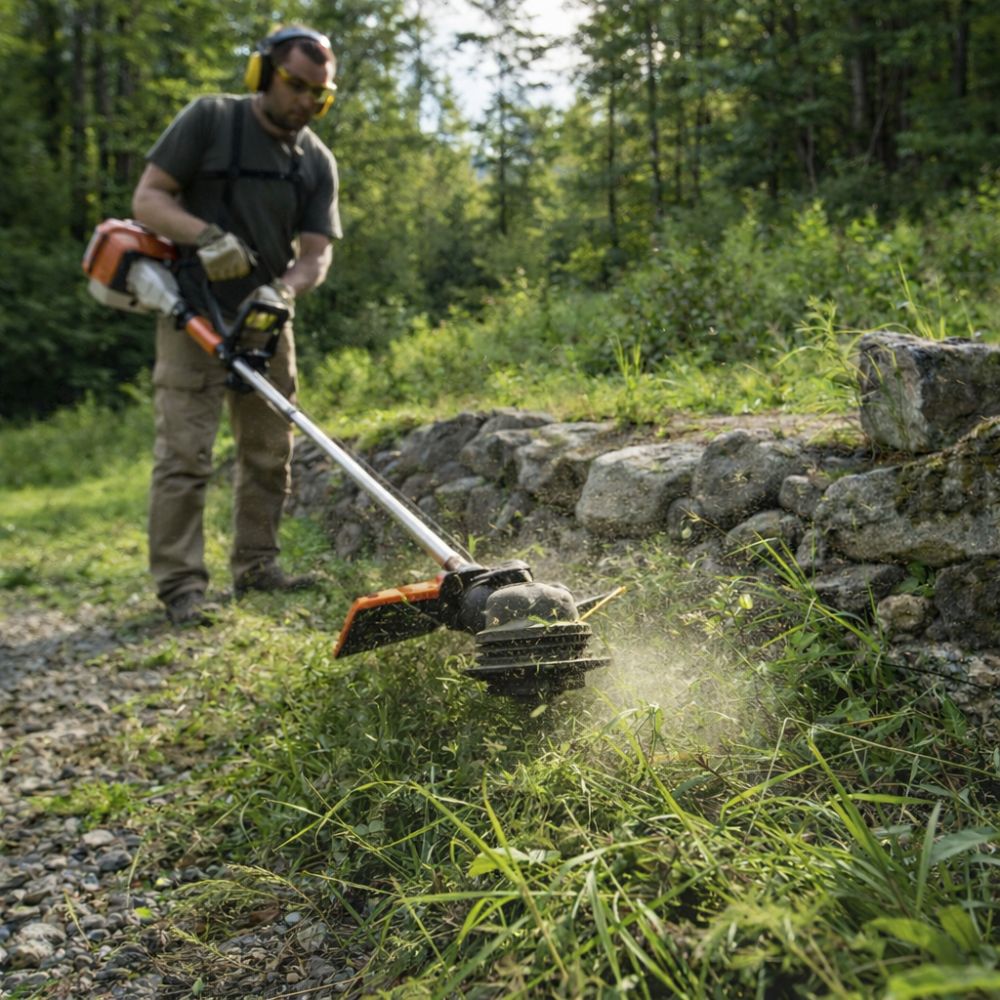
With dozens of trimmer line combinations available, how do you know which is right for your trimmer and your job? The answer depends on three key factors: diameter, shape, and material.
Here in coastal New Hampshire, trimmer line faces tough conditions: sandy soil near the seacoast, salt spray that accelerates degradation, and dense vegetation on inland properties. At Seacoast Power Equipment’s parts counter in North Hampton, we stock trimmer line from Stihl, Echo, Husqvarna, Oregon, and RedMax. After nearly 60 years of serving the region, we’ve seen what works across every New England application.
This guide breaks down everything you need to know about trimmer line selection. Whether you’re a homeowner trimming around flower beds or a professional landscaper running commercial equipment 8 hours a day, you’ll know exactly which line to buy.
How Trimmer Line Works
The trimmer line spins at 7,000-10,500 RPM depending on the trimmer model, creating centrifugal force that keeps the line rigid and horizontal. The line doesn’t slice through vegetation like a blade. Instead, it impacts grass and weeds at high speed. This is impact cutting, not slicing.
A thicker line has more mass, which means more impact force. Sharper edges on shaped lines (square, serrated) create cleaner cuts compared to round lines that tend to tear.
Why Wrong Line Causes Problems:
Too Thin:
- Breaks frequently on tough weeds and woody stems
- Wears down quickly, requiring more frequent reloading
- Limited cutting power on thick grass
Too Thick:
- Bogs down small trimmers that don’t have enough power
- Won’t feed properly through smaller trimmer heads
- May void warranty on residential trimmers
Wrong Shape:
- Round line tears grass, creating ragged edges and brown tips
- Square or twisted lines on low-power trimmers may not spin fast enough
- Star-shaped line breaks easily despite clean cutting when used on rocks
The goal is to match line diameter to your trimmer’s power, line shape to your cutting needs, and material to your durability requirements. Regular maintenance, including air filter cleaning and spark plug replacement, keeps your trimmer running at peak RPM for optimal line performance.
Always check your trimmer’s manual for the line diameter range (e.g., “.080 to .095”). Exceeding the maximum diameter can damage the trimmer head or void your warranty. Bring your trimmer model number to our parts counter, and we’ll look it up for you.
Trimmer Line Diameter Guide
Trimmer line diameter is measured in inches. Common sizes include .065″, .080″, .095″, .105″, .130″, and .155″. This measurement represents the line’s thickest dimension.
Feature Snippet: Most homeowners with 1-3 acre properties and gas trimmers (25-30 cc) should use 0.080″ diameter trimmer line. Battery trimmers under 40V require .065″ to .080″ maximum. Professional landscapers use a .095″ to .105″ diameter with commercial-grade equipment (35cc+). Using a line too thick for your trimmer power causes engine bog and clutch wear.
Diameter Selection Chart
| Diameter | Application | Typical User | Trimmer Power Needed | Approx. Annual Cost* |
| .065″ | Light trimming, edging, flower beds | Homeowners, small yards | Battery (20-24V), Electric | $15-25 |
| .080″ | General residential (most common) | Homeowners, 1-3 acres | Battery (40V+), Gas (23-28 cc) | $25-40 |
| .095″ | Heavy residential / Light commercial | Serious homeowners | Gas (28-35 cc) | $35-55 |
| .105″ | Commercial standard | Professional landscapers | Gas (35 cc+) | $140-320 |
| .130″ | Heavy commercial / Brush clearing | Commercial brush clearing | Gas (40 cc+) | $280-400 |
*Estimated costs based on typical usage patterns and average pricing. Actual costs vary by region, retailer, property size, and vegetation density.
How to Choose the Right Diameter
Your Trimmer’s Power:
- Battery (under 40V) or Electric: .065″ to .080″ max
- Gas (under 30 cc): .080″ to .095″ range
- Gas (30 cc+) or Commercial: .095″ to .105″ range
- Professional brush cutter: .105″ to .155″ range
Your Property & Vegetation:
- Maintained lawn, light edging: .065″ to .080″
- 1-2 acres, mixed grass/weeds: .080″ to .095″
- Overgrown areas, fence lines: .095″ to .105″
- Commercial properties, all-day use: .105″ to .130″
For most homeowners with 1-3 acre properties and gas trimmers in the 25-30 cc range, .080″ diameter offers the perfect balance. It’s thick enough to handle tough weeds without constant breakage, thin enough not to bog down the engine, and affordable for weekly use.
Common Mistakes:
“Bigger is always better”: Oversized lines bog down smaller trimmers, causing clutch wear and poor performance
“I’ll save money with thinner line”: Thin lines break more frequently on tough weeds, meaning more time reloading and more line wasted
“I can use any size my head fits”: Trimmer head capacity doesn’t equal trimmer engine capacity
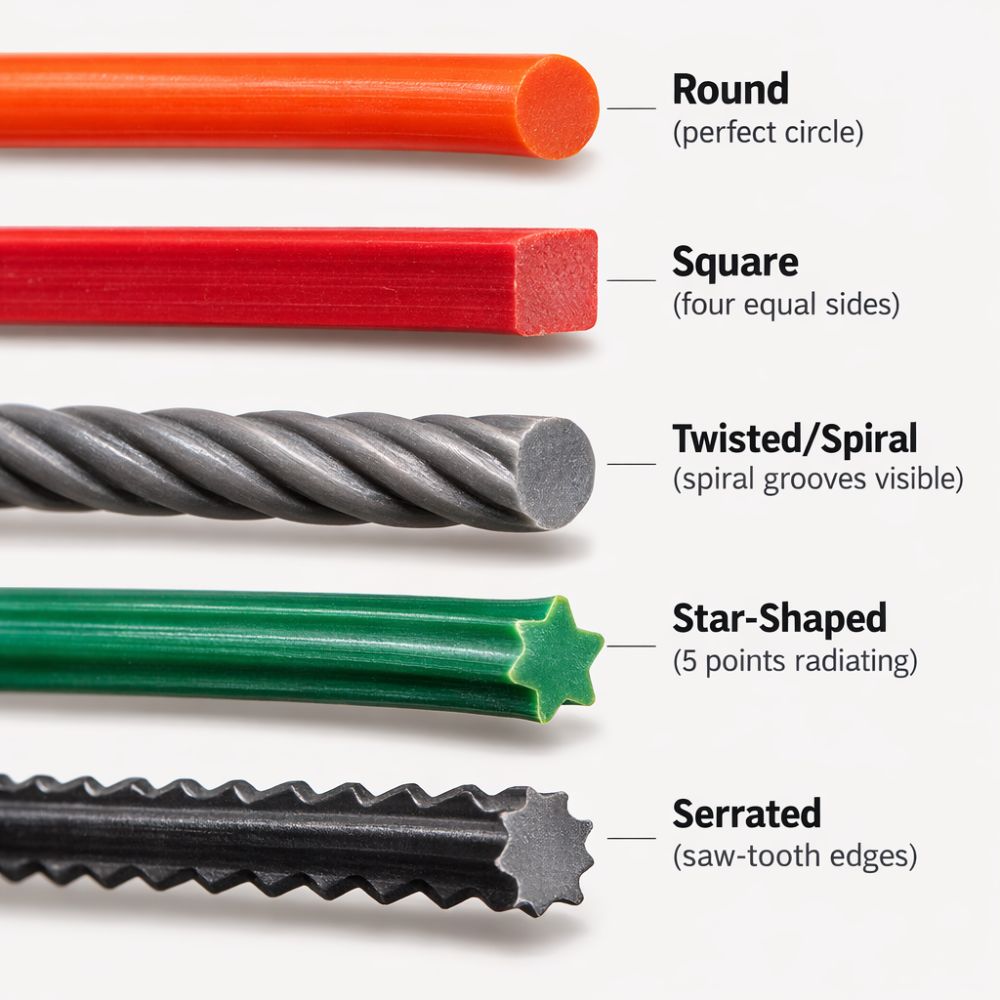
Trimmer Line Shapes: Round, Square, Twisted, and Star
Line shape affects three critical factors: cutting efficiency, durability, and noise level. There’s no single “best” shape. It depends on your priorities.
Feature Snippet: Round trimmer line offers maximum durability ($8-12/lb) and impact resistance against hard surfaces but tears grass. Square line provides cleaner cuts with four cutting edges ($12-16/lb). Star-shaped line cuts are the cleanest ($15-20/lb) but break easily on concrete and rocks. Choose round for edging, square for lawn health, and star for premium residential work.
Round Line (Standard)
Pros:
- Most durable: Consistent diameter all around
- Best against hard surfaces: Less likely to break on concrete, rocks, fences
- Most affordable: $8-12 per pound in bulk
- Universal compatibility: Works with all trimmer heads
Cons:
- Tears grass instead of cutting cleanly
- Less efficient on thick weeds
Best For: Homeowners trimming around obstacles (trees, fences, rocks), budget-conscious users, edging driveways and sidewalks
Brands: Stihl Round Line, Echo Cross-Fire, Oregon Magnum Gatorline Round
Square Line
Pros:
- Four cutting edges: Cleaner cut than round line
- Good durability: Nearly as thick as round line
- Effective on thick grass/weeds
Cons:
- Breaks easier on hard surfaces
- Slightly more expensive: $12-16 per pound
Best For: Heavy residential use (thick grass, overgrown areas), light commercial use, users who want clean cuts without premium price
Brands: Echo Black Diamond, Stihl Square Line, Oregon Magnum Gatorline Square
Twisted/Spiral Line
Pros:
- Cleaner cut than round: Spiral edges slice better
- Quieter operation: Spiral reduces air resistance
- Good balance of durability and performance
Cons:
- Moderate durability: Less dense than round
- Mid-range cost: $12-15 per pound
Best For: Residential users who want cleaner cuts, noise-sensitive areas, professional landscapers who value cut quality
Brands: Stihl PolyCut, Echo SRM Spiral, Oregon Vortex
Multi-Sided / Star-Shaped Line
Pros:
- Cleanest cut of all: Multiple sharp edges slice grass cleanly
- Fastest cutting: Requires fewer passes
- Professional favorite for quality work
Cons:
- Least durable: Thin profile between points
- Poor against hard surfaces
- Most expensive: $15-20 per pound
Best For: Professional landscapers prioritizing cut quality, maintained lawns (minimal hard surface contact), estate properties
Brands: Stihl X-Line, Echo Crossfire Star, Oregon Platinum Gatorline
Serrated/Saw-Tooth Line
Pros:
- Aggressive cutting: “Saws” through thick weeds
- Fast work on overgrowth
- Good for commercial clearing
Cons:
- Overkill for maintained lawns
- Moderate durability
- Higher cost: $14-18 per pound
Best For: Overgrown properties, fence line clearing, commercial brush clearing
Brands: Stihl Serrated, Echo X-treme, Oregon Magnum Gatorline Serrated
Shape Selection Guide
| Your Priority | Recommended Shape | Why | Cost per Pound |
| Maximum durability | Round | Solid cross-section, longest-lasting | $8-12 |
| Cleanest cut | Star or Twisted | Sharp edges slice grass vs. tear | $15-20 |
| Best value | Square | Good cut quality, good durability | $12-16 |
| Quiet operation | Twisted/Spiral | Aerodynamic shape reduces noise | $12-15 |
| Heavy weeds | Serrated or Square | Aggressive cutting action | $12-18 |
| Hard surface contact | Round | Most impact-resistant | $8-12 |
Trimmer Line Materials
Standard Nylon (Most Common)
Characteristics:
- Good durability for residential use
- Flexible (doesn’t shatter easily)
- Absorbs some moisture
- Cost: $8-12/lb in bulk
Best For: Homeowners, general residential use
Copolymer Nylon (Premium)
Characteristics:
- Manufacturers claim 20-30% improved durability compared to standard nylon
- Less water absorption
- Better UV resistance (critical in coastal New Hampshire’s salt air and humidity)
- Cost: $10-14/lb
Best For: Serious homeowners, light commercial use
Aluminum-Core / Reinforced Line
Characteristics:
- Manufacturers claim 30-40% improved durability compared to standard nylon
- Maintains rigidity better
- More expensive
- Cost: $14-18/lb
Best For: Commercial use, high-volume trimming
Coastal New Hampshire’s humidity and salt air accelerate UV degradation. Store trimmer line in sealed containers following proper off-season storage procedures to prevent premature breakdown common in seacoast conditions.
Material Selection Guide
| User Type | Recommended Material | Why | Annual Cost* |
| Casual homeowner (50 hrs/year) | Standard nylon | Adequate durability, best value | $15-30 |
| Active homeowner (100+ hrs/year) | Copolymer | Better longevity justifies cost | $30-55 |
| Professional landscaper | Aluminum-core or premium copolymer | Durability equals less downtime | $140-320 |
*Estimated annual costs. Actual expenses vary based on property conditions, trimming frequency, and regional pricing.
Best Trimmer Line for Specific Jobs
For Homeowners with 1-2 Acre Maintained Lawns:
- Diameter: .080″
- Shape: Round or Square
- Material: Standard nylon
- Recommended: Echo .080″ Round or Stihl .080″ Square
- Cost: $8-12 per pound (lasts 2-3 months for weekly use)
For Homeowners with Heavy Weeds:
- Diameter: .095″
- Shape: Square or Twisted
- Material: Copolymer
- Recommended: Echo Black Diamond .095″ Square, Stihl .095″ Twisted
- Cost: $12-15 per pound
For Professional Landscapers:
- Diameter: .095″ to .105″
- Shape: Square (best balance) or Round (durability)
- Material: Aluminum-core or premium copolymer
- Recommended: Echo Black Diamond .105″, Stihl ProLine .105″
- Cost: $14-18 per pound
Feature Snippet: Echo Black Diamond .105″ square trimmer line is the commercial landscaping industry standard, costing $14-16 per pound. Professional landscapers use 10-20 pounds per season (250-400 hours) compared to homeowners using 1-3 pounds (40-60 hours). Premium copolymer line lasts 20-30% longer than standard nylon.
For Edging Driveways and Sidewalks:
- Diameter: .080″ to .095″
- Shape: Round (critical for concrete contact)
- Material: Standard or copolymer nylon
- Recommended: Echo Cross-Fire Round, Oregon Magnum Gatorline Round
For Overgrown Properties:
- Diameter: .105″ to .130″
- Shape: Serrated or Square
- Material: Reinforced/aluminum-core
- Recommended: Echo X-treme .105″, Stihl Serrated .130″
- Note: Requires commercial-grade trimmer (35cc+ gas)
For Battery-Powered Trimmers:
- Diameter: .065″ to .080″ MAX
- Shape: Round or Twisted (lower drag)
- Material: Standard nylon
- Recommended: Echo .065″ or .080″ Round
- Note: Battery power is limited; too thick drains battery fast
Top Brands at Seacoast Power Equipment
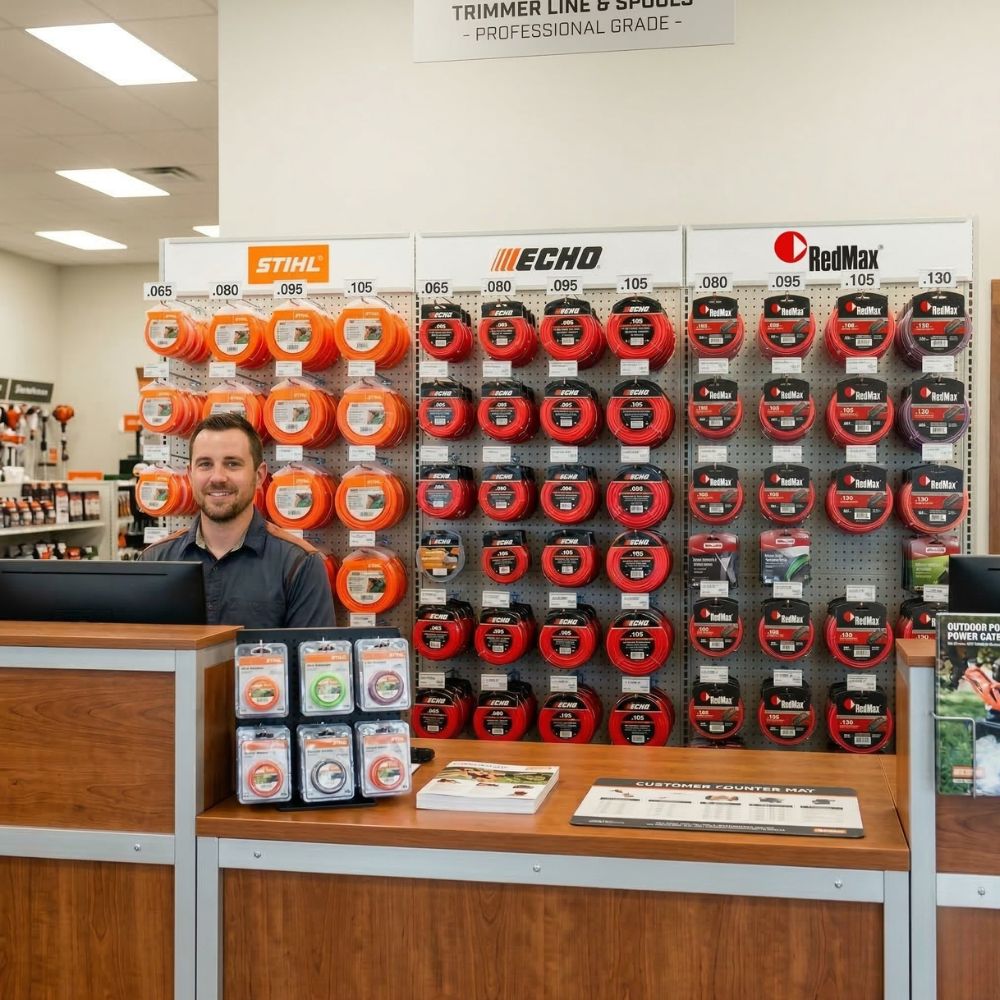
With over $150,000 in parts inventory, we stock trimmer line for immediate availability rather than waiting for shipments. Our parts counter carries trimmer line from leading manufacturers:
Stihl Trimmer Line (Premium Quality)
- Stihl Round Line (.080″, .095″, .105″): $9-13/lb
- Stihl Square Line (.095″, .105″): $12-15/lb
- Stihl X-Line (.095″ star-shaped): $16-19/lb
Echo Trimmer Line (Professional Favorite)
- Echo Cross-Fire Round (.080″, .095″, .105″): $9-12/lb
- Echo Black Diamond (.095″, .105″ square): $13-16/lb (Industry standard for commercial)
- Echo X-treme Serrated (.105″): $15-18/lb
Oregon Magnum Gatorline (Value Leader)
- Oregon Round (.080″, .095″, .105″): $8-11/lb
- Oregon Square (.095″, .105″): $11-14/lb
- Oregon Platinum (.105″ reinforced): $15-17/lb
Husqvarna Trimmer Line (OEM Quality)
- Husqvarna Whisper Twist (.095″ twisted): $11-14/lb (Quiet operation)
- Husqvarna Titanium (.095″): $12-15/lb
Our Recommendations:
- Budget-Conscious Homeowners: Oregon Magnum Gatorline Round .080″ ($8-9/lb)
- Serious Homeowners: Echo Cross-Fire or Stihl Round .095″ ($10-12/lb)
- Professional Landscapers: Echo Black Diamond .105″ ($14-16/lb)
- Premium Work: Stihl X-Line .095″ ($17-19/lb)
All lines are available at our parts counter in North Hampton, NH. Can’t find your preferred brand? We can special order with 2-3 day delivery. Learn how to select quality replacement parts across all your power equipment needs.
Trimmer Line Cost Comparison
Line Cost vs. Durability Analysis
| Line Type | Cost per Pound* | Feet per Trimming Session | Sessions per Pound | Cost per Session | Best For |
| Economy Nylon .080″ | $6-8 | 150-200 ft | 8-10 sessions | $0.70-1.00 | Very light residential |
| Standard Nylon .080″ | $8-12 | 200-300 ft | 12-15 sessions | $0.65-0.85 | Most homeowners |
| Premium Copolymer .095″ | $12-16 | 300-400 ft | 18-22 sessions | $0.60-0.75 | Heavy residential |
| Commercial Reinforced .105″ | $16-20 | 400-600 ft | 25-30 sessions | $0.55-0.70 | Professional use |
*Estimated pricing and performance based on typical market rates and usage patterns. Actual results vary by brand, vegetation density, and trimming conditions. Contact local dealers for current pricing.
Value Analysis:
Economy Line ($7/lb):
- Homeowner uses 3 lbs per season = $21
- Frequent breakage adds 30 extra minutes reloading
Premium Line ($14/lb):
- Homeowner uses 2 lbs per season = $28
- Minimal breakage saves 20 minutes
Conclusion: $7 extra for premium line is worth it
The “Too Cheap” Trap: $5-6 per pound bargain trimmer line from big box stores often breaks 2-3x more frequently than quality brands. You’ll spend more time reloading than the money you saved.
Common Trimmer Line Problems
Line Breaks Constantly:
- Line too thin for vegetation type
- Hitting too many hard surfaces
- Old/brittle line (UV degraded)
Solutions: Increase diameter, switch to round line for hard surfaces, buy fresh line
Line Won’t Feed from Spool:
- Line too thick for trimmer head
- Wound incorrectly on spool
- Head mechanism jammed with debris
Solutions: Check trimmer manual for max diameter, rewind spool carefully, clean trimmer head
Trimmer Bogs Down:
- Line too thick for engine power
- Dull blade-like line
- Engine issue
Solutions: Reduce diameter, replace worn line, check engine components
Ragged/Brown Grass:
- Round line tears grass instead of cutting
Solution: Switch to square, twisted, or star-shaped line for cleaner cuts that promote lawn health
Need help diagnosing trimmer problems? Our factory-trained service department can inspect your trimmer and recommend the right line. We also offer pickup and delivery for service appointments throughout the seacoast region.
String Trimmer Line FAQs
What size trimmer line should I use?
For most homeowners with gas trimmers (25-30 cc), .080″ diameter is the best choice. Battery trimmers should use .065″ to .080″ max. Professional landscapers typically use .095″ to .105″ with commercial equipment (35cc+). Always check your trimmer manual for maximum line diameter. Visit our parts counter, and we’ll help you choose the right size for your specific trimmer model.
What’s better: round or square trimmer line?
Round line is more durable and best for areas with hard surfaces (concrete, rocks, fences). A square line has four cutting edges and provides a cleaner cut on grass and weeds, which is better for lawn health. For general residential use, square line offers the best balance. For edging driveways and sidewalks, always use round lines to prevent constant breakage on concrete.
What trimmer line do professionals use?
Most professional landscapers use .095″ to .105″ diameter square or twisted line. Echo Black Diamond (.105″ square) is the commercial landscaping industry standard because it balances durability, cut quality, and cost. Some professionals prefer round line (.105″) for properties with extensive hard surface contact.
How much trimmer line do I need?
A typical homeowner uses 1-3 pounds of line per season (40-60 hours of trimming). Professional landscapers use 10-20 pounds per season (250-400 hours). Buy line in bulk (1-3 lb spools) for best value. One pound of .080″ line contains approximately 400-500 feet, with average residential trimming sessions using 20-35 feet.
Does trimmer line go bad?
Yes. UV exposure breaks down nylon over time (6-12 months if stored in sunlight). Line becomes brittle and breaks easily. Store trimmer line indoors in a cool, dark place. In coastal New Hampshire’s humid, salt-air conditions, UV degradation happens faster. Keep lime in sealed containers to prevent moisture absorption and premature breakdown.
Can I use any brand of line in my trimmer?
Yes, trimmer line is universal as long as it’s within your trimmer head’s diameter range. You can use Echo line in a Stihl trimmer, Oregon line in a Husqvarna trimmer, etc. The key is matching diameter to your trimmer’s specifications, not matching brand to brand. Quality matters more than brand matching.
What’s the difference between .080 and .095 trimmer line?
A .080″ diameter line works best for homeowners with 1-3 acres and gas trimmers of 25-30 cc, costing $8-12 per pound. 0.095″ diameter is 19% thicker, designed for heavy residential use or light commercial work with 28-35 cc engines, costing $12-15 per pound. The thicker .095″ line breaks less on tough weeds but requires more engine power to maintain speed.
How long does a pound of trimmer line last?
Homeowners typically use 1-3 pounds per season (40-60 hours of trimming). Professional landscapers use 10-20 pounds per season (250-400 hours). One pound of .080″ line contains approximately 400-500 linear feet, though this varies by line density and construction. An average residential trimming session uses 20-35 feet of line, meaning one pound provides 12-20 sessions depending on property size and vegetation thickness.
Can I use automotive trimmer line from big box stores?
Generic trimmer line from big box stores ($5-6/lb) often breaks 2-3 times more frequently than quality brands like Stihl, Echo, or Oregon. While initially cheaper, you’ll spend more time reloading and waste more line. Quality brands from authorized dealers come with consistent diameter tolerances and better UV resistance, making them more cost-effective long-term.
Where can I buy quality trimmer line in NH?
Seacoast Power Equipment in North Hampton stocks trimmer line from Stihl, Echo, Husqvarna, Oregon, and RedMax in all popular diameters and shapes. We carry bulk spools (1-5 lbs) for better value than small pre-wound packages. Our factory-trained staff can match line to your specific trimmer model. Open Monday-Saturday with same-day availability on all major brands.
Find Your Perfect Trimmer Line in New Hampshire’s Seacoast
Choosing the right trimmer line doesn’t have to be complicated. Match the diameter to your trimmer’s power (.080″ for most homeowners, .095″ to .105″ for professionals). Choose round for durability and edging, square or twisted for cleaner cuts and lawn health, and star-shaped for premium residential work.
Seacoast Power Equipment has served New Hampshire’s seacoast for nearly 60 years with factory-trained expertise and over $150,000 in parts inventory. Our parts counter stocks every popular trimmer line diameter, shape, and brand for same-day availability. Bring in your trimmer model or tell us about your property, and we’ll recommend the exact line you need.
Commercial landscapers: Ask about our fleet maintenance programs, including bulk trimmer line discounts (15-25% off), priority service scheduling, and seasonal equipment preparation throughout New Hampshire’s seacoast region.
Check our current promotions for parts and accessories specials.
Call: (603) 964-8384
Visit: Seacoast Power Equipment, 106 Lafayette Road, North Hampton, NH
Hours: Monday-Friday 8am-5pm, Saturday 8am-3pm
Explore our comprehensive equipment maintenance guides, including seasonal care schedules, troubleshooting tips, and professional recommendations for all power equipment types serving New Hampshire landscapes.