
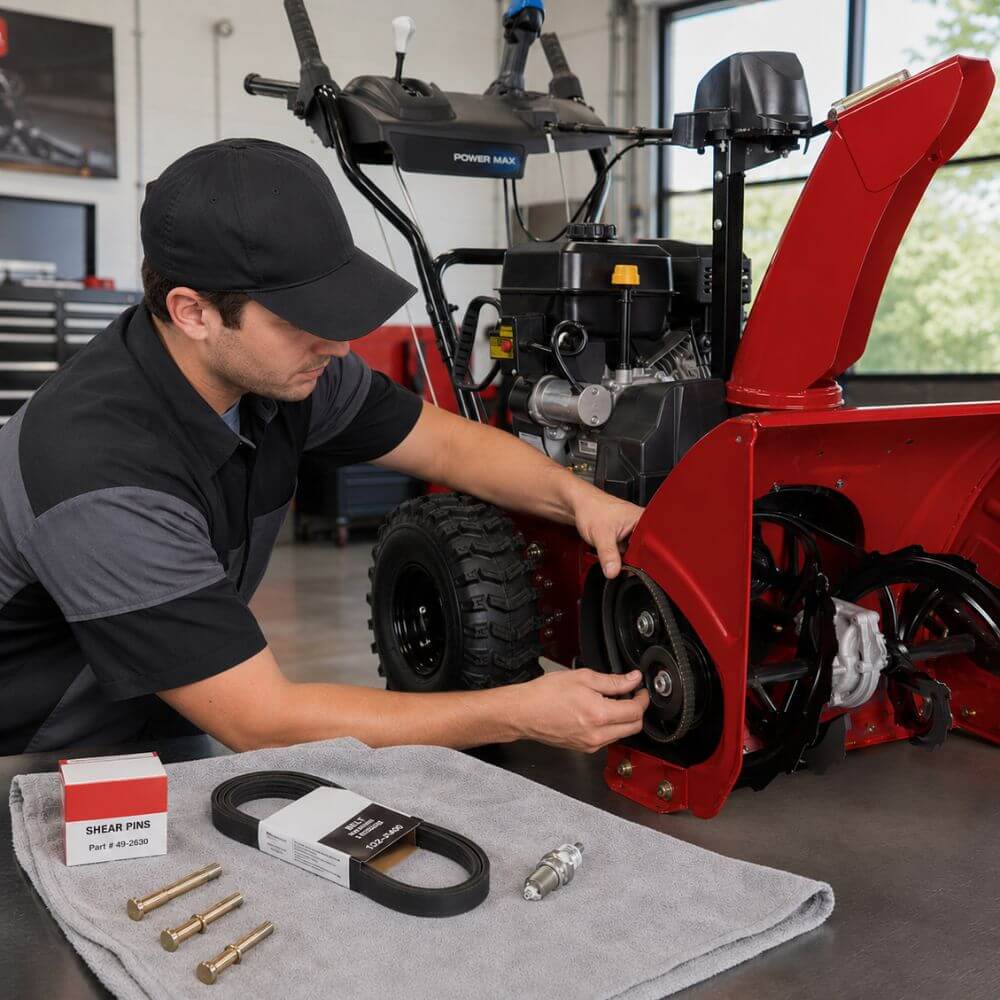
August feels far removed from snow season. That distance is exactly why it is the right time to service your snow blower.
Every fall, our service department in North Hampton fills with snow blowers that haven’t run since March. The owners waited until October, November, or December and discovered the machine won’t start, the carburetor is gummed from sitting with stale fuel, and the auger belt is cracked from another summer in a hot garage. Some of those machines need a week’s worth of parts and labor. Most of them could have been ready for the season in two to three days if they’d come in two months earlier.
August service is not a gimmick to generate off-season work. It is the practical answer to a predictable pattern: wait until you need the machine, find out it doesn’t work, and compete with every other NH seacoast homeowner for a service appointment during the busiest window of the year. Toro, the self-described America’s number one snow blower brand, launched National Snow Blower Maintenance Week in October. If you are reading this in August, you are already ahead of that curve.
This guide covers what pre-season snow blower service involves, what you can check yourself, and what belongs in the service department before the first storm of the season.
Why August: The Service Window Nobody Uses
Service departments at outdoor power equipment dealers follow a predictable seasonal cycle. Spring brings mowers, chainsaws, and handheld equipment. Summer is quiet for snow equipment. That is exactly why summer is the right window. September and October bring the first wave of snow blower service requests as homeowners start thinking about winter. November and December bring a rush when the first real snow is in the forecast.
By October, typical service turnaround has already extended from our standard 24 to 48 hours. By November, the backlog deepens. The homeowner who brings in their Ariens or Toro in August gets their machine back in two days with everything done right, before any wait-time pressure exists.
There is also a practical readiness argument. A snow blower serviced in August and properly stored for fall is ready on Day One. A machine brought in for emergency service on November 15th, the day after a surprise early storm, may not make it back in time. The NH seacoast is not immune to early-season snow events. In a region that saw significant ice storm activity in January 2026, being caught without functioning equipment is not a minor inconvenience.
According to Toro’s product support team, typical at-home maintenance runs in the range of $80 to $120 for most homeowners, but skipped or improperly performed maintenance can push that cost into the hundreds of dollars and, in some cases, lead to full replacement. The math for professional service is similar: a pre-season tune-up costs a fraction of emergency repair or replacement after a season of neglect.
The Most Common Reason Snow Blowers Fail to Start
Before the component checklist, understand what causes most first-of-season failures. It shapes everything else.
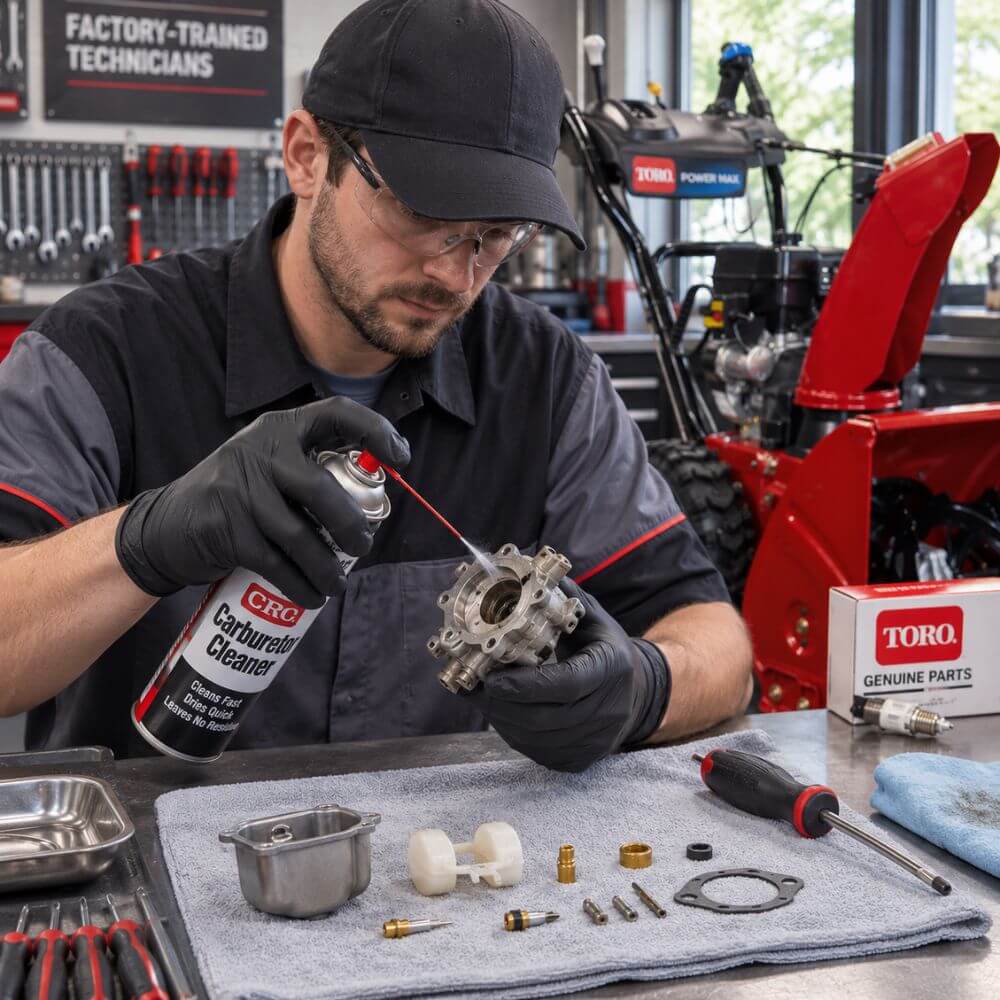
Stale fuel and carburetor varnishing. Gasoline with ethanol begins to degrade within 30 days. The lighter volatile components evaporate, leaving behind heavier residues that varnish the carburetor’s internal passages, needle valves, and float chamber. A snow blower that sat from March to November with a partial tank of pump gas has had more than enough time for that varnish to form. Fresh fuel will not dissolve it. The carburetor needs to be disassembled, cleaned, and in many cases rebuilt with a new diaphragm and needle valve set before the engine will start and run properly.
Ariens, in their official pre-season preparation guidance, recommends using fuel with minimal ethanol content (no more than 10%) and either draining the fuel system completely before storage or treating it with a fuel stabilizer to slow degradation. If you did not do either at the end of last season, pre-season carburetor service is the likely result.
Toro’s operator documentation for the Power Max series specifies not storing gasoline more than 30 days and running the machine until the engine runs out of fuel before storage. If those steps were skipped, the carburetor is where the problem lives.
This is also the most common service item our technicians find on snow blowers that arrive in October and November. A carburetor cleaning on a varnished unit is a multi-hour professional service job. It is not a quick fix and not something a can of carb cleaner sprayed through the air intake will resolve.
Pre-Season Service Checklist: What Gets Inspected and Why
This is what a thorough pre-season snow blower service covers. Some of these items you can address yourself with basic mechanical confidence. Others, particularly fuel system and carburetor work, belong with factory-trained technicians and proper small engine service tools.
Fuel system. Drain any old fuel completely. If the machine has been sitting with fuel since last spring, the system should be drained, fresh fuel added, and the carburetor inspected for varnish. If the machine won’t start or runs poorly on fresh fuel, carburetor service is needed before the season.
Engine oil. Change the oil before the season if it wasn’t changed after last season. The Ariens Deluxe series maintenance schedule specifies an oil change every 25 hours or annually. For most NH homeowners who use a snow blower seasonally, the annual interval applies regardless of hours. Check your specific model’s operator’s manual for the recommended oil type. Ariens specifies SAE 5W-30 synthetic on the Deluxe series. Consult your manual before assuming that applies to your machine.
Spark plug. Inspect before each season. Clean the electrode if mild fouling is present. Replace if the electrode shows visible erosion, if the ceramic is cracked, or if the machine is hard-starting despite a clean carburetor and fresh fuel. The Ariens Deluxe series specifies gapping the spark plug to 0.030 inches every season. Consult your model’s operator’s manual for the correct gap specification. It varies by engine.
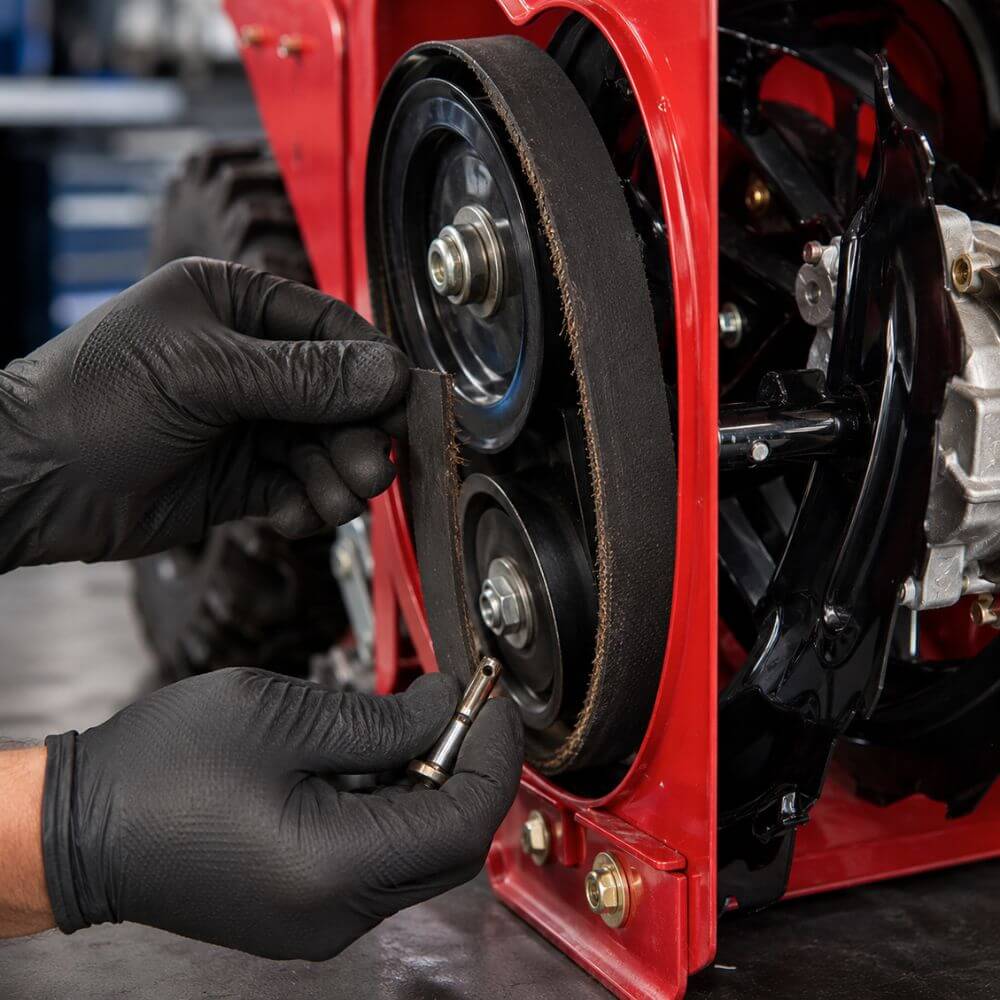
Auger belts. This is one of the most commonly missed maintenance items on two-stage snow blowers. Ariens maintenance guidance covers three failure signs to inspect for: sidewall fraying (small hairs or edge deterioration on the belt sides), glazing (a shiny, almost burnished surface on the belt face from heat cycles), and cracking (visible surface cracks from rubber aging). Any of these conditions means belt replacement before the season. A belt that is starting to show these signs at the end of August will almost certainly fail during a heavy snowfall in February, exactly when you need the machine running.
Toro’s pre-season preparation guidance for the YardCare series specifies inspecting the drive belt for fraying, cracking, or signs of stretching before each snow season and recommends having an extra belt on hand in the event the belt breaks while operating.
Most Ariens two-stage models use a dual-belt-drive system: an auger belt and a separate drive belt. Both should be inspected. Belt replacement is a service job on most two-stage units; the process requires access behind the belt system cover and proper tensioning on reinstallation.
Shear pins. Ariens’ shear pins are designed to break when the auger hits a hard object, such as a rock, a buried stick, or a toy left in the driveway, protecting the gearbox from more expensive damage. Inspect all shear pins before the season. Replace any that are bent, cracked, or that have already partially sheared. Ariens explicitly recommends stocking spare shear pins and notes that shear pins always seem to break when you’re halfway through a job and can’t find spares. We stock OEM Ariens shear pins and bolts at Seacoast Power.
Note on Toro two-stage models: Toro two-stage snow blowers do not use shear pins, according to Toro’s customer support documentation. Their commercial-grade gear case design eliminates the need for them. If the auger hits an obstruction or is overloaded, the engine may shut off. This is not a failure. It is the Toro system’s equivalent of shear pin protection.
Scraper bar and skid shoes. The scraper bar is the metal blade at the bottom of the auger housing that rides just above the pavement, scraping snow cleanly. It wears down with use and should be inspected for thickness. Toro’s operator manuals specify that the scraper should be set 1/8 inch (approximately 3 mm) above a level surface, with skids adjusted to maintain that clearance. A scraper bar that has worn past serviceability will leave snow behind and can damage the auger housing if not replaced.
Skid shoes, the adjustable metal feet that set the scraper height, also wear down and can be flipped or replaced when the contact surface is gone. These are among the most commonly missed components, according to Toro’s product support team, who note that the most commonly missed parts are skid shoes and scrapers on two-stage blowers. Both are stocked OEM parts at Seacoast Power.
Auger gear case. Modern Ariens two-stage models use synthetic gear oil in the auger gear case, not grease. Check your specific model’s operator’s manual. The lubricant type has changed across different Ariens generations, and using the wrong lubricant damages the gear case. If the oil level is low or the oil is contaminated, this is a service item before the season.
Tire pressure. Check both drive tires and equalize the pressure. Uneven tire pressure causes the machine to pull to one side during traction drive operation, a handling problem that affects clearing quality and operator control. Pressure specifications are in the operator’s manual or on the tire sidewall.
Control cables. Operate all control levers, including traction, auger engagement, and chute rotation, and check for smooth operation. Cables that are stiff, slow to return, or not fully engaging are a service item. Ariens recommends operating all controls periodically during the off-season to prevent sticking, which is a realistic suggestion for any machine that spends months without being run.
Electric start battery. For electric-start snow blowers, check battery charge and condition. Ariens notes that EFI models may need a quick battery charge before first use. A battery that sat all summer may have self-discharged and may not hold a full charge. A battery that cannot hold charge needs replacement before the season, not after the first storm.
What to Do Yourself vs. What to Bring In
Being clear about which service items are realistic DIY versus which belong with a professional saves time and avoids the risk of incomplete repairs.
Reasonable DIY for mechanically confident owners: Oil change (if comfortable draining and refilling small engine oil), spark plug inspection and replacement, tire pressure check, shear pin inspection and replacement, control lever operation check, and fuel system drain if machine hasn’t been started.
Professional service recommended: Carburetor inspection, disassembly, and cleaning or rebuild; auger and drive belt inspection and replacement (particularly on two-stage units where belt routing and tensioning require correct procedure); auger gear case oil service; scraper bar and skid shoe adjustment or replacement; and any issue where the machine won’t start or runs poorly after fresh fuel and a new spark plug.
Our factory-trained technicians at Seacoast Power Equipment service all snow blower brands, not just the brands we carry, with a typical 24 to 48 hour turnaround in our August service window. We stock OEM parts for Ariens, Toro, Honda, and Husqvarna, and our $150,000+ parts inventory means most service items don’t require waiting on parts to arrive.
If you can’t transport your snow blower to our North Hampton location, pickup and delivery are available throughout the NH seacoast and into southern Maine. Call (603) 964-8384 or schedule a pickup. We’ll bring it in, service it, and return it before the season arrives.
Repair vs. Replace: When Pre-Season Service Reveals a Bigger Problem
Pre-season service sometimes surfaces a machine that has reached the end of its practical service life. This is actually useful information. Finding it in August rather than after the first snowstorm gives you time to make a thoughtful replacement decision rather than an emergency one.
Signs that a snow blower may be at or past its economically viable service life include: auger housing that has rusted through or cracked, gear case damage from a shear pin bypass (someone used a standard bolt instead of the designed shear pin, which transferred the impact to the gear case), engine damage that would cost more to repair than the machine is worth, or cumulative wear on multiple systems that would require significant investment to bring back to reliable condition.
Our guide to recognizing the signs your snow blower needs replacement covers the specific failure indicators to look for. If your machine is showing multiple signs from that list, August is the right time to start looking at new models before the season, not after you’ve had an emergency in February.
For buyers looking at brand options, our NH snow blower brand comparison covers Ariens, Toro, Honda, and Husqvarna in the context of NH seacoast weather conditions.
Pre-Season Service for Commercial and Estate Operations
For commercial property management operations and estate caretakers who run multiple snowblowers, some managing four or more machines across large NH seacoast properties, pre-season fleet service is a logistics challenge, not just a maintenance task.
The same service window logic applies at scale: every machine that needs service in August avoids the fall crunch. A commercial crew that loses one snow blower to an emergency repair in January has a real operational problem.
Seacoast Power Equipment accommodates commercial fleet service scheduling. If you’re managing multiple units that need pre-season service before the season, contact us at (603) 964-8384 to coordinate service timing so all machines are ready before winter. We also carry OEM parts in depth, including multiple shear pin sets, belts, scraper bars, and skid shoes, so fleet-level parts needs can typically be filled from existing inventory.
For broader storm season preparation, our chainsaw storm prep guide covers getting your saw ready before hurricane season peaks.
Frequently Asked Questions
When should I service my snow blower before winter?
August is the optimal window for NH property owners, ahead of the fall demand that fills service departments and before October’s first cold snaps create urgency. The 24- to 48-hour turnaround we offer in August typically extends well beyond that by October and November.
What does a snowblower pre-season service include?
Fuel system inspection and drain or treatment; carburetor inspection and cleaning if needed; engine oil change; spark plug inspection and replacement; auger and drive belt inspection and replacement if warranted; shear pin inspection (two-stage models); scraper bar and skid shoe inspection and adjustment; tire pressure check; control cable operation check; and electric start battery test if applicable.
How often should snow blower belts be replaced?
Inspect belts before each season for sidewall fraying, glazing, or cracking. These are the signs that replacement is needed, per Ariens maintenance guidance. Most homeowner-use snow blowers need belt inspection annually and replacement every two to four seasons depending on use volume and storage conditions. A machine stored in a hot garage will age belts faster than one stored in a climate-controlled space.
My snow blower sat all spring and summer with fuel in the tank. What should I expect?
Expect carburetor issues. Ethanol-blended pump gas degrades within 30 days. A machine sitting with old fuel since March has very likely developed carburetor varnish that will prevent proper starting and running. Fresh fuel alone won’t fix it. Bring the machine in for carburetor service before relying on it for the season.
Do Toro two-stage snow blowers use shear pins?
No. Toro two-stage snow blowers do not use shear pins, per Toro’s customer support documentation. Their gear case design eliminates the need for them. If the auger hits an obstruction, the engine may shut off to protect the drivetrain. Toro single-stage models have their own rotor blade and scraper system that wears differently from two-stage auger systems.
Do you service all snow blower brands?
Yes. We service all makes and models, not just the brands we carry, with factory-trained technicians and a typical 24- to 48-hour turnaround in our August service window. We carry OEM parts for Ariens, Toro, Honda, and Husqvarna and can source most other brand parts in 2 to 3 business days.
Can you pick up my snow blower if I can’t transport it?
Yes. Pickup and delivery is available throughout the NH seacoast and into southern Maine. Call (603) 964-8384 or schedule online.
Seacoast Power Equipment is an authorized Ariens, Toro, Honda, and Husqvarna dealer in North Hampton, NH, serving the NH seacoast, Southern Maine, and Northern Massachusetts. Factory-trained technicians service all snow blower brands with a typical 24- to 48-hour turnaround. We carry $150,000+ in parts inventory and offer pickup and delivery throughout the region. Don’t wait until November. August service means a ready machine before the first storm.
Browse snow blowers at Seacoast Power → | Schedule service → | Pickup and delivery →