

Every year, riding mowers (including zero-turn models) send approximately 80,000 people to emergency rooms across the United States, according to the U.S. Consumer Product Safety Commission. A significant portion of those incidents involve loss of control on slopes, improper dismounting, and operating too close to drop-offs and water edges. Zero-turn mowers are not uniquely dangerous tools. But they are fast, responsive, and heavy. Those three characteristics create serious consequences when operators underestimate terrain or skip pre-operation safety steps.
For NH seacoast property owners and commercial landscaping crews, the terrain adds another layer. Coastal properties in the North Hampton, Hampton, and Rye area include soft, moisture-saturated soil near water, slopes that look mild but register dangerous on a tilt measurement, and drop-offs near coastal edges that leave no margin for error. Running a zero-turn on that terrain without understanding its limits is how preventable accidents happen.
This guide covers what the industry safety standards say, what the specific risks are for NH terrain, and what to check and know before every cutting session, whether you own a homeowner model or run a commercial fleet.
What the Safety Standards Actually Say
Zero-turn mowers are covered by two primary safety frameworks in the United States: ANSI/OPEI B71.1 for consumer-grade equipment and ANSI/OPEI B71.4 for commercial-grade machines. These standards establish minimum requirements for stability, operator controls, blade braking, and rollover protection.
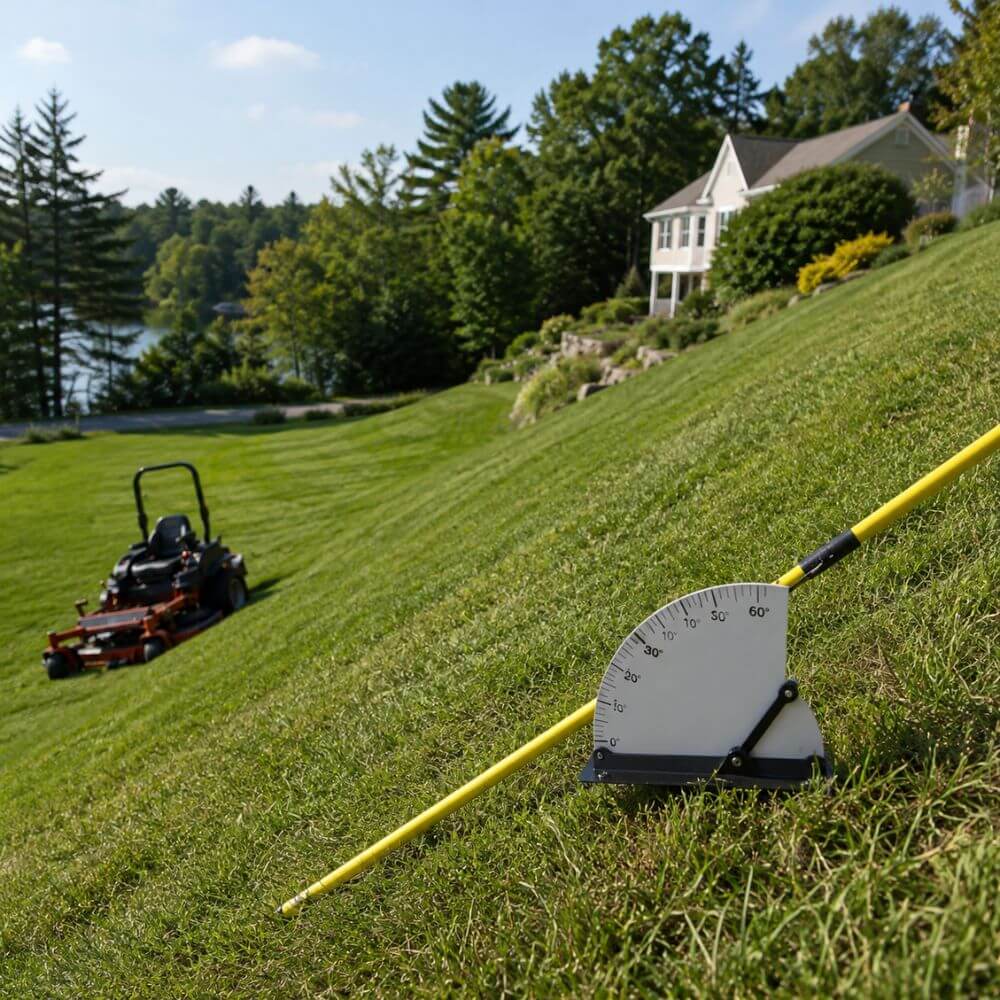
On slope limits, the guidance is consistent across manufacturers, OSHA, and independent safety authorities: do not operate a zero-turn mower on any slope greater than 15 degrees. Toro states this directly in its zero-turn safety guidance. OSHA’s riding mower safety resource recommends avoiding slopes over 15 degrees when no manufacturer-specific guidance is available. The ANSI commercial mower standard (B71.4) requires stability testing on a tilt table: the mower must not begin to tip at a longitudinal slope of 30 degrees or a lateral slope of 20 degrees. Those are engineering stability thresholds, not operating recommendations. The 15-degree operating limit is the correct reference for real-world use.
To put 15 degrees in concrete terms: a 15-degree slope rises roughly 32 inches over every 10 feet of horizontal run. If you are not sure whether your property’s slopes fall within that range, a slope indicator (also called a clinometer or inclinometer) is the right tool. Free smartphone apps serve this function, and printable versions are available from several mower manufacturers. Do not estimate by eye on unfamiliar terrain.
The commercial mower standard also addresses rollover protective structures (ROPS). ROPS, the rollbar that protects the operator if the machine overturns, is now standard equipment on most commercial zero-turns. If your commercial machine has a folding ROPS bar, it should always be in the fully raised and locked position during operation. There is no rollover protection when the bar is folded down.
Why Zero-Turns Behave Differently on Slopes
Understanding what makes zero-turn mowers specifically challenging on slopes helps explain why the safety rules exist and why ignoring them has consequences that differ from a conventional lawn tractor.
A zero-turn mower steers by controlling the speed and direction of each rear drive wheel independently. That system enables the zero-radius turning that makes these machines so efficient on flat terrain. On a slope, it creates a different dynamic: if the operator makes a sudden lever movement, especially a turn across or up a slope, the machine’s weight distribution can shift abruptly. On soft or wet soil, traction can drop faster than the operator anticipates.
Zero-turn mowers can also weigh over 1,700 pounds in commercial configurations. That weight, combined with a high center of gravity relative to the wheel stance, means a slope that looks manageable can tip the machine in less time than the operator can react. Commercial mowers with suspension systems, like the Ferris IS series with rear coil-over-shocks and a pivoting front axle, manage terrain undulation and operator fatigue more effectively than machines without suspension. But suspension improves ride quality and control on uneven terrain; it does not change the 15-degree slope limit.
Coastal NH terrain specifics. Properties in the NH seacoast region create conditions that compound slope risk in ways inland properties do not:
- Soil saturation. Coastal properties near tidal areas, storm drainage zones, and low-lying coastal terrain hold more moisture in the soil. Saturated soil dramatically reduces traction. A machine that holds its line on dry turf can slip on waterlogged ground at the same slope angle.
- Drop-offs near water. Properties with ponds, drainage channels, or coastal edges present hard-stop hazards that leave no recovery room. OSHA guidance specifies a buffer zone of at least two mower widths from drop-offs; within that zone, string trimmers and walk-behind mowers are the appropriate tools, not zero-turns.
- Deceptive coastal slopes. Coastal land that appears flat or nearly flat, particularly lawn areas that grade toward marsh or waterfront, can have localized slope angles that exceed safe zero-turn limits. Measure before you mow on any property you haven’t assessed.
The Three Most Common Zero-Turn Operator Errors
These are the errors our factory-trained technicians and the broader safety literature identify most consistently. All three are avoidable.
1. Turning across or on a slope.
The most dangerous maneuver on a slope is a lateral turn: swinging the mower to cut across the face of the hill. This shifts weight to the downhill side and, on wet or soft ground, is the primary cause of rollovers. The correct technique for slopes is to mow up and down the slope, not across it. At the top of each pass, make a wide, deliberate turn on the flattest available ground before heading back down. Never make a sharp left-steer turn on an incline.
2. Mowing too close to edges and drop-offs.
Retaining walls, pond edges, drainage ditches, ramps, and steps are where zero-turns lose traction and tip. The instinct is to get as close as possible to eliminate trimming. The correct approach is to maintain at least two mower widths of clearance from any edge or drop-off, then hand-trim or use a string trimmer for the boundary zone. This adds time to a job. It prevents a 1,700-pound machine from going over an edge.
3. Speed on unfamiliar terrain.
Zero-turn mowers can travel at 8 to 12 mph at top speed. At that speed, the distance required to react and stop safely is much greater than operators expect. On a first pass over any unfamiliar property, including a new client site for commercial crews, cut your speed well below normal operating speed. Identify obstacles, soft spots, slopes, and edge hazards before they appear at operating speed. Scouting the property on foot before the first cut is standard practice for professional crews; it should be for residential operators as well.
Pre-Operation Safety Checklist
Run this before every cutting session. It takes under five minutes and addresses the systems most likely to fail when they matter.
Operator presence control (OPC). Sit in the seat and verify that the blade disengages when you rise from the seat. This is the primary safety system that stops blade rotation if an operator leaves the seat without first disengaging the deck. If it does not function correctly, the mower needs service before use.
Blade brake. Disengage the deck and verify that the blades stop fully within the timeframe specified in your operator’s manual. A blade that continues to spin after deck disengagement is a service issue.
ROPS position. If the mower is equipped with a ROPS, confirm the bar is in the fully raised and locked position. Fasten the seatbelt. These two safety systems work together. Neither provides protection independently.
Tire pressure. Uneven tire pressure affects traction and handling on slopes. Check both rear-drive tires before cutting on any uneven terrain. Manufacturer-specified pressure is in the operator’s manual.
Site walk. Walk the property before the first pass of each session if conditions have changed since last time: storm debris, new soft spots from rainfall, or any changes to edge conditions near drop-offs and water. A five-minute walk-through prevents the surprises that happen at operating speed.
Fuel and oil. Check both before starting. Running out of fuel on a slope and losing hydraulic engagement while coasting create a loss-of-control scenario.
Clearing the area. Remove rocks, wire, toys, and other objects from the cutting area before starting. Zero-turn mowers operate at blade tip speeds that turn debris into projectiles. On commercial sites, require site clearing as a pre-mow step for the entire crew.
ROPS: What It Does and Why the Seatbelt Matters
ROPS is standard equipment on most commercial zero-turn mowers produced in recent years. It is a structural rollbar designed to protect the operator from being crushed if the machine tips over. But ROPS only works as designed when the seatbelt is also worn.
A zero-turn with ROPS and no seatbelt creates a false sense of protection. If the machine tips, an operator without a seatbelt is thrown from the seat, either into the path of the machine or clear of the protective arc of the ROPS. The system is designed to work as a unit: ROPS holds the structure away from the ground, and the seatbelt keeps the operator within that protective zone.
For commercial operators: if your fleet includes older machines without ROPS, contact the manufacturer. Most major zero-turn manufacturers have retrofit programs. For new equipment purchases, ROPS should be a baseline requirement on any commercial machine used by employees.
Choosing a Zero-Turn That Fits Your Terrain
Safety starts before the first operation. It starts with selecting a machine matched to the terrain you’re actually cutting. The most common mismatch in NH is buying a homeowner-tier machine for property conditions that call for a commercial or commercial-adjacent model.
For homeowners on flat to gently rolling coastal NH properties (under an acre, minimal slope, maintained edges), a mid-range zero-turn with a 48-inch to 54-inch deck fits most work comfortably. The important thing at this tier is understanding the slope limits of whatever machine you select and measuring terrain against them before the first cut.
For homeowners on larger or more complex properties (an acre or more, wooded edges, coastal terrain, slopes that approach the 10 to 15 degree range), a step up to a machine with more stability, better traction in wet conditions, and broader deck options improves both safety and cutting quality. This is also where the Try Before You Buy program at Seacoast Power Equipment adds genuine safety value: testing a machine on terrain similar to yours before committing to it tells you things a spec sheet cannot.
For commercial landscaping crews running equipment all day on varied client sites across the NH seacoast, including coastal properties, estates, and managed grounds, the suspension system on commercial models matters. Seacoast Power Equipment carries the Ferris IS 700, IS 2100, and IS 3200Z series, which use patented rear coil-over-shocks and a pivoting front axle to manage uneven terrain and reduce operator fatigue over a full day of operation. Fatigue is a safety variable: a crew running a hard-riding machine for six hours makes worse decisions at the end of the day than a crew on a machine that absorbs terrain properly.
Browse our full zero-turn mower lineup to see current Ferris, Toro, Husqvarna, Gravely, Ariens, Simplicity, and Stihl models in stock. Our commercial mower buying guide covers model selection in depth for both residential and commercial buyers. For crew operations, our spring commercial fleet preparation guide addresses how to structure equipment readiness at the season level, including safety system checks across a full fleet.
When to Bring the Mower in for Service
Safety systems, including operator presence controls, blade brakes, and ROPS hardware, degrade with use and should be inspected regularly, not only when a problem is noticed. The following conditions mean the machine needs professional service before the next cutting session:
- The operator presence control does not stop the blades when you rise from the seat
- The blade brake takes longer than specified to stop after deck disengagement
- Any hydraulic leak is visible near the drive system
- The ROPS hardware shows damage, bent components, or loose mounting points
- Unusual vibration or noise under the deck or from the drive system
- Any handling change on flat terrain, such as pulling to one side or sluggish response to the lap bars, that was not present before
Our factory-trained technicians service all zero-turn brands with a typical 24 to 48 hour turnaround. Backed by $150,000 or more in on-hand parts inventory, we stock OEM parts for the brands we carry and can source most other brand parts in 2 to 3 business days. Pickup and delivery is available throughout the NH seacoast and into southern Maine. Call (603) 964-8384 or schedule a service pickup before the mowing season gets ahead of your maintenance schedule.
For a complete zero-turn maintenance schedule, including oil changes, blade sharpening intervals, deck service, and drive system care, our zero-turn maintenance guide covers the full seasonal checklist for both residential and commercial operators.
Frequently Asked Questions
What is the maximum safe slope for a zero-turn mower?
Do not operate a zero-turn mower on any slope greater than 15 degrees. This guidance is consistent across OSHA, Toro’s published safety specifications, and independent safety authorities. Always consult your specific machine’s operator’s manual for the manufacturer’s slope rating, which takes precedence. Measure slopes with a clinometer before operating on unfamiliar terrain.
Should I mow across a slope or up and down it?
Mow up and down the slope, not across it. Mowing across a slope shifts weight to the downhill side and increases rollover risk. Make wide, deliberate turns on flat ground at the top of each pass.
What is ROPS and do I need it?
ROPS is a rollover protective structure: the rollbar that protects the operator if the machine overturns. It is standard on most commercial zero-turn mowers. If your machine has ROPS, the bar must be in the fully raised and locked position during operation. The seatbelt must also be worn. ROPS and the seatbelt work as a system, and rollover protection drops sharply without both.
How do I know if a slope is too steep for my zero-turn?
Use a clinometer or slope indicator app to measure the actual angle. A 15-degree slope rises roughly 32 inches over every 10 feet of horizontal distance. If you don’t have a slope indicator, that visual reference is a reasonable field estimate, but measuring is more reliable than estimating by eye, especially on coastal terrain where gradual grades can be deceptive.
What should I do if my mower stops on a slope?
Do not attempt to turn around on the slope. Disengage the blades. Navigate straight up or straight down the slope to flat ground before attempting any other action.
How close can I mow to a pond, ditch, or coastal water edge?
Maintain at least two mower widths of clearance from any drop-off, pond edge, drainage ditch, or coastal water edge. Within that buffer zone, use a walk-behind mower or string trimmer. Wet ground near water dramatically reduces traction.
Is a zero-turn safe for a first-time rider mower-operator?
Zero-turns have a steeper learning curve than conventional lawn tractors because the lap bar steering is less intuitive than a steering wheel. Take time on flat, open terrain first. Practice controlled deceleration and turns before operating near slopes, edges, or obstacles. Consider a demonstration session at Seacoast Power Equipment before purchase.
Seacoast Power Equipment has been serving the NH seacoast since 1965, and today serves the NH seacoast, southern Maine, and northern Massachusetts from our North Hampton, NH location. We carry zero-turn mowers from Ferris, Toro, Husqvarna, and other leading brands, with factory-trained technicians on-site for service and a Try Before You Buy program for buyers who want to test equipment on terrain similar to their own before committing. Call (603) 964-8384 or stop in.
Browse zero-turn mowers at Seacoast Power → | Schedule service →