
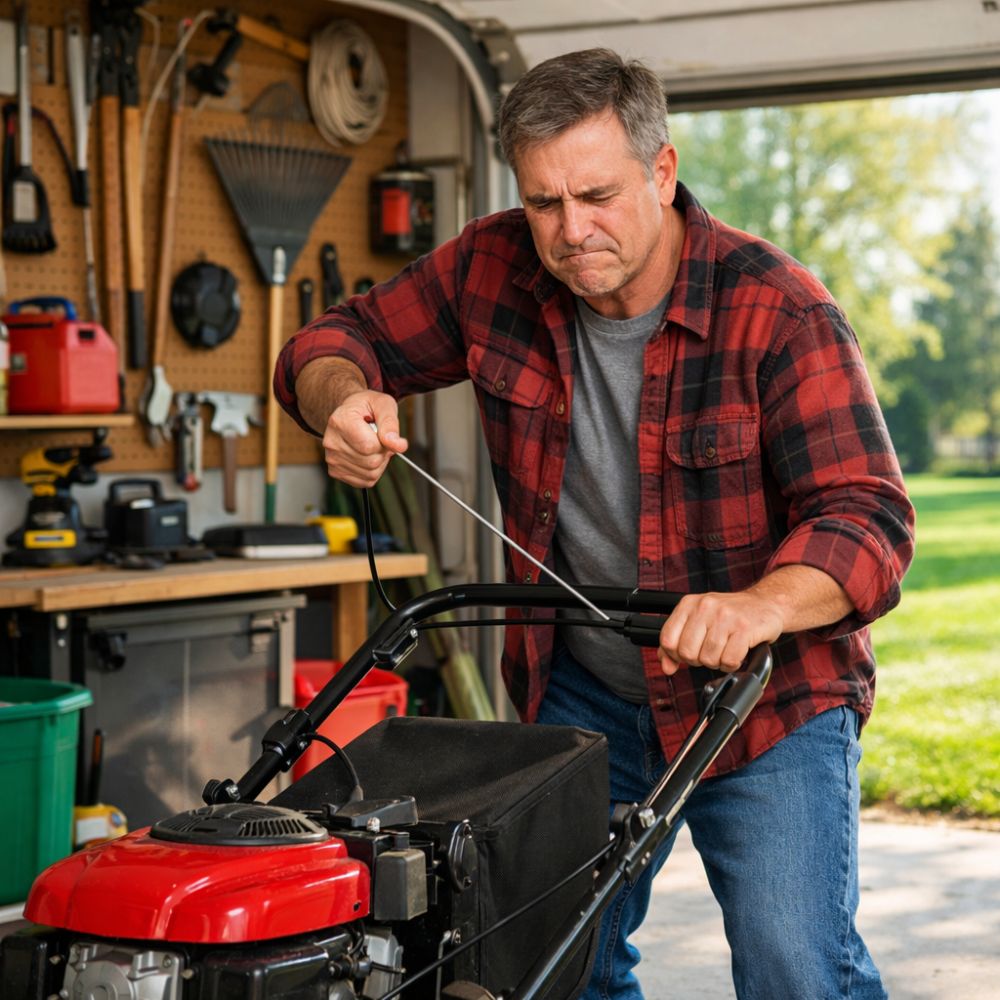
You wheel your mower out on the first warm Saturday in April, ready to tackle the lawn that’s been growing wild since last October. You pull the cord once, twice, three times. Nothing. The silence is deafening, and your to-do list is getting longer by the minute.
Lawn mowers that won’t start after winter storage are one of the most common springtime headaches for New Hampshire homeowners. After months in the garage or shed, small engines face a perfect storm of problems: stale fuel, corrosion, moisture damage, and component failures that compound over time. These cold-weather engine issues are preventable with proper maintenance.
At Seacoast Power Equipment, our factory-trained technicians see hundreds of these cases every spring across the NH Seacoast region. After nearly 60 years in business and thousands of spring tune-ups, we’ve identified seven problems that account for 95% of post-winter starting failures. This guide walks you through each problem, how to diagnose it, and whether it’s a DIY fix or requires professional service. We’ll help you get back to mowing, whether that’s in your own garage this afternoon or in our service department within 24-48 hours.
Start Here: 5-Minute Pre-Diagnosis Checklist
Before diving into complex troubleshooting, check these basics. About 15% of mowers we see just need fresh gas or a reconnected spark plug wire.
Quick Checks:
- Fuel level: Is there gas in the tank? Obvious but often overlooked.
- Safety mechanisms: Is the bail or safety bar engaged properly?
- Spark plug wire: Is it connected? It can disconnect during storage or transport.
- Oil level: Check the dipstick. Low oil safety switches prevent starting.
- Blade obstruction: Any debris preventing blade rotation?
If these checks don’t reveal the problem, let’s move to the seven most common causes of lawn mower-won’t-turn-over issues after winter.
Problem #1: Stale Fuel and Carburetor Clogs (Causes 40-50% of Starting Failures)
Why This Happens
Gasoline degrades after 30-60 days without fuel stabilizer. The volatile compounds evaporate, leaving behind a gummy varnish that clogs carburetor jets and fuel passages. Ethanol in modern gas accelerates this degradation, and winter temperature fluctuations worsen condensation and water accumulation in your fuel system.
How to Diagnose This Problem
Visual Indicators:
- Gas smells stale or varnish-like instead of sharp and fresh
- Fuel appears darker or brown rather than clear amber
- Visible sediment or particles in the fuel tank
- Mower cranks but won’t fire, or fires briefly then dies
Testing Method: Remove the spark plug and spray starter fluid into the cylinder. If it starts briefly and then dies, you’ve confirmed a fuel delivery problem. If it doesn’t start at all, you likely have a spark or compression issue.
DIY Solution (Difficulty: Medium)
For Walk-Behind Mowers:
- Drain old fuel completely using a siphon pump or by tipping and draining
- Remove the air filter and spray carburetor cleaner into the carburetor throat
- Let it sit 10-15 minutes, then spray again
- Replace the air filter and add fresh non-ethanol gas plus fuel stabilizer
- Attempt to start (may take 5-10 pulls)
Tool Requirements: Carburetor cleaner ($6-10), fresh gas ($15), fuel stabilizer ($8-12), siphon pump ($10-15)
For Riding Mowers: The carburetor is harder to access under the hood with multiple connections. Higher risk of incorrect reassembly means professional service is recommended unless you’re mechanically experienced.
Professional Service Option
When to Call Seacoast Power:
- You’ve tried DIY cleaning and the mower still won’t start
- Riding mower requires carburetor removal or rebuild
- You’re not comfortable working with fuel systems
- Mower sat with fuel for 2+ years (likely needs carburetor replacement)
What We Do: Complete carburetor cleaning or rebuild, fuel system flush with fresh gas, and fuel filter replacement. Service is typically completed in 24-48 hours with our $150,000+ parts inventory on hand.
Cost Estimate: $85-150 for carburetor cleaning; $180-250 for carburetor replacement plus labor
Understanding proper winter storage techniques can prevent this problem next winter. Learn more about equipment storage and winter maintenance tips for New Hampshire residents.
Problem #2: Worn, Fouled, or Disconnected Spark Plug (25-30% of Cases)
Why This Happens
Carbon buildup accumulates from combustion cycles, oil fouling occurs when you overfill the crankcase or have worn piston rings, and corrosion develops during winter storage. The electrode gap increases over time, reducing spark strength. Sometimes the plug physically disconnects during transport or storage.
How to Diagnose This Problem
Visual Inspection:
- Locate the spark plug (usually on top or in front of the engine).
- Remove the rubber boot and inspect the wire connection
- Use a spark plug wrench to remove the plug
- Examine the electrode end:
- Black/sooty: Carbon fouled (too rich mixture or old gas)
- White/blistered: Running too hot (rare in storage situations)
- Rust/corrosion: Moisture damage
- Cracked ceramic: Physical damage (replace immediately)
- Worn electrode: Gap too wide (use feeler gauge; typically .030″ but check your manual)
Spark Test: Reconnect the spark plug wire to the removed plug, ground the plug threads against engine metal, then pull the starter cord and observe. You should see a blue spark. No spark means a bad plug or ignition coil issue.
DIY Solution (Difficulty: Easy)
Cleaning Attempt: Use a wire brush to clean carbon deposits and check or adjust the gap with a feeler gauge. Reinstall and test.
Replacement (Recommended): Spark plugs cost $3-8, making them cheap insurance. Match the plug type to manufacturer specifications by checking your manual or bringing the old plug to our parts counter. Always replace if the plug has over 100 hours of use since the last change, the electrode is significantly worn, or the ceramic is damaged in any way.
Seacoast Power Parts Counter: We stock OEM plugs for Honda, Toro, Stihl, Husqvarna, and all major brands at $3-8 per plug.
When to Call a Professional
If the spark plug looks fine but you still have no spark, you likely have an ignition coil or flywheel key issue. Repeated plug fouling indicates deeper engine problems that require professional diagnosis.
Regular maintenance prevents most spark plug issues. Learn about maintaining equipment during peak season to keep your mower running smoothly.
Problem #3: Dead Battery (Riding Mowers, Zero-Turns, Electric-Start Models)
Why This Happens
Batteries self-discharge during winter storage at 3-5% per month. Cold temperatures reduce battery capacity further. Corrosion on terminals creates poor connections, and typical battery lifespan is only 3-5 years. Winter storage accelerates failure.
How to Diagnose This Problem
- Key turns but engine cranks slowly or weakly: Low battery
- Clicking sound but no cranking: Dead battery or bad solenoid
- No sound at all: Check connections first, then battery
Testing: Use a multimeter to check voltage. A fully charged battery should read 12.6+ volts. Under 12.2 volts, it needs charging. Under 11.8 volts likely needs replacement.
DIY Solution (Difficulty: Easy)
Jump Start or Charge: Clean terminals with a wire brush and baking soda solution. Charge with an automotive battery charger (slow charge: 2-4 amps for 4-8 hours). You can jump-start using a car battery with jumper cables for an immediate test.
Replacement: If the battery won’t hold charge, replace it. Riding mower batteries cost $40-80 depending on size. Installation is straightforward: negative (black) cable first, then positive (red).
Professional Service Option
Battery load testing confirms whether replacement is needed. Installation is included with a battery purchase. Fleet customers can access our battery replacement programs for multiple units.
Seacoast Power Service: We stock replacement batteries for all major brands and offer free battery testing.
If you’re managing multiple machines, our commercial equipment maintenance programs provide priority service and preventive care schedules.
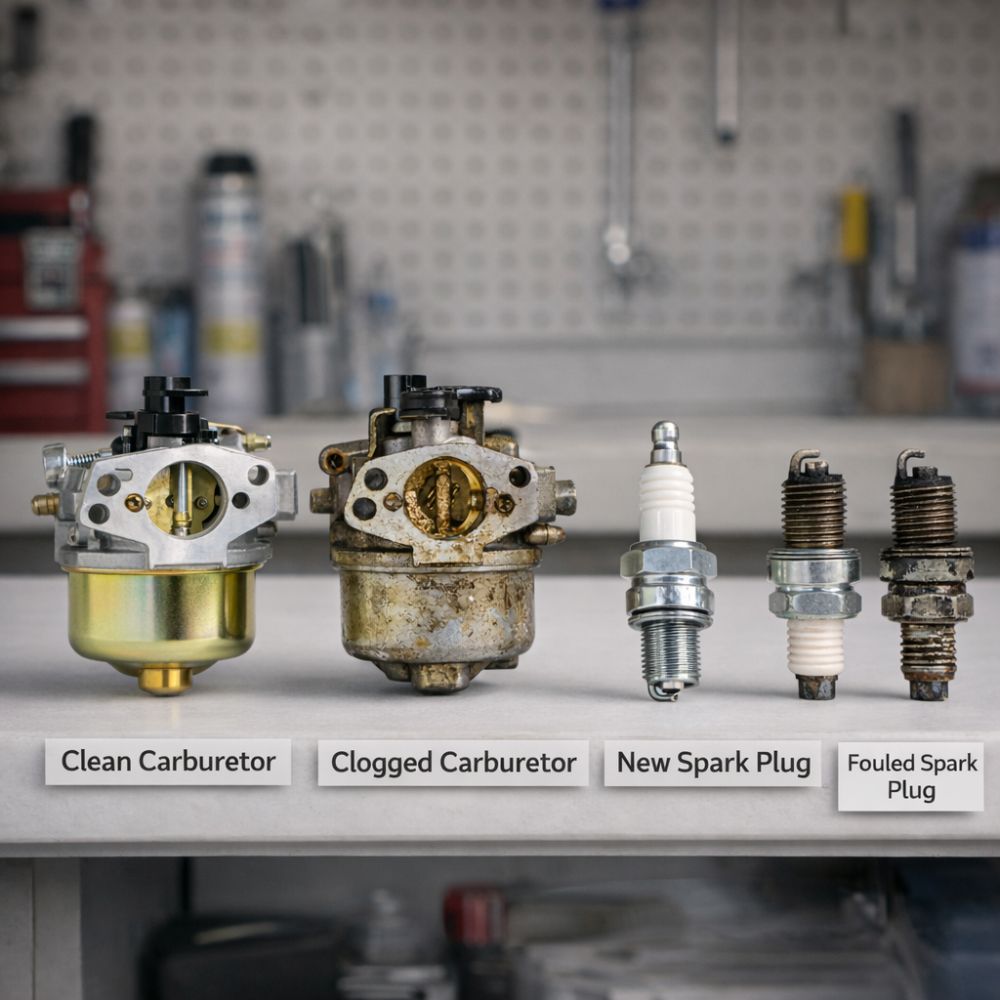
Lawn mowers commonly won’t start after winter due to stale fuel clogging carburetors (40-50% of cases), fouled spark plugs (25-30%), or dead batteries in riding models. Factory-trained technicians at Seacoast Power Equipment diagnose and repair these issues with 24-48 hour turnaround, serving New Hampshire’s seacoast region since 1965.
Problem #4: Clogged Air Filter Starving the Engine (15-20% of Cases)
Why This Happens
Air filters trap dust, grass clippings, and debris during operation. Sitting idle allows moisture and mold to accumulate on the filter material. A clogged filter restricts airflow, creating an incorrect air-fuel mixture. Your engine can’t breathe properly, so it won’t start or runs very rough.
How to Diagnose This Problem
Remove the air filter cover (usually 1-2 screws or clips) and inspect the filter:
- Paper filter: Hold up to light. You should see light through it
- Foam filter: Should be white or cream colored, not black or gray
DIY Solution (Difficulty: Very Easy)
Paper Filters ($5-12): Always replace paper filters. Cleaning doesn’t restore proper function. Match the filter to your engine model. Installation takes 60 seconds.
Foam Filters ($4-8): Wash in warm soapy water, rinse thoroughly, and squeeze dry (don’t twist). Lightly oil with motor oil and squeeze out excess before reinstalling.
Prevention: Replace or clean air filters every 25-50 hours of operation or at the start of each season. Buy 2-3 filters at season start and keep them on hand.
Our parts department stocks filters for all major brands at $4-12 depending on model. Proper peak season maintenance includes regular filter changes to ensure optimal performance.
Problem #5: Old Oil Triggering Low-Oil Safety Shutdown (10-15% of Cases)
Why This Happens
Modern mowers have low-oil sensors that prevent engine damage by shutting down the engine. Oil degrades over winter through moisture contamination and oxidation. Oil level drops if there was a slow leak. Milky white oil indicates water contamination, a serious issue requiring professional diagnosis.
How to Diagnose This Problem
Check the dipstick. Oil level should be in the “full” range. Oil color should be amber or brown, not black or milky white. Milky white oil means water in the crankcase, either from condensation or head gasket failure.
DIY Solution (Difficulty: Easy)
Oil Change Procedure:
- Warm the engine if possible for easier draining
- Drain old oil into a container (tilt mower or use drain plug)
- Replace the oil drain plug if applicable
- Refill with appropriate oil type:
- Most mowers: SAE 30 or 10W-30
- Check your manual for exact specifications
- Typical capacity: 15-20 oz (walk-behind mowers), 48-64 oz (riding mowers)
- Check dipstick to confirm correct level
Cost: $5-8 for oil (quart), $3-5 for oil filter if applicable
Learn how often to change oil in small engines for optimal engine performance and longevity.
When to Call a Professional
Call if you find milky white oil (water contamination requires professional diagnosis), you’re uncertain about oil type or capacity, or you have a riding mower with difficult oil filter access.
Problem #6: Primer Bulb Not Working or Choke Stuck (8-12% of Cases)
Why This Happens
Primer bulbs crack or harden over time, especially in cold temperatures. Choke cables can stick or fray after sitting idle. Fuel lines connected to the primer bulb develop cracks or leaks. Governor linkage can bind after months of inactivity.
How to Diagnose This Problem
Press the primer bulb. It should feel resistance and spring back. A cracked bulb will leak fuel you can see or feel. Test the choke by pulling the choke lever; it should close the carburetor butterfly valve smoothly. Move the throttle lever through its full range; it should move smoothly without binding.
DIY Solution (Difficulty: Easy to Medium)
Primer Bulb Replacement:
- Remove 2 screws holding the bulb
- Note fuel line connections (take a photo first)
- Install new bulb ($4-8)
- Reconnect fuel lines (ensure tight fit with clamps)
Choke Cable: More complex repair. Professional service is recommended for safety and proper adjustment.
Professional Service Option
Choke and throttle linkage service costs $65-95. Primer bulb replacement with labor costs $35-50 at our service department.
Problem #7: Safety Switch Malfunction or Sheared Flywheel Key (5-10% of Cases)
Why This Happens
Safety Switches: Blade engagement switches can fail, seat switches on riding mowers malfunction, and bail bar switches wear out with repeated use. These are designed to prevent operation in unsafe conditions.
Flywheel Key (Serious Issue): If your mower blade hit a solid object like a rock or stump, the flywheel key can shear. This is actually a safety feature that protects the engine. Symptoms include the engine turning over but not starting, or starting but running very rough with severe vibration.
How to Diagnose This Problem
Safety Switch Test: You can bypass individual switches temporarily for testing (consult your manual for proper procedure). WARNING: Only bypass temporarily for testing. Never operate with permanently disabled safety features.
Flywheel Key: Requires removing the flywheel to inspect the key. This is not a DIY job for most homeowners due to the specialized tools required.
Professional Service Recommended
Safety switch diagnosis and replacement costs $75-125. Flywheel key replacement costs $95-150 and requires specialized tools like a flywheel puller. Do NOT bypass safety switches permanently. This creates safety and liability risks.
Seacoast Power Service: Our technicians diagnose electrical and safety switch issues quickly with specialized testing equipment, getting you back to mowing safely. Learn why choosing local repair over big chains provides better service and faster turnaround.
When to DIY vs. When to Call Seacoast Power Equipment
| Situation | DIY Confidence Level | Professional Service Recommended |
| Simple fixes (spark plug, air filter, oil change) | ✅ High, Save $50-75 in labor | Consider if you lack tools or time |
| Carburetor cleaning (walk-behind) | ⚠️ Medium, Possible with tutorial | Recommended if problem persists |
| Carburetor rebuild/replacement | ❌ Low to high risk of incorrect reassembly | ✅ YES, Requires specialized knowledge |
| Battery charging/replacement | ✅ High, Very straightforward | Consider for fleet/multiple units |
| Electrical diagnosis (safety switches) | ❌ Low, Requires multimeter and experience | ✅ YES, Misdiagnosis can be dangerous |
| Flywheel key replacement | ❌ Low, Requires flywheel puller tool | ✅ YES, Not a DIY job for most owners |
Why Choose Professional Service
Time savings: What takes you 3-4 hours takes a professional 30-45 minutes with proper tools and experience.
Correct diagnosis: Avoid throwing parts at the problem hoping something works. Our technicians diagnose the root cause immediately.
Warranty protection: Some manufacturers require professional service to maintain warranty coverage.
Safety: Fuel and electrical systems have inherent risks. Our factory-trained technicians handle them safely every day.
Pickup and delivery available: We’ll come to you throughout the seacoast region. No need to trailer your mower.
Seacoast Power Equipment Service Advantages
- Factory-trained technicians (Honda, Toro, Stihl, Husqvarna certified)
- 24-48 hour turnaround on most repairs
- All brands serviced, not just what we sell
- $150,000+ parts inventory. No waiting for parts orders
- Loaner equipment available for commercial customers
- Free estimates on all service work
- Serving New Hampshire’s seacoast since 1965
Understanding when to call professionals saves time and prevents costly mistakes. Read about the top 10 common lawn equipment issues to know what you can tackle yourself.
What Will It Cost? DIY vs. Professional Service Price Breakdown
| Repair Type | DIY Cost (Parts Only) | Professional Service Cost | DIY Time Investment | Pro Turnaround |
| Spark plug replacement | $3-8 | $35-50 | 15 minutes | 24 hours |
| Air filter replacement | $5-12 | $30-45 | 5 minutes | 24 hours |
| Oil change | $5-15 | $45-65 | 30 minutes | 24 hours |
| Carburetor cleaning | $10-25 | $85-150 | 2-3 hours | 24-48 hours |
| Carburetor replacement | $60-120 | $180-250 | 3-4 hours (if experienced) | 24-48 hours |
| Battery replacement | $40-80 | $75-120 | 20 minutes | Same day |
| Primer bulb replacement | $5-10 | $35-50 | 30-45 minutes | 24 hours |
| Safety switch replacement | $15-35 | $75-125 | N/A (diagnosis required) | 24-48 hours |
| Complete spring tune-up | $30-50 | $89-149 | 2-3 hours | 24-48 hours |
Spring Tune-Up Package (Professional Service)
Includes: Oil change, spark plug replacement, air filter replacement, blade sharpening, fuel system check, safety inspection, and complete lubrication.
Value Proposition: For $89-149, you get everything done correctly in 24-48 hours versus spending 2-3 hours plus $30-50 on parts with the risk of misdiagnosis. Our technicians catch problems before they become expensive repairs.
Consider our typical repair timelines when planning your spring equipment service.
How to Avoid These Problems Next Spring: Winterization Checklist
Proper winterization prevents 80% of spring starting problems. Here’s what to do before storing your mower in October or November.
Option 1: Drain Fuel Completely (Recommended for Long-Term Storage)
- Run mower until tank is nearly empty
- Add fuel stabilizer to remaining fuel
- Run for 5 minutes to circulate stabilizer
- Drain any remaining fuel from tank and carburetor bowl
Option 2: Fill Tank and Add Fuel Stabilizer (Easier)
- Fill tank completely (prevents condensation)
- Add fuel stabilizer (follow package instructions: typically 1 oz per 2.5 gallons)
- Run engine for 10 minutes to circulate stabilizer throughout fuel system
Other Critical Winter Prep Steps
- Change oil (old oil contains combustion acids that damage engines over winter)
- Remove or clean air filter
- Clean mower deck thoroughly to prevent rust
- Remove spark plug, spray fogging oil into the cylinder, and pull cord slowly 2-3 times
- Reconnect spark plug
- Remove battery and store in a warm place (or connect to trickle charger)
- Cover mower with breathable cover (prevents moisture buildup)
Storage Location Matters
Best: Heated garage or shed
Good: Unheated garage or shed (dry environment)
Acceptable: Covered outdoor storage with breathable tarp
Avoid: Uncovered outdoor storage (invites moisture, rust, and rodent damage)
Seacoast Power Equipment Fall Service: We offer complete winterization service ($75-95), including all steps above plus storage tips for your specific model. Our complete fall equipment maintenance checklist covers everything you need. Start preparing in autumn with our fall-to-winter transition maintenance guide for New England homeowners.
Proper winter equipment care tips and winterizing your lawn tractor ensure spring starts smoothly. Once your mower is running, follow these early spring lawn care tips for a thriving yard.
Frequently Asked Questions: Lawn Mower Won’t Start After Winter
How long does gas last in a lawn mower over winter?
Without fuel stabilizer, gasoline begins to degrade in 30-60 days. After 3-4 months of typical winter storage, gas is significantly degraded and will cause starting problems. Ethanol-blended fuels like E10 and E15 degrade even faster. With fuel stabilizer, gas can last 12-24 months. For best results in New Hampshire’s cold winters, either drain fuel completely or use non-ethanol gas with stabilizer.
Can I use old gas if I mix it with fresh gas?
Not recommended. Old gas contains varnish and gum that will contaminate fresh gas and clog your carburetor. Always drain old gas completely, dispose of it properly (most NH transfer stations accept old fuel), and start with fresh fuel. Exception: If gas was stored with stabilizer and is less than 6 months old, you can mix 25% old gas with 75% fresh gas.
How much does lawn mower repair cost in New Hampshire?
Basic service (tune-up, spark plug, air filter, oil change) costs $89-149. Carburetor cleaning costs $85-150. Carburetor replacement costs $180-250. Major repairs (engine rebuild, transmission work) cost $300-800. At Seacoast Power Equipment, we provide free estimates before any work begins, and we stock most parts so there’s no waiting for orders.
Is it worth fixing an old lawn mower, or should I buy a new one?
General rule: If repair costs exceed 50% of replacement value, consider buying new. For example, a 10+ year old walk-behind needing $200+ in repairs should probably be replaced (new models cost $300-600). A 5-year-old riding mower needing $400 carburetor work is worth repairing (the new equivalent costs $2,500-4,000). Mowers with sentimental value or perfect features are often worth repairing regardless of cost. Our service team will honestly advise you if repair isn’t economical. We’d rather sell you the right new mower than waste your money on an uneconomical repair.
Can Seacoast Power Equipment service mowers not bought from you?
Absolutely. We service all brands of lawn equipment, regardless of where you bought it. Our factory-trained technicians work on Honda, Toro, Stihl, Husqvarna, John Deere, Craftsman, Cub Cadet, and more. Many customers come to us after big box stores or other shops couldn’t fix their equipment. We’re authorized service providers for most major brands. When you need parts, we can help you select the right replacement parts for your specific model.
How long does lawn mower service take at Seacoast Power Equipment?
Most repairs are completed in 24-48 hours. Simple tune-ups can often be done same-day or next-day during our slower periods (May-August). Spring (April-early May) is our busiest season, so book early if possible. We offer pickup and delivery service throughout the NH seacoast region for your convenience. Check our average repair timelines for more details.
Do you offer pickup and delivery for lawn mower service?
Yes. We offer free pickup and delivery for service customers within our seacoast service area, including North Hampton, Portsmouth, Hampton, Exeter, and surrounding towns. For commercial customers, we can often provide same-day pickup for emergency repairs. Our mobile equipment repair service brings convenience directly to you.
What brands does Seacoast Power Equipment service?
We service all major power equipment brands, including Honda, Toro, Stihl, Husqvarna, John Deere, Craftsman, Cub Cadet, Simplicity, Ferris, Echo, RedMax, Billy Goat, Briggs & Stratton, Kohler, Kawasaki, and many more. As a Honda Premier Dealer and authorized service center for multiple brands, we have factory-trained technicians who work on equipment daily. If you’re comparing replacement parts, read about OEM vs. aftermarket parts to understand quality differences.
Get Your Mower Running This Spring: DIY or Professional Service
Lawn mowers that won’t start after winter storage are frustrating but usually fixable. In most cases, the problem is stale fuel, a fouled spark plug, or a simple maintenance issue that can be resolved in an hour or less. For homeowners comfortable with basic mechanics, DIY fixes can save $50-100. For those who value their time or face more complex issues like carburetor problems or electrical faults, professional service is the smart choice.
For NH seacoast homeowners, Seacoast Power Equipment has been the trusted solution since 1965. Our factory-trained technicians have seen every possible starting scenario across every brand of mower. Whether you need parts for a DIY fix or complete service with pickup and delivery, we’re here to help.