
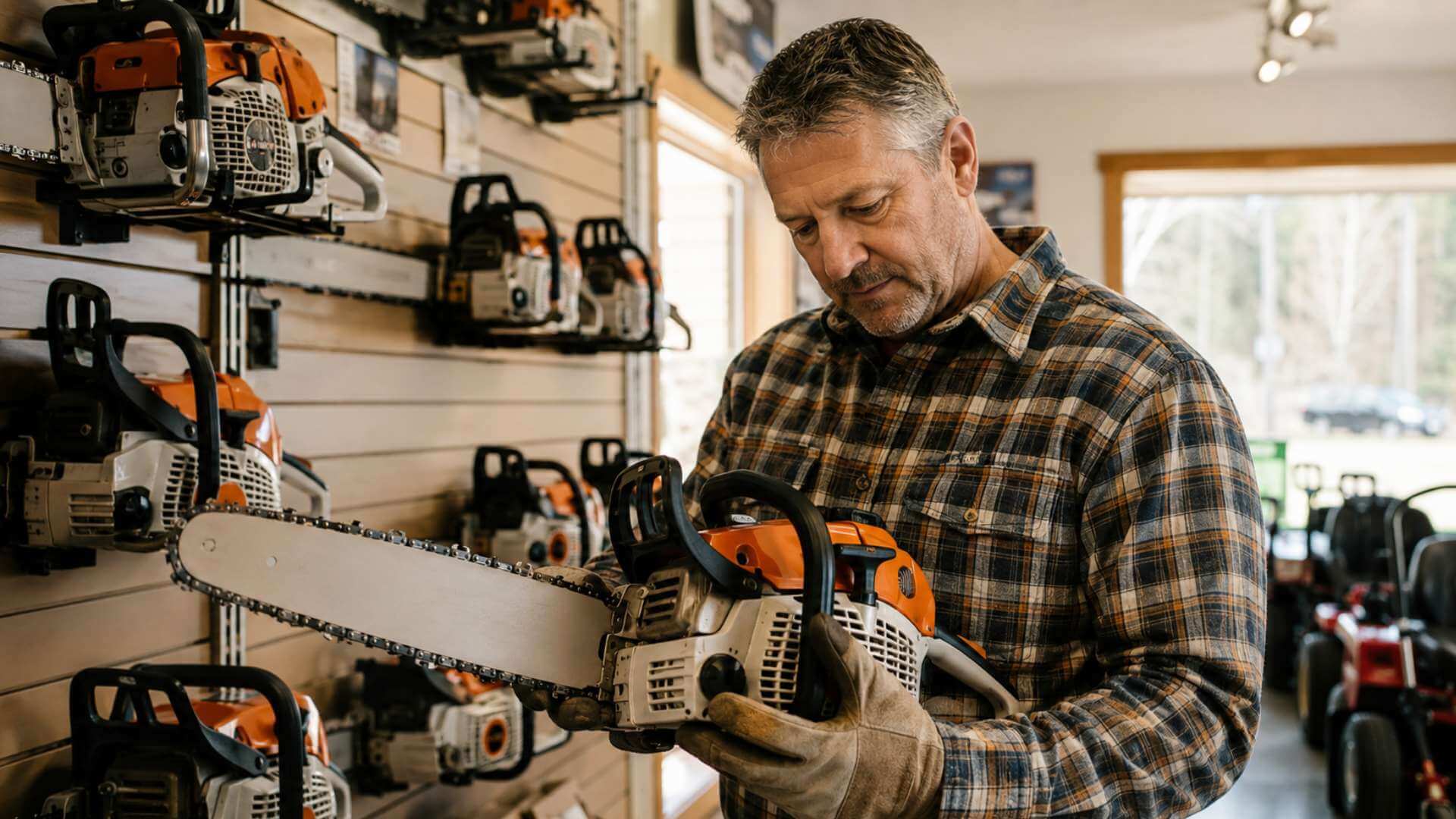
Buying a chainsaw without knowing what you need is an expensive mistake. Too small and the saw bogs down on anything bigger than a downed limb. Too large and you’re hauling unnecessary weight through every cut, all day. The right match comes down to three things: what you’re cutting, how often you’re cutting it, and what you’re comfortable running.
At Seacoast Power Equipment in North Hampton, we’ve been matching NH Seacoast homeowners, arborists, and commercial crews to the right chainsaw since 1965. This guide covers what you actually need to know before you buy.
What Are You Actually Cutting?
This is the question most people skip. They walk in and ask for “a good chainsaw” without thinking through what that saw is going to do. Before you look at a single model, be honest about your use case.
Occasional homeowner use means trimming branches after a storm, cutting up a downed tree a few times a year, and keeping a half-acre or acre property clear. You are not running this saw for hours at a stretch.
Regular property maintenance means you’re on larger land, dealing with wood lots, managing fallen trees, cutting firewood seasonally, or maintaining trails. This saw gets used hard, but not daily.
Professional arborist or commercial crew work means the saw is a tool you depend on to earn money. It runs most of the day. Downtime costs you. The bar is long, the engine is large, and reliability under load matters more than anything else.
Each of these use cases calls for a different saw. A homeowner chainsaw is not a professional chainsaw with a smaller engine. They’re different tools built to different tolerances, and buying the wrong tier costs you either in performance or in money spent on capability you’ll never use.
Bar Length: The Spec That Matters Most
Bar length determines how large a trunk you can cut in a single pass. The rule of thumb is simple: your bar should be at least 2 inches longer than the diameter of the wood you’re cutting most often. That gives the saw room to complete the cut without pinching.
For most NH homeowners managing downed limbs, smaller ornamental trees, and the occasional cleanup after a northeaster, a 14-inch to 16-inch bar is the right starting point. It’s maneuverable, lightweight, and handles the vast majority of residential cutting without strain.
Homeowners on larger properties (wooded lots, acreage with mature hardwoods, coastal estates with large ornamentals) typically need a 16-inch to 18-inch bar. That range handles most real-world New Hampshire property work comfortably: cutting up fallen oaks and maples, managing tree lines, and keeping land clear after storm damage.
Arborists, tree care crews, and anyone felling mature timber regularly work with 20-inch bars and longer. These configurations require a saw with the engine displacement to drive the chain through that much wood without stalling. Matching bar length to engine size matters: a small homeowner engine cannot safely run a 20-inch bar under load.
A note on bar length and kickback. Longer bars increase the potential kickback zone if the nose of the bar contacts wood unexpectedly. New chainsaw users, or anyone unfamiliar with a particular saw, should start with a shorter bar until they’re comfortable with the tool’s behavior.
Engine Size: What the Numbers Mean
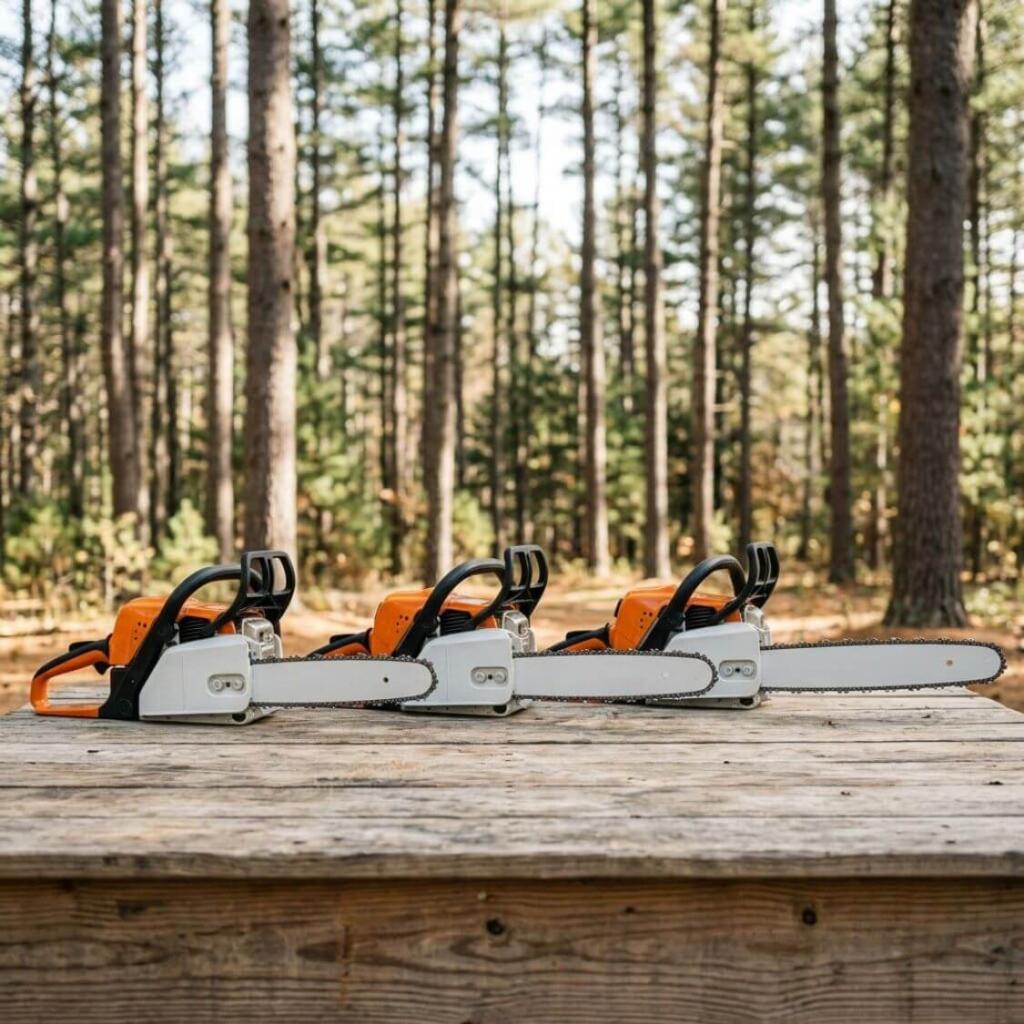
Chainsaw engine displacement is measured in cubic centimeters (cc). More displacement means more power, but it also means more weight, more fuel consumption, and a larger saw to handle. The right engine size tracks directly with the use case.
Homeowner saws are lightweight, easier to start, and built for occasional use rather than sustained daily work. Stihl’s MS 170 is the entry-level option in this class: a compact saw suited for light-duty downed limb work and basic property cleanup. The MS 251 Wood Boss steps up to mid-homeowner territory, designed for felling small trees, pruning, and cutting firewood.
Farm and estate saws, covering most serious homeowner and semi-professional work, run roughly 45cc to 60cc. The Stihl MS 271 Farm Boss is a well-known example in this class, built with extended run times and reduced emissions for property owners who use their saw regularly without going full professional. Husqvarna’s residential lineup, including the 120 Mark II at 38cc and the 135 Mark II at 38cc with a higher output, covers similar ground.
Professional saws start around 60cc and go up significantly from there. The Husqvarna 572 XP is a 70.6cc professional chainsaw built for forestry and tree care crews. It produces 5.8 hp and runs bars from 15 to 28 inches, with a weight of 14.5 lbs (powerhead only), a legitimate power-to-weight ratio that makes all-day use realistic. The Stihl MS 500i sits at the high end of professional saws: the first chainsaw with electronically controlled fuel injection, built exclusively for forestry crews and arborists doing full-day tree felling and large-diameter timber work.
Most NH homeowners do not need a professional saw. They need a well-matched mid-range saw that handles their actual property. The professional tier earns its price point for people who run it hard enough to justify it.
Gas vs. Battery: The Honest Trade-Off
Battery chainsaws have improved significantly. They’re not a novelty. But they’re not a replacement for gas in every application, either. Here’s where each fits.
Battery chainsaws make sense when:
- You’re doing light to medium cutting: limb trimming, small tree removal, occasional property cleanup
- Noise is a factor (noise-sensitive neighborhoods, proximity to homes, early morning arborist work)
- You already own Stihl battery-powered equipment on the AK or AP platform, and sharing batteries across tools has real value
- You want to avoid the cold-start headaches that plague gas saws sitting in storage for months
The Stihl MSA series battery chainsaws operate on the AK and AP battery platforms. If you own a Stihl string trimmer, blower, or hedge trimmer on either platform, your batteries work across tools. That shared ecosystem changes the cost math: you’re not buying a new battery system, you’re extending one you have.
Gas chainsaws make more sense when:
- You’re cutting for extended stretches (multiple tanks of fuel vs. one battery charge)
- You’re felling larger timber where chain speed and sustained torque under load matter
- You’re a commercial crew running a saw most of the day
- You need the longest bars available, which still require gas-powered displacement to run safely
The honest answer for most NH homeowners is that the battery works fine for the light end of what they do. If you’re also cutting firewood for the winter or dealing with significant storm cleanup on a larger property, a gas saw, properly maintained, is still the more capable tool for the heavy end of that work.
We carry both and can walk you through the specific trade-offs for your situation.
Stihl vs. Husqvarna vs. Echo: Matching Brand to Use Case
Seacoast Power Equipment carries Stihl, Husqvarna, and Echo chainsaws. Here’s how to think about each.
Stihl is the dominant brand for homeowners and professionals across New England. One important distinction: Stihl only sells through authorized dealers. You cannot buy genuine Stihl equipment at Home Depot, Lowe’s, or most online retailers. As an authorized Stihl dealer in North Hampton, we carry the full lineup and handle all Stihl warranty repairs on-site. No shipping equipment to a regional service center.
The Stihl lineup runs from the MS 170 at the entry homeowner level up through the MS 500i for professional forestry. The breadth of that range, combined with the availability of OEM chains, bars, and parts, makes Stihl the most serviceable brand we carry. When a chain wears out or a bar needs replacement, we stock it.
Husqvarna is particularly strong in the professional tier. The 572 XP is a respected pro saw with a genuine following among arborist crews. Husqvarna also offers a solid residential lineup for homeowners who prefer the brand. Their AutoTune technology automatically adjusts the engine’s fuel-air mixture, reducing the need for carburetor tuning, a practical advantage for saws that sit between uses.
Echo covers homeowners and light commercial users well. Echo’s CS series includes solid mid-range saws suited for property maintenance, storm cleanup, and seasonal firewood cutting. Echo is a reliable brand at accessible price points.
The brand that fits best is the one that matches your use case, comes with service support near you, and has a parts supply you can rely on. All three brands we carry meet that standard. Browse our Stihl equipment lineup or Husqvarna equipment to see current in-stock models.
Why Authorized Dealer Status Matters
This point is worth making clearly, because it affects every aspect of chainsaw ownership after the purchase.
Stihl does not sell through big-box stores or most online retailers. If you see Stihl on a major retail website, look closely. It’s likely a third-party reseller, potentially selling equipment without full manufacturer warranty support. Buying from an authorized Stihl dealer is your guarantee of a genuine product, a valid warranty, and on-site service.
Warranty service matters more than most buyers think at the point of purchase. A chainsaw that develops a carburetor issue, chain brake problem, or ignition fault under warranty needs to go to an authorized dealer for that repair to be covered. We handle Stihl warranty repairs in North Hampton with a typical 24 to 48 hour turnaround. We stock OEM Stihl chains, bars, filters, and carb kits for same-day parts availability.
For Husqvarna and Echo, authorized dealer status works the same way. Factory-trained technicians with the right service tooling and access to OEM parts produce better repair outcomes than a general small engine shop. We are authorized for all brands we carry.
The Try Before You Buy Advantage
Most people buy a chainsaw without ever picking it up. They go by the spec sheet and the price. That works reasonably well for a string trimmer. For a chainsaw, it matters that the saw actually fits you.
Balance, grip diameter, throttle feel, and starting effort all vary between models. A saw that feels natural and well-balanced is safer and easier to use. One that doesn’t fit your hands or feels front-heavy is fatiguing and increases the risk of user error.
Seacoast Power Equipment offers a Try Before You Buy program. For larger equipment, we can arrange a demonstration on your property before purchase. For chainsaws, come into the store: pick up the models you’re considering, check the balance, work the throttle trigger, and feel the difference between a 14-inch bar and a 16-inch bar in your hands. Our staff can match you to the right model based on what you’re cutting and how you cut it.
This is something no big-box store and no online retailer can offer. It’s the difference between buying a tool that works for you and buying one that works on paper.
What to Buy for Your Situation: A Practical Summary
You own a suburban or coastal NH property under an acre. Occasional storm cleanup, limb removal, and the odd small tree. A Stihl MS 170 or MS 251 with a 14-inch to 16-inch bar handles everything you’ll encounter. A battery is worth considering if you’re cutting infrequently and already own Stihl battery tools.
You manage a larger NH property with 2 to 5 acres of mature trees, a wood lot, or significant coastal vegetation. You need more saw dust. A mid-range gas saw in the 45cc to 55cc range with a 16-inch to 18-inch bar is the right tool. An Echo CS mid-range, a Stihl MS 271, or a Husqvarna residential model in this class will handle firewood, storm cleanup, and land management without being overkill.
You’re an arborist, commercial landscaper, or tree care professional in the NH Seacoast area. You need a professional-tier saw with the displacement and construction to run hard all day. The Husqvarna 572 XP, Stihl MS 500i, and similar professional models in those lineups are what you’re looking at. Come in and talk specifics: bar length, chain pitch, and power-to-weight ratio all factor into the right match for your work.
You’re semi-retired, safety-conscious, and want something that starts easily without fighting it. Battery chainsaws on Stihl’s AK platform are worth a serious look. They start with a trigger pull, produce no exhaust, and eliminate the cold-start ritual that frustrates occasional users. The trade-off is run time per charge and maximum cutting capacity. For light residential use, that trade-off is often the right one.
Pre-Season Service: Don’t Wait Until You Need It
One thing our factory-trained service team sees every summer: customers bringing in saws that have been sitting in a shed for a year and won’t start when storm cleanup calls for them. Stale fuel gums carburetors. Chains rust. Bar oil runs low or goes bad. These are preventable problems.
If your chainsaw has been sitting since last fall, now is the right time to bring it in for a pre-season check. We carry a full OEM parts inventory with $150,000+ in stock: chains, bars, filters, spark plugs, and carb kits. Our typical service turnaround is 24 to 48 hours. If you can’t bring the saw in yourself; we offer pickup and delivery throughout the NH seacoast and into southern Maine. Schedule service or request pickup and we’ll take it from there.
If you’re managing a property through peak storm season without a saw you trust, that’s the wrong time to find out it needs work.
For NH homeowners who’ve been thinking through their handheld equipment more broadly, our spring string trimmer maintenance guide covers similar preparation principles for trimmers and blowers. And if you’re thinking about the full picture of what storm season requires (including backup power), our generator maintenance guide is worth a read before hurricane season gets active.
Frequently Asked Questions
What bar length do most NH homeowners need?
Most residential properties in the NH seacoast area are well served by a 14-inch to 16-inch bar. If you’re regularly cutting downed trees larger than a foot in diameter or managing a wood lot, a 16-inch to 18-inch bar is a better fit.
Can I buy Stihl chainsaws at Home Depot or online?
No. Stihl sells exclusively through authorized dealers. Seacoast Power Equipment is an authorized Stihl dealer in North Hampton, NH. That means genuine product, valid warranty, and on-site service.
How do I know if my property needs a homeowner saw or a professional saw?
If you’re cutting more than a few times a year, dealing regularly with trees larger than 12 inches in diameter, or doing firewood production on a meaningful scale, you’re at the upper edge of homeowner use. Bring us a description of what you’re cutting and how often. We can match you to the right class.
Is a battery chainsaw powerful enough for storm cleanup?
For light to medium storm cleanup (branches, small fallen trees under 8 to 10 inches in diameter): yes. For significant storm response involving large hardwoods and multiple trees, a gas saw with appropriate displacement handles more volume per charge cycle and sustains cutting capacity over a longer work session.
What does chainsaw service typically cost, and how long does it take?
Service pricing varies by what’s needed. Our typical turnaround is 24 to 48 hours. We offer pickup and delivery across the NH seacoast and into southern Maine. Call us at (603) 964-8384 or use our contact page to schedule service.
Do you carry OEM chainsaw parts?
Yes. We carry $150,000+ in parts inventory, including OEM Stihl and Echo chains, bars, filters, spark plugs, and carb kits. If a part isn’t on the shelf, we can source it in 2 to 3 business days.
Seacoast Power Equipment is an authorized Stihl dealer serving North Hampton, Portsmouth, Hampton, Exeter, Dover, Rye, Kittery, and the broader NH seacoast region. Our factory-trained technicians service all chainsaw brands. Stop in or call (603) 964-8384. We’ll match you to the right saw for your property and make sure you have what you need before storm season gets busy.