
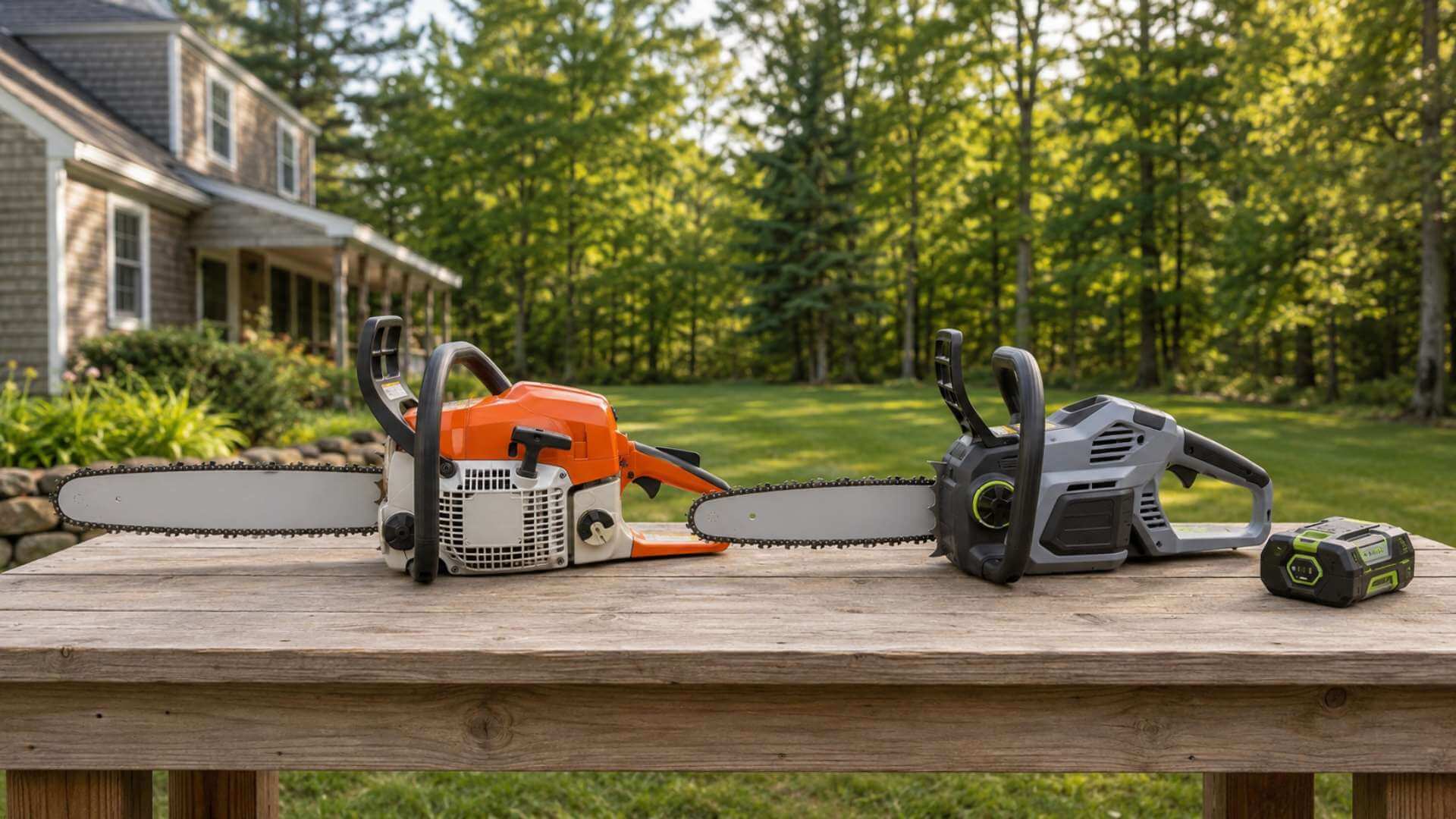
The battery chainsaw question comes up at our counter in North Hampton multiple times a week now. A few years ago, it was a niche conversation. Today, it is one of the most common buying decisions we help NH property owners work through.
The honest answer is not “gas is better” or “battery is the future.” Instead, it’s that each fits a real use case, and the buyers who get it wrong are usually the ones who picked based on principle rather than what they actually do with a chainsaw.
Here is what the decision actually comes down to.
What Battery Chainsaws Do Well Now
The technology has moved significantly. Battery chainsaws in 2026 are not the underpowered first-generation tools that reinforced skepticism about cordless cutting equipment. The Stihl MSA lineup, which runs on the AP Professional System, delivers real cutting performance for a wide range of residential and light professional work.
The MSA 220, running on Stihl’s AP Professional System, offers up to 40 minutes of runtime when paired with the AP 300 S battery. It features a brushless motor for fast acceleration and low maintenance, runs a 16-inch bar, produces zero exhaust emissions, and carries IPX4 weather-resistant construction. This is not a saw for occasional pruning only. It handles felling and limbing work at a level that replaces gas for many homeowner applications.
At the top of Stihl’s battery lineup, the MSA 300 C-O is described by Stihl as the most powerful battery chainsaw they make. It features a magnesium motor housing, mechanical and electronic chain brakes, an oil sensor, and a fleece air filter. It is certified by the American Green Zone Alliance for low-emission standards, which matters for properties, municipalities, and commercial operations with noise or emissions requirements.
For lighter homeowner use, Stihl’s AK battery system covers the MSA 60, MSA 70, and MSA 80: a family of saws for general yard maintenance and smaller limb work. The MSA 60, the lightest in the AK family, runs up to 40 minutes on the AK 20 battery and is built for homeowners doing regular but light property maintenance.
So what does battery do better than gas in real-world NH use?
Starts instantly, every time. Pull the trigger and the motor runs. There is no cold-start sequence, no primer bulb, no choke positioning, and no flooded carburetor from storing fuel over winter. For a homeowner who uses a chainsaw a few times a year, this matters more than any performance specification.
No exhaust, significantly less noise. In noise-sensitive neighborhoods, on managed estates where early morning work is expected, or in any situation where air quality and sound levels matter, battery wins outright. Gas chainsaws are loud tools. A battery saw running at the same bar speed is significantly quieter.
No fuel mixing, no ethanol risk, no storage decay. As covered in our chainsaw maintenance guide, ethanol-blended pump gasoline begins to degrade within 30 days and is one of the leading causes of carburetor problems. A battery saw eliminates this failure mode entirely. Charge it, store it, pick it up six months later, and it runs.
Battery ecosystem advantage. If you already own Stihl tools on the AP system (string trimmers, blowers, and hedge trimmers), a battery chainsaw on the same platform adds capability without adding a second battery system. One charger, one set of batteries, multiple tools. The total cost calculation changes significantly when you already have the batteries.
Where Gas Still Has the Advantage
Battery chainsaws have earned their place. Gas still has structural advantages that matter for specific buyers and use cases. These are not performance myths from reluctant adopters. They are real.
Extended cutting duration. A 40-minute runtime per charge works well for light homeowner use: one or two sessions of limb clearing, some firewood, and seasonal storm cleanup on a modest property. For a professional crew running a saw for most of the workday, 40 minutes is a problem. Gas chainsaws run as long as you have fuel, and refueling takes 90 seconds. Battery rotation on a professional site requires planning, extra batteries, and a charging strategy that adds logistical overhead.
Heavy timber cutting. The largest gas chainsaws, including the Stihl MS 500i and the Husqvarna 572 XP, run 60cc to 70cc and above with 20-inch to 28-inch bars. These are tools for felling mature hardwood timber, running extended bar lengths through large-diameter trunks, and sustained professional forestry work. The current battery lineup, including the MSA 300, does not match the top-tier gas saws in displacement-equivalent power for that category of work. For NH arborists taking down mature oaks and maples on coastal estates, gas professional saws remain the right tool.
Cold weather performance. Lithium-ion battery capacity drops in cold temperatures. A battery that delivers 40 minutes of runtime on a 70-degree July day may deliver noticeably less on a cold November morning. New Hampshire has a real fall and winter. If you are using a chainsaw for firewood production in October and November, which is one of the most common residential chainsaw use cases in the seacoast region, cold weather capacity reduction is a practical consideration. Gas performance in cold weather is more predictable, though cold starting requires proper technique.
Total cost for high-volume users. Battery systems involve an upfront investment in batteries and chargers that can exceed the cost of a comparable gas saw, particularly for buyers who need multiple batteries for extended runtime. For a homeowner who already has the batteries from other Stihl tools, that cost is largely absorbed. For a new buyer starting from scratch with heavy use requirements, the total investment can favor gas.
The NH-Specific Context: Coastal Property and Storm Season
New Hampshire’s seacoast properties create a specific set of chainsaw use patterns worth naming directly.
Coastal humidity and salt air. Gas chainsaws left with fuel in the tank in a damp coastal shed are particularly susceptible to carburetor varnishing and corrosion in fuel system components. Battery chainsaws have no fuel system to degrade. For coastal property owners whose saws live in a garage or shed within range of salt air, battery eliminates a real maintenance vulnerability.
Storm cleanup. The most intense chainsaw use most NH homeowners encounter is post-storm cleanup after a summer northeaster or early fall hurricane. These events typically involve multiple trees, extended cutting across a full day, and unpredictable access to power for recharging. A single battery charge may not cover a significant storm response. For the homeowner whose primary use case is storm cleanup on a larger property, a gas saw that is maintained properly and ready to run is the more reliable emergency tool. The battery works well as a complement: use gas for the heavy initial work and the battery for the follow-up limb clearing when noise matters and the urgency is lower.
Property size. An acre or under, with light to moderate cutting and occasional use: battery is a serious option. Two to five acres with significant wooded areas, regular firewood production, or professional property management work: gas or a gas-battery combination fits better.
The Battery Ecosystem Decision
If you already own Stihl tools on the AP Professional System, the battery chainsaw decision is simpler than it looks. The AP 300 S battery that pairs with the MSA 220 is the same battery that powers AP-compatible string trimmers, blowers, hedge trimmers, and pole pruners. You have already bought into the ecosystem. Adding a chainsaw means adding one tool, not an entirely new battery investment.
If you own Stihl tools on the AK homeowner system, the lighter platform covering the MSA 60/70/80 family and AK-compatible trimmers and blowers, a homeowner battery chainsaw on the same platform extends the same logic.
For buyers who do not own any Stihl battery equipment yet and are starting from scratch, the ecosystem case is weaker. The battery and charger add cost on top of the tool-only price. That investment makes more sense when it covers multiple tools rather than a single chainsaw.
We carry both the AK and AP battery system tools at Seacoast Power in North Hampton and can match the right platform to your existing equipment before you buy.
Side-by-Side: Who Should Choose Which
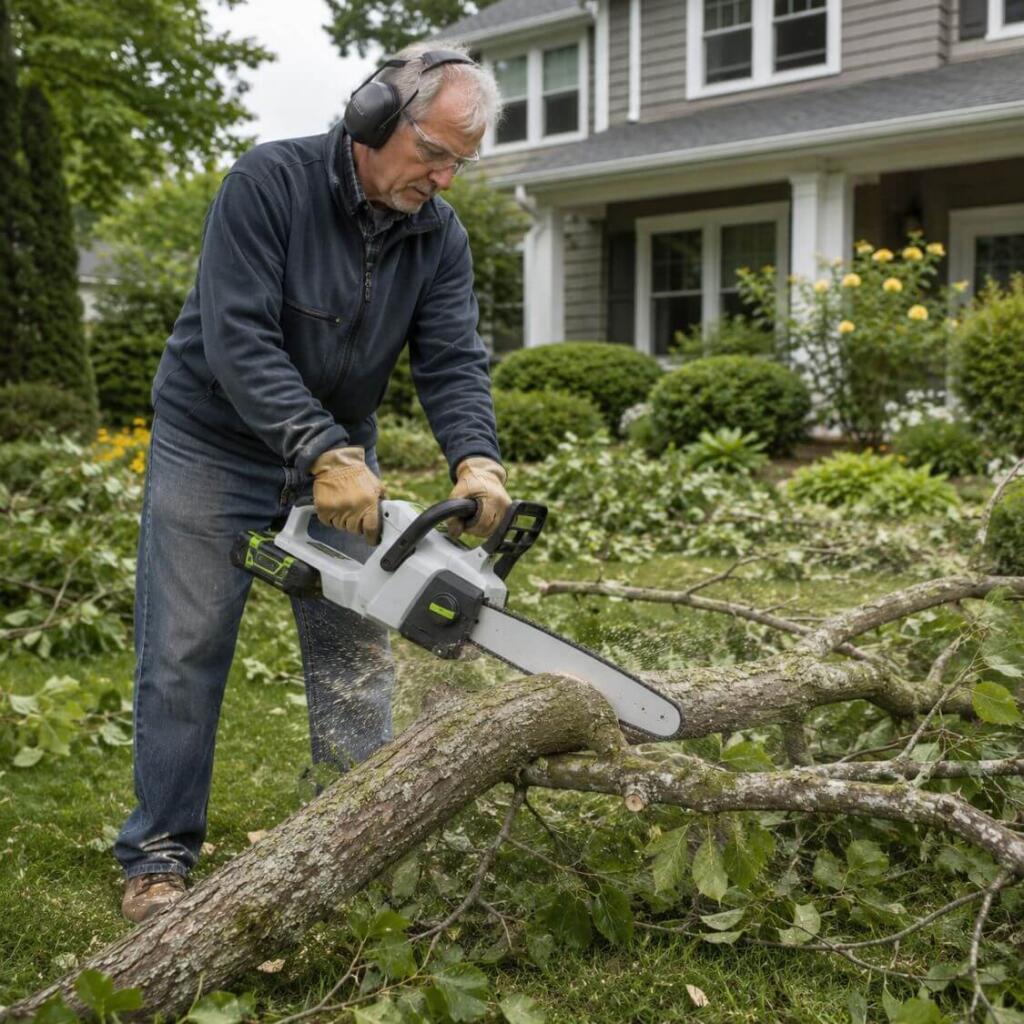
This is not a universal recommendation. It is a use-case map.
Battery chainsaw fits you if:
You use a chainsaw a few times a year for property cleanup, occasional limb removal, and light cutting. The instant-start, no-fuel convenience makes the saw more likely to get used rather than sitting in the shed because starting it feels like work.
You own other Stihl battery tools on the AK or AP platform and want to add a chainsaw to that system without a new battery investment.
You work in noise-sensitive environments: a managed estate, a residential neighborhood, or an early-morning property where gas chainsaw noise creates problems.
You are concerned about carb-gumming and fuel decay because the saw sits for months between uses. Battery eliminates this failure mode.
You do light-to-medium residential cutting: limbing, small felling, modest firewood, and storm cleanup on a property under an acre. The MSA 220 handles this work comfortably.
Gas chainsaw fits you if:
You run a saw for extended periods, half a day or more, and need to keep cutting without managing battery rotation.
You are felling mature timber, running bars over 18 inches, or doing the kind of sustained professional work where gas displacement still sets the ceiling on cutting capacity.
You need storm cleanup capability on a larger property where a single battery charge may not cover the work and there is no guarantee of charging access.
You are a commercial landscaping or arborist crew running multiple saws and need the flexibility of refueling in the field without charging infrastructure.
Cold-weather use in October through December, firewood season in New Hampshire, is a regular part of your cutting schedule.
Both makes sense if:
You manage a larger property, run a professional crew, or have a combination of light and heavy cutting needs. Many serious NH property owners run a gas saw for primary felling and heavy timber and a battery saw for limb clearing, cleanup work, and anything where noise and exhaust are factors. This is not redundancy. It is the right tool for the right job.
A Straight Answer on “Is Battery Worth It?”
For the NH homeowner with a modest property, occasional cutting needs, and other Stihl battery tools already in the shed: yes. Battery is worth it. The convenience advantage is real, the maintenance simplicity is real, and the cutting performance for light to medium residential work is now fully capable.
For the professional arborist crew, the estate caretaker with significant annual felling work, or the property owner running a saw through peak storm season on a large wooded lot, gas is still the primary tool. Battery may complement it. It does not replace it.
For everyone else, which is most buyers, the right answer comes from an honest look at how often you cut, how long you cut each session, and whether you already have the battery ecosystem that makes battery chainsaws economically sensible.
Come into the shop and we’ll put both in your hands. Our factory-trained technicians have been matching NH seacoast customers to the right equipment since 1965, and this particular decision is one we can help you make in about ten minutes.
Frequently Asked Questions
Is a Stihl battery chainsaw powerful enough for real cutting work?
The MSA 220, on the AP Professional System, handles felling and limbing with a 16-inch bar and up to 40 minutes of runtime on the AP 300 S battery. For light to medium residential cutting, yes. For extended professional use or heavy timber, gas still sets the ceiling on sustained performance.
How long does a battery chainsaw last per charge?
The Stihl MSA 220 delivers up to 40 minutes of runtime with the AP 300 S battery. The MSA 60 (AK system) delivers up to 40 minutes with the AK 20 battery. Runtime varies based on battery charge level, wood species, bar length, and cutting technique. Heavy hardwood cutting drains batteries faster than limbing softwood.
Can I use my existing Stihl AP battery tools with a Stihl battery chainsaw?
If your existing tools run on the AP Professional System, yes. AP batteries are compatible across the AP tool family. AK system batteries work with AK system tools. The two platforms are not cross-compatible. We can confirm compatibility with your existing equipment before you buy.
Does cold weather affect battery chainsaw performance?
Yes. Lithium-ion battery capacity decreases in cold temperatures. For fall and winter cutting, firewood season in New Hampshire, gas chainsaws deliver more consistent performance across temperature ranges. Battery is best suited to spring, summer, and early fall use for most NH applications.
Do battery chainsaws require the same chain maintenance as gas saws?
Yes. Chain sharpening, tension adjustment, and bar care are the same regardless of power source. The battery chainsaw also requires bar oil in the same way a gas saw does. The automatic oiler system functions identically. What a battery eliminates is fuel mixing, carburetor maintenance, and cold-start procedures.
Can a battery chainsaw handle NH storm cleanup?
For light to moderate storm cleanup on a smaller property (branches, limbs, trees under 12 inches in diameter), yes. For significant storm response involving multiple large trees across a larger property, a gas saw provides more sustained cutting capacity and no dependency on charging access. Many property owners use both.
Seacoast Power Equipment is an authorized Stihl dealer in North Hampton, NH, carrying both gas and battery chainsaw options for homeowners, arborists, and commercial crews across the NH seacoast, southern Maine, and northern Massachusetts. Our factory-trained technicians service all brands with a typical 24- to 48-hour turnaround.