
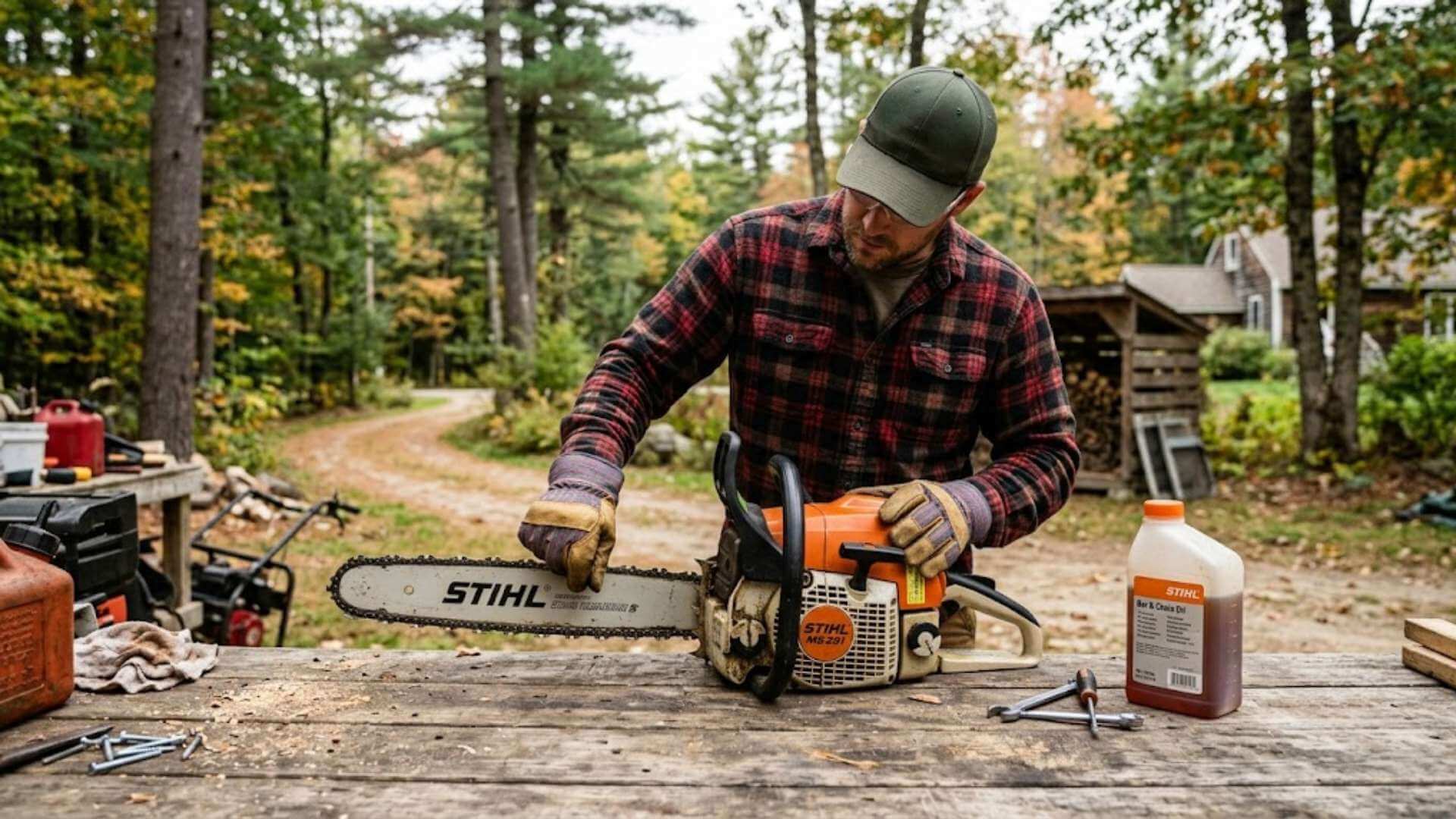
July is when New Hampshire chainsaw problems show up. A saw that sat through spring while you were running the mower gets pulled out for the first summer storm cleanup. Then it doesn’t start, cuts crooked, or bogs down halfway through a log. These are not mechanical failures. They’re maintenance gaps. Most of them are preventable.
This guide covers what every NH property owner should know about keeping a chainsaw in working condition through peak cutting season. Some of it you can do yourself. Some of it belongs in the service department. Knowing which is which saves you time, money, and a lot of frustration.
The Four Things That Fail First
Before getting into specific procedures, it helps to know what goes wrong most often. Our factory-trained technicians at Seacoast Power Equipment have been servicing chainsaws in North Hampton since 1965. The same four issues come in the door repeatedly.
Dull chain. The most common and the most overlooked. A dull chain doesn’t just cut slowly. It makes the engine work harder, generates more heat, puts more strain on the bar, and dramatically increases the physical effort required from the operator. Most homeowners run a dull chain far longer than they should.
Fuel and carburetor problems. Gas that has been sitting in the saw since last fall breaks down. Ethanol in pump gasoline absorbs moisture and separates over time, leaving a varnish residue in the carburetor and fuel lines. This is the leading cause of chainsaws that won’t start after sitting in storage.
Bar oil problems. Running a chainsaw without adequate bar oil destroys the bar rail and chain sprocket faster than almost any other single failure. It is also among the most overlooked items during a cutting session.
Air filter neglect. Chainsaws operate in dusty, debris-heavy environments. A clogged air filter chokes the engine, reduces power, raises operating temperature, and over time can allow fine particles to reach the cylinder and damage piston rings.
Everything else in this guide flows from keeping these four things in check.
Chain Maintenance: Sharpening, Tension, and Knowing When to Replace
Signs your chain needs sharpening
A properly sharpened chain produces large, uniform chips, not fine dust. According to Stihl’s maintenance guidance, when your saw starts producing finer sawdust instead of chips, it’s time to sharpen. Other clear signals: smoke coming from the cut despite adequate chain lubrication and correct tension, and the saw pulling noticeably to one side during cutting, which typically means one side of the chain is dull or has teeth filed to uneven lengths.
A dull chain also requires noticeably more downward pressure from the operator. A sharp chain on a properly matched saw feeds itself through the wood. When you’re pushing rather than guiding, the chain needs attention.
How to sharpen a chainsaw chain
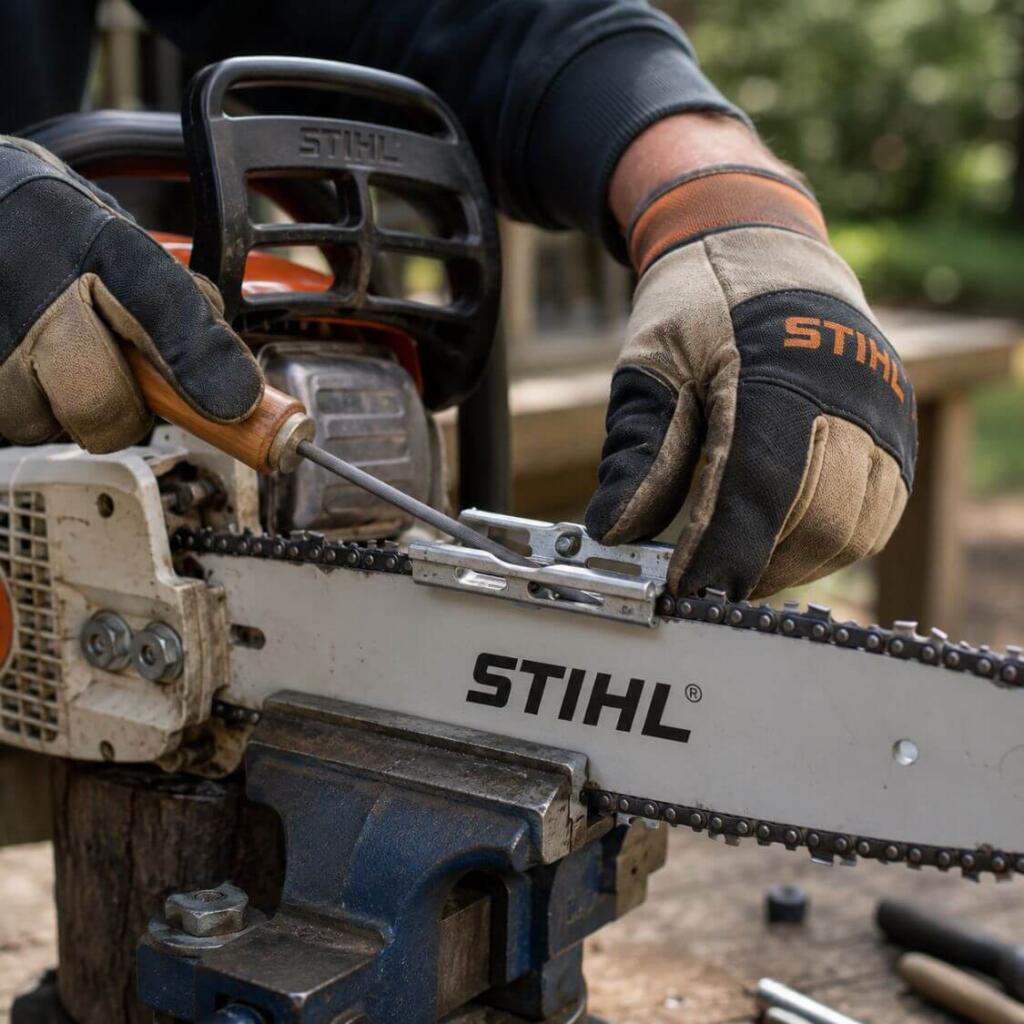
Manual sharpening uses a round file matched to your chain’s pitch. Stihl recommends their 2-in-1 Filing Guide, which sharpens cutters and resets depth gauges in a single tool. The depth gauge height is as important as cutter sharpness, and letting it drop too low increases kickback risk.
The process: engage the chain brake, clamp the bar in a bench or stump vise (not clamping the chain itself), identify the most worn tooth as your reference, and file in forward strokes only at a 90-degree angle to the guide rail with one-quarter of the file diameter protruding above the tooth. File all teeth to the same length as your reference tooth, then turn the saw and repeat for the other side.
For property owners who use their saw occasionally, sharpening once per season or when the sawdust signal appears is usually sufficient. For professional crews cutting daily, touching up the chain at every refueling stop is the right cadence. Stihl recommends frequent filing as part of regular maintenance, and the few minutes it takes pays back in cutting speed and engine longevity.
If you notice the wear indicator on any tooth has been reached (the small mark etched into the cutter), replace the chain rather than sharpening. Filing past the wear marker removes the hardened outer steel and accelerates deterioration of everything that follows.
Chain tension
Chain tension should be checked before each use and again when the chain heats up during extended cutting. The chain should sit snug against the bottom of the guide bar rail but still move by hand with light resistance. It should snap back against the bar when pulled down slightly. A loose chain can derail. An overtightened chain puts excess stress on the bar nose, drive sprocket, and engine. A chain tightened while hot will over-tighten as it cools.
Adjust tension with the saw-off and cool down. Always check tension after the first few cuts on a new chain, as new chains stretch slightly during break-in.
Bar Care: The Maintenance Step Most People Skip
The guide bar takes significant abuse on both rails, particularly on the underside where most cutting occurs. Skipping bar maintenance accelerates rail groove wear, causes uneven chain wear, and eventually makes straight cuts impossible.
Rotating the bar. Flip the guide bar upside down every time you change the chain or sharpen. This distributes wear evenly across both rail edges. Most bars that wear out prematurely never got rotated.
Cleaning the bar groove and oil ports. Sawdust and debris pack into the bar groove and can block the oil inlet ports that feed chain lubrication. Clean both with a thin tool (a flat screwdriver tip or a dedicated bar groove cleaner) before reinstalling the chain. A blocked oil port means the chain runs dry even when the oil tank is full.
Filing bar rails. Over time, the guide bar rails develop burrs from chain contact. A few strokes of a flat file along the rails smooths them out and helps the chain track straight. This takes two minutes and meaningfully extends bar life.
When to replace the bar. If the bar groove has widened to the point where the chain side links move laterally with play, if the rail edges are visibly rounded rather than square, or if there is a noticeable bow to the bar, it is time for replacement. We stock OEM bars for Stihl and Echo at Seacoast Power, and the $150,000+ parts inventory means we typically have what you need the same day.
Bar and Chain Oil: The One You Can’t Skip
Bar and chain oil is consumed continuously during cutting. The automatic oiler pumps it to the chain while the engine runs. Running out mid-cut is one of the fastest ways to damage a bar and chain.
Check the bar oil level before every use. If the oil tank drains much faster than the fuel tank, the oiler rate may need adjustment (most professional-grade saws have an adjustable oiler). If bar oil seems to be escaping through the bar groove but the chain still feels dry, the oil port may be blocked.
Use dedicated bar and chain oil: not motor oil, not vegetable oil, not whatever is available. Bar and chain oil is formulated to adhere to a fast-moving chain and provide consistent film lubrication across the contact surfaces. Motor oil is too thin and sheds off. Using the wrong oil accelerates wear on both the chain and bar rail.
A quick field test for oiler function: Hold the running saw a few inches above a light-colored surface like a stump or piece of plywood, rev the engine briefly, and look for a light oil spray line on the surface. If you don’t see it, check the oil level first, then check whether the oil port is blocked.
Air Filter: How Often, and What to Look For
The air filter protects the engine from the sawdust, bark fragments, and grit that fill the air during cutting. In heavy cutting conditions (dry hardwoods, bark-heavy timber, post-storm debris), filters clog faster than in lighter use.
Clean the air filter after every few uses, or any time cutting performance drops without an obvious chain or fuel cause. Stihl’s pre-separation system on models like the MS 271 extends filter cleaning intervals by spinning larger particles out of the air stream before they reach the filter, but the filter itself still needs periodic cleaning.
Cleaning method: remove the filter cover, take out the filter element, and tap it gently to dislodge loose debris. For foam filters, wash in warm soapy water, rinse, and allow to dry completely before reinstalling. A wet filter restricts airflow nearly as much as a clogged one. For paper elements, tap clean and inspect for tears or heavy soiling. A torn filter should be replaced, not cleaned.
If you’re seeing a pattern of frequent filter clogging, check that the filter housing seal is intact and that no debris pathways have opened around the filter housing.
Fuel System: Where Seasonal Problems Start
More chainsaws come into our service department with fuel-related starting and running problems than any other single cause. Almost all of them involve one of three things: stale fuel, incorrect fuel mix ratio, or ethanol damage.
Stale fuel. Pumped gasoline begins to degrade within 30 days. The lighter volatile compounds evaporate, leaving heavier residues that varnish carburetors and clog fuel lines. If your saw sat from October to July without the fuel being drained or stabilized, the carburetor is likely gummed. Fresh fuel alone won’t fix this. The varnish residue requires cleaning.
Stihl recommends that for any unit left unused for more than 30 days, the fuel tank should be emptied and the engine run until all remaining fuel is consumed and it stops. This removes all fuel from the system (tank, fuel lines, and carburetor) before storage.
Fuel mix ratio. Gas-powered chainsaws run two-stroke engines that require a gasoline and two-stroke oil mix. Most modern chainsaws, including the Stihl and Echo models we carry, run at 50:1 (50 parts gasoline to 1 part two-stroke oil). Using straight gasoline without oil will destroy the engine. Using the wrong ratio causes either oil fouling (too rich) or scoring damage (too lean). Always verify your saw’s required ratio in the operator’s manual.
Ethanol. Standard pump gasoline in the US may contain up to 10% ethanol (E10). Stihl recommends using fuel with no more than 10% ethanol content, and explicitly warns that using fuel with greater than 10% ethanol content, including E15 or E85, can cause damage and void the warranty. Echo carries the same guidance. If you have access to non-ethanol premium fuel, it is the better choice for any small engine that will sit between uses.
Premixed fuels like Stihl MotoMix or Echo Red Armor are ethanol-free, pre-mixed at the correct ratio, and shelf-stable for up to two years. For a chainsaw used seasonally, the convenience and shelf life are worth the price premium over mixing your own from pump gas.
Carburetor Symptoms: What You Can Address vs. What Needs a Technician
The carburetor is where most running problems originate after a period of storage. Knowing what the symptoms indicate helps you decide whether a fix is within reach or whether the saw belongs in the service department.
Symptoms a careful owner can address:
A saw that is hard to start after sitting but eventually runs well once warmed up is often a fuel freshness issue. Drain the tank, add fresh premixed fuel, and attempt starting again. If it resolves, the carburetor itself is likely fine.
A saw with a dirty air filter that runs rich (black smoke, rough idle, poor throttle response) improves after filter cleaning. This is a maintenance item, not a carburetor problem.
Symptoms that need professional service:
A saw that starts but won’t hold idle, surges at idle, or dies immediately when the throttle is released has a carburetor adjustment or internal contamination issue. This requires the right tools and knowledge to address correctly. Incorrect carburetor adjustment creates running problems and can damage the engine.
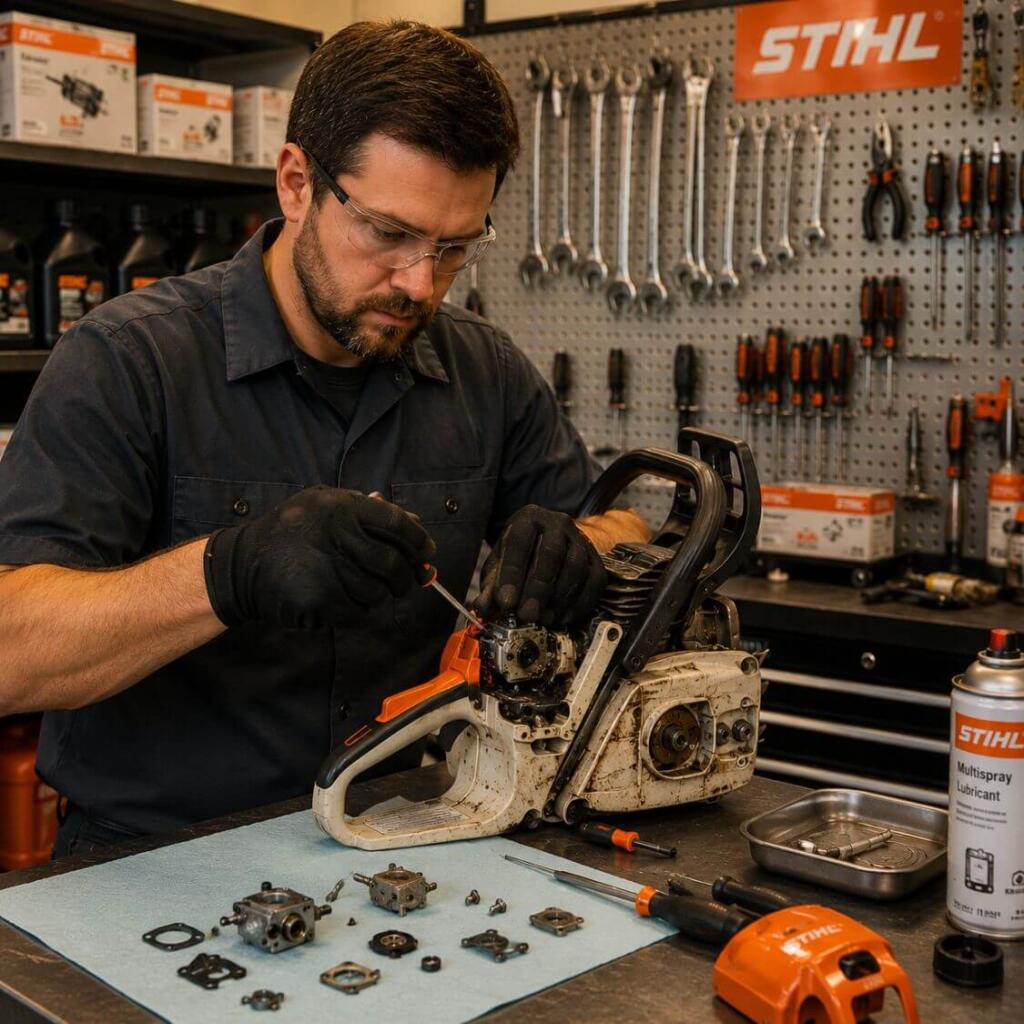
A saw with varnish residue from stale fuel sitting in the carburetor passages needs disassembly and cleaning that goes beyond what a homeowner can reliably do with compressed air and a can of carb cleaner. A proper carburetor cleaning at a service department involves removing and cleaning the needle valves, diaphragm, and cover plate, inspecting the diaphragm for deterioration, and verifying that all passages are clear.
A saw that leaks fuel from the carburetor has a failed diaphragm or needle valve seal. This is a parts replacement job.
Our factory-trained technicians service chainsaws for all brands with a typical 24- to 48-hour turnaround. We stock OEM carburetor rebuild kits for Stihl and Echo in our $150,000+ parts inventory, which means most carburetor repairs don’t require waiting on parts. If you can’t bring the saw in, pickup and delivery are available across the NH seacoast and into southern Maine.
Spark Plug: Simple, Overlooked, Important
The spark plug is a small part with an outsized effect on starting reliability and running quality. A fouled or worn spark plug causes hard starts, rough running, and misfires.
Inspect the spark plug seasonally: at minimum once per year, more often for saws running heavy work loads. Look at the electrode and ceramic insulator. A light tan or gray color is normal. Black sooty deposits indicate a rich fuel mixture (too much oil or a choked carburetor). White or blistered ceramic indicates running lean or overheating. Oil fouling (wet, oily deposits) can indicate a fuel mix ratio problem or a failing diaphragm.
Clean a fouled plug with a wire brush if the condition is mild. Replace when the electrode shows visible erosion, the gap has widened beyond spec, or the ceramic is cracked. Spark plugs are a consumable. A fresh plug costs a few dollars and eliminates one of the most common starting failure points.
Pre-Season Service: Don’t Wait Until You Need It
The pattern our service department sees every year: a homeowner pulls a saw out of storage for the first serious storm of summer, it doesn’t run, and they bring it in during the busiest service period of the season.
The smarter approach is pre-season service before peak cutting time. Now, in July, before the heavy storm months of August and September, is the right window. That means fresh fuel or a flushed system, a cleaned air filter, a sharpened chain, a bar groove cleaned and oiled, and a spark plug inspected.
If the saw hasn’t run well in over a year, a carburetor cleanout is worth doing before you need it, not during a storm cleanup when turnaround time is under pressure.
We offer pickup and delivery for customers who can’t transport equipment. Call (603) 964-8384 to schedule or bring the saw in directly to our North Hampton shop.
For NH property owners thinking about full storm-season preparation, our generator maintenance guide covers backup power readiness on the same timeline. If your handheld equipment (string trimmers, blowers) needs the same pre-season attention, the preparation principles are covered in our spring trimmer maintenance checklist.
Frequently Asked Questions
How often should I sharpen my chainsaw chain?
When cutting produces fine sawdust instead of chips, or when you notice smoke from the cut despite proper lubrication and tension, the chain needs sharpening. For occasional homeowners, once per season is typically adequate. For professional crews, touching up the chain at each refueling stop is the right approach.
Can I use motor oil as bar and chain oil?
No. Bar and chain oil is formulated to adhere to a fast-moving chain and provide film lubrication under high-speed contact conditions. Motor oil is too thin for this application and sheds off quickly, leaving the chain and bar rail running dry. Use dedicated bar and chain oil.
What fuel mix ratio do most chainsaws require?
Most modern gas-powered chainsaws, including the Stihl and Echo models we carry, run at 50:1 (50 parts gasoline to 1 part two-stroke oil). Always verify in your saw’s operator’s manual, as some older models use different ratios.
My chainsaw starts but immediately dies. What’s wrong?
This is typically a carburetor issue: either contamination from stale fuel, an adjustment problem, or a failed diaphragm. Start by checking that the fuel is fresh and at the correct mix ratio. If fresh fuel doesn’t resolve it, the carburetor likely needs professional cleaning or parts. Our service department handles this with a typical 24- to 48-hour turnaround.
How do I know when to replace the bar vs. just flipping it?
Flip the bar at every chain change to distribute wear evenly. Replace the bar when the rail groove shows visible widening (chain side links have lateral play), the rail edges are rounded rather than square, or the bar is visibly bowed. We stock OEM bars for Stihl and Echo and can advise on the right replacement at the counter.
Do you service chainsaws for brands other than what you sell?
Yes. Our factory-trained technicians service all makes and models, not just the brands we carry. The 24 to 48 hour turnaround applies regardless of brand.
How do I store a chainsaw for an extended period?
Drain the fuel tank and run the engine until it stops. This removes fuel from the tank, lines, and carburetor. Clean the bar groove and coat the chain with bar oil to prevent rust. Store in a dry location away from moisture and temperature extremes.
Seacoast Power Equipment is an authorized Stihl and Echo dealer in North Hampton, NH, serving the NH seacoast, southern Maine, and northern Massachusetts. Our factory-trained technicians service all chainsaw brands with a typical 24- to 48-hour turnaround. We carry $150,000+ in parts inventory, including OEM chains, bars, filters, spark plugs, and carburetor kits. Pickup and delivery available throughout the seacoast region.