
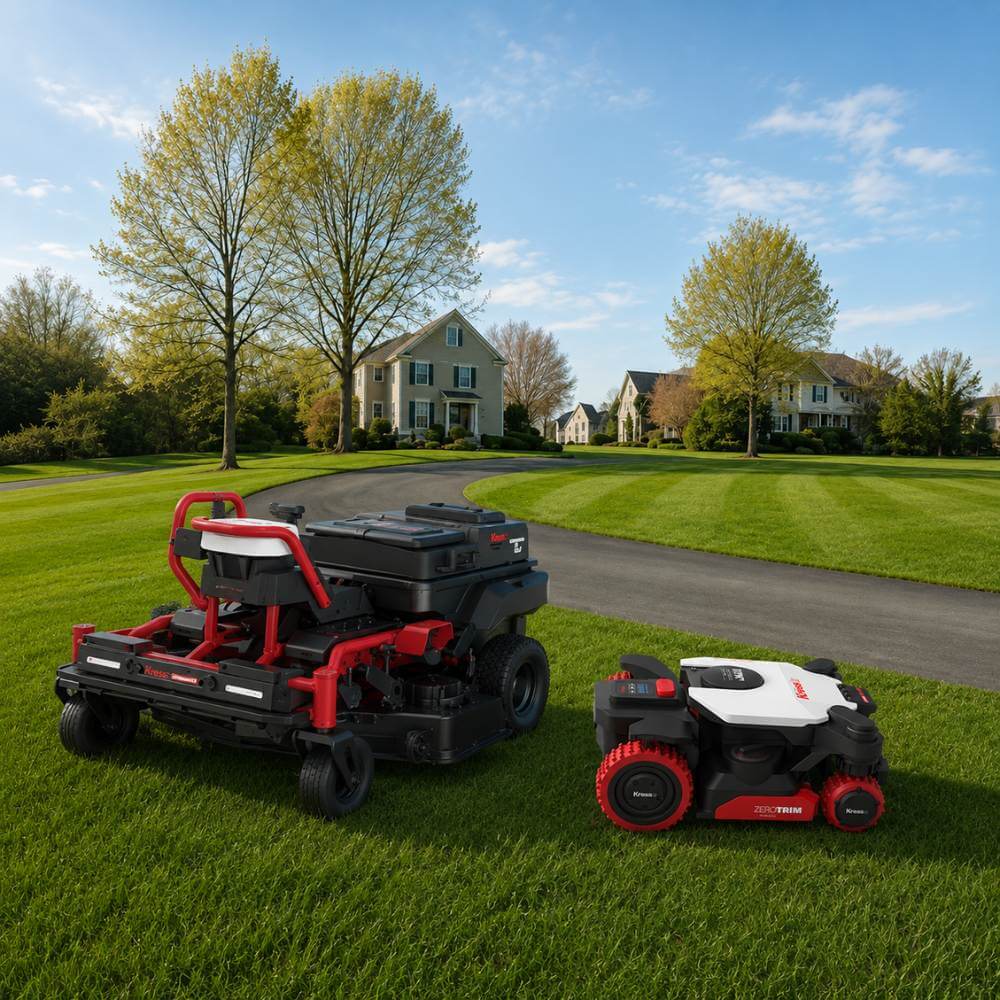
Kress robotic mowers stand out in a crowded field for one reason: Vision AI optical navigation. It is a technology most robotic mowers do not have, and on New Hampshire properties with heavy tree cover and GPS-challenging terrain, it makes a real difference. If you are trying to decide between Kress models (or whether Kress is right for your property at all), this guide covers what you need to know.
The EyePilot residential lineup consists of three models (KR282, KR284, and KR286) differentiated purely by coverage capacity. All three share identical drivetrain, navigation, and terrain-handling specifications. The Voyager sits in a completely different category: a $60,000 commercial autonomous mower built for professional landscaping operations, not residential properties.
The matching decision is straightforward for residential buyers: pick the model that covers your acreage. For commercial operators evaluating Voyager, the calculation shifts to labor replacement economics and multi-property route operations.
We’ve spent nearly 60 years matching seacoast property owners with the right equipment for their specific terrain and operational needs. Kress represents newer technology in our robotics lineup, but the matching process remains the same: property size, terrain complexity, and use case determine which model works. This guide covers the complete US Kress lineup so you know exactly which option fits your situation.
Best Time to Buy: If you are considering a robotic mower for spring, order between January and March for pre-season installation. Our factory-trained technicians handle setup, boundary mapping, and system programming with every Kress purchase.
Understanding Vision AI Technology: What Sets Kress Apart
Before comparing individual models, here’s what distinguishes Kress from GPS-only robotic mowers:
Vision AI Optical Navigation Traditional robotic mowers rely exclusively on RTK GPS satellite positioning. Kress adds Vision AI: onboard cameras that recognize the environment visually. The mower “sees” landmarks, obstacles, and terrain features and then uses that visual data alongside GPS to navigate.
This matters on New Hampshire properties where GPS signals degrade. Under heavy tree canopy, near buildings, or in areas with weak satellite visibility, GPS-only systems lose accuracy. Vision AI maintains reliable positioning by switching to visual navigation when the satellite signal weakens.
RTKⁿ Satellite Positioning All Kress models use RTKⁿ (Real-Time Kinematic with network correction). The “ⁿ” indicates network-delivered correction data. No physical base station or antenna required on your property. Correction signals arrive over integrated 4G, delivering centimeter-level positioning accuracy without added hardware.
V-SLAM Technology V-SLAM (Visual Simultaneous Localization and Mapping) lets the mower build visual maps of your property as it operates. It recognizes objects, remembers their locations, and uses that information for navigation even when GPS is unavailable. This technology keeps Kress mowers operating reliably in challenging GPS environments where competitors struggle.
No Boundary Wire Required Like other premium robotic mowers, Kress systems don’t need buried perimeter wire. You define boundaries through mapping (either guided walk or autonomous mapping), then refine them in the app. No trenching, no wire installation, no annual wire maintenance.
Those are the shared foundations across all Kress EyePilot models. Now the specifications.
Kress EyePilot 4×4 Residential Lineup: Three Models, Identical Technology
The US EyePilot lineup consists of three models differentiated only by coverage capacity. All three share identical drivetrains, navigation, terrain capabilities, and feature sets.
Complete EyePilot 4×4 Specifications (All Three Models)
Navigation & Technology:
- RTKⁿ satellite positioning with Vision AI
- V-SLAM (Visual Simultaneous Localization and Mapping)
- Vision-based lawn mapping (wire-free setup)
- Obstacle-aware navigation with intelligent object avoidance
- Integrated 4G connectivity (all models include 4G standard)
- WiFi/Bluetooth capability
- Over-the-air software updates
Drive System & Terrain:
- Four-wheel drive (4WD) with four-motor drivetrain
- Articulated body geometry
- Independent axles maintaining ground contact across uneven terrain
- Front-wheel steering (smooth turns without turf damage)
- Real-time torque control to each wheel independently
- Maximum slope capability: 84% (≈40°)
- Vertical obstacle clearance: 2.4 inches (6 cm)
- Self-leveling cutting system maintaining consistent cut height across slopes
Cutting Performance:
- ZeroTrim edge cutting system (cuts precisely to lawn edges)
- Cutting width: 8.7 inches (22 cm)
- Cutting height: 1.57-3.54 inches (40-90 mm)
- Cutting height adjustment: Electric with 4,090 steps (digitally adjustable per zone)
- Number of cutting blades: 3
- Cutting methods: Logic (structured paths for stripes or random for natural finish)
- Self-leveling blade disc
- Handles thick and overgrown grass reliably
Battery & Performance:
- Battery capacity: 6 Ah
- Battery voltage: 20V
- Charging current: 3A
- Sound level: 62 dB (quieter than conversation)
- Weight: 41.45 lbs (18.8 kg)
- Water protection: IPX6 (hose-cleanable)
- Front LED lights for low-light operation
Connectivity & Security:
- Kress app integration for iOS/Android
- Fleet management ready
- GPS tracking / anti-theft location monitoring
- PIN code security
- Auto-lock when lifted
- Lift sensor
- Multi-zone management with precise routing between areas
- Digital zone height configuration
The Three Models: Coverage Capacity Only
KR282 Specifications:
- Coverage: 0.5 acres (2,000 m²) per 24-hour cycle
- Price: $2,999.99
- Best For: Properties up to half an acre with challenging terrain requiring 4WD capability
KR284 Specifications:
- Coverage: 1.0 acres (4,000 m²) per 24-hour cycle
- Price: $3,599.99
- Best For: Properties up to one acre with steep slopes or complex terrain
KR286 Specifications:
- Coverage: 1.5 acres (6,000 m²) per 24-hour cycle
- Price: $4,299.99
- Best For: Properties up to 1.5 acres requiring maximum residential EyePilot coverage
The three models are mechanically identical. The coverage capacity difference comes from battery runtime and mowing efficiency optimizations. All three handle the same slopes (84%), the same obstacles (2.4″ clearance), and the same terrain challenges (articulated 4WD).
EyePilot Model Selection: Match to Your Acreage
The decision is straightforward:
For 0.5-Acre Properties: Choose KR282. Covers your property in one 24-hour cycle with full 4WD terrain capability. $2,999.99
For 1.0-Acre Properties: Choose KR284. Completes your property in one 24-hour cycle with the same 4WD capability as the smaller model. $3,599.99
For 1.5-Acre Properties: Choose KR286. Maximum residential EyePilot coverage with the same technology as smaller models. $4,299.99
For Properties Over 1.5 Acres: EyePilot residential models max out at 1.5 acres. Consider the Husqvarna Automower 560H for 2-3.5-acre properties. Consider commercial-grade options for larger estates. Voyager is NOT appropriate for residential use despite its 7-acre capacity (see below).
There are no 2WD EyePilot models in the US market. Every EyePilot sold in the United States comes with full four-wheel drive and 84% slope capability. You’re not choosing between 2WD and 4WD. You’re choosing coverage capacity only.
Ready to see which model fits your property? Stop by our North Hampton showroom or call (603) 964-8384 to schedule a property demo. We will bring the right EyePilot model to your property so you can see how it handles your actual terrain, slopes, and obstacles before you buy.
All EyePilot Models Handle New Hampshire Terrain
Every EyePilot model shares the same terrain capabilities:
84% Slope Rating This handles steep residential slopes common on seacoast properties. An 84% slope equals approximately 40 degrees (steeper than most residential properties except waterfront hillsides and extreme grade changes). This is one of the highest slope ratings in the residential robotic mower category.
Articulated 4WD Suspension The articulated body keeps all four wheels grounded as terrain changes beneath the mower. Independent axles adjust dynamically to uneven ground, maintaining a consistent cutting height across slopes and contours without scalping high spots or missing low areas.
2.4-Inch Obstacle Clearance This handles raised edges, lawn transitions, small roots, and terrain irregularities that stop lower-clearance mowers. The mower crosses between the lawn and hardscape smoothly without getting stuck.
Front-Wheel Steering Unlike skid-steer systems that damage turf during turns, front-wheel steering enables smooth direction changes without tearing grass. This matters for lawn health on properties where the mower operates daily.
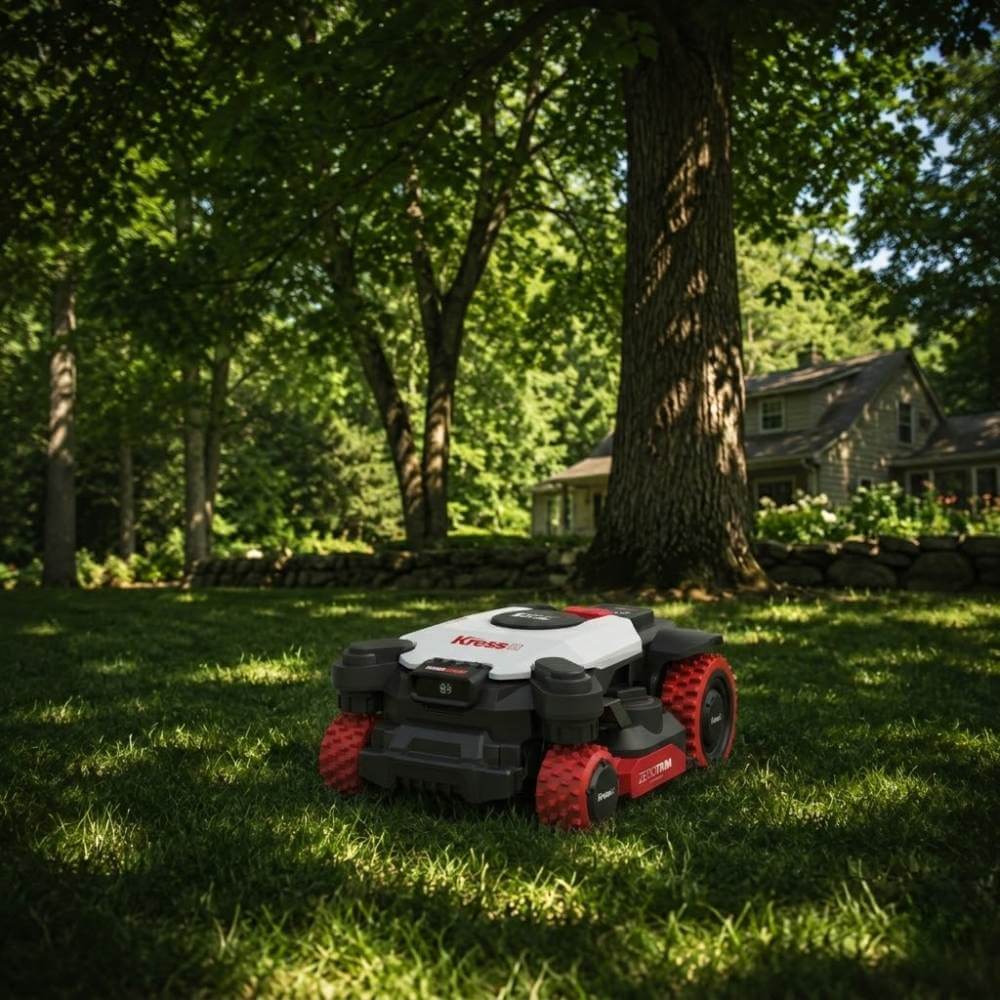
Tree Canopy Performance The Vision AI system specifically addresses GPS degradation under mature trees. When the satellite signal weakens, the mower switches to visual navigation using V-SLAM technology. It recognizes tree trunks, garden beds, and property features visually, continuing to mow accurately even when GPS provides incomplete data.
This is why Kress positions Vision AI as “commercial-grade intelligence for residential lawn care.” The technology comes from autonomous vehicle development and is adapted for lawn care applications.
Kress Voyager KR800: Commercial Autonomous Mowing
The Voyager occupies a completely different category from residential EyePilot models. This is purpose-built commercial equipment for professional landscaping operations, not a residential mower with commercial features.
Kress Voyager KR800 Specifications
Price: $59,999.99 USD
Navigation:
- RTKⁿ satellite positioning
- 360° camera system
- 360° ultrasonic sensors
- Front-facing LiDAR
- Multi-layer redundant obstacle detection (cameras + LiDAR + ultrasonic working simultaneously)
Performance:
- Deck width: 40 inches (102 cm), standard commercial zero-turn territory
- Cutting height: 1.5 to 5.0 inches (38-127 mm)
- Mowing speed: up to 5.6 mph (9 km/h)
- Coverage per charge: up to 7 acres (28,000 m²)
- Runtime: up to 8 hours continuous operation
- Maximum incline: 22° / 40% (less than residential EyePilot but designed for commercial properties)
Battery & Charging:
- Battery capacity: 10 kWh (significantly larger than residential 6Ah battery)
- Battery voltage: 45V
- Charging time: 9 hours
- CyberPack battery expandability (adds approximately 30 minutes / 1,000 m² per pack)
Commercial Features:
- One-time smart perimeter mapping via guided ride
- Unlimited property map storage
- Route-based operation (travels with landscaping crews from site to site)
- Kress Commercial app integration
- Fleet Management System compatibility
- Remote diagnostics
- Over-the-air updates
- Real-time location tracking
Service Life & Warranty:
- Rated service life: 5,000 operating hours
- Warranty: 5 years or 2,000 hours (whichever comes first)
- No hour limit within first 2 years
- Designed for daily commercial duty cycles
Safety & Certification:
- ETL CUS certification (Intertek): North American electrical/mechanical safety
- CE Machinery Directive certification: European safety standards
- EN 18031 RED cybersecurity certification (TÜV SÜD): connected system security
- 360° multi-sensor obstacle detection for operation in active commercial environments
Best For: Professional landscaping companies, property management firms operating multiple sites, municipalities, large commercial estates, and operations looking to replace manned zero-turn labor with autonomous equipment.
Voyager vs. EyePilot: Why These Are Different Categories
| Factor | EyePilot Residential | Voyager Commercial |
| Price | $2,999 to $4,299 | $59,999 |
| Primary Use | Single residential property | Multi-property route operations |
| Coverage | 0.5-1.5 acres per day | Up to 7 acres per charge |
| Runtime | Approximately 6-8 hours | 8 hours continuous |
| Cutting Width | 8.7 inches | 40 inches |
| Transportability | Stays at one property | Travels with crew daily |
| Map Storage | One property | Unlimited properties |
| Obstacle Detection | Vision AI + V-SLAM | LiDAR + Vision AI + Ultrasonic (triple redundancy) |
| App | Consumer app | Commercial fleet platform |
| Service Life | Residential duty cycle | 5,000-hour rated commercial |
| Warranty | Standard residential | 5 years/2,000 hours commercial |
| Target Buyer | Homeowner | Professional landscaper |
The Voyager’s 40-inch cutting width immediately identifies its commercial positioning. That’s standard commercial zero-turn territory, designed for productivity across large areas, not residential property maneuverability.
The price reflects the difference: $60,000 for equipment designed to replace a full-time mower operator versus $3,000-$4,300 for residential automation.
The $60,000 Investment: Understanding Voyager Economics
Kress positions the Voyager cost as “comparable to the annual cost of a mower operator.” For landscaping businesses, the calculation compares:
- Annual labor cost (wages, taxes, insurance, benefits) for one mower operator
- Equipment cost amortized over 5,000-hour service life
- Operational savings (fuel elimination, reduced equipment wear, productivity gains)
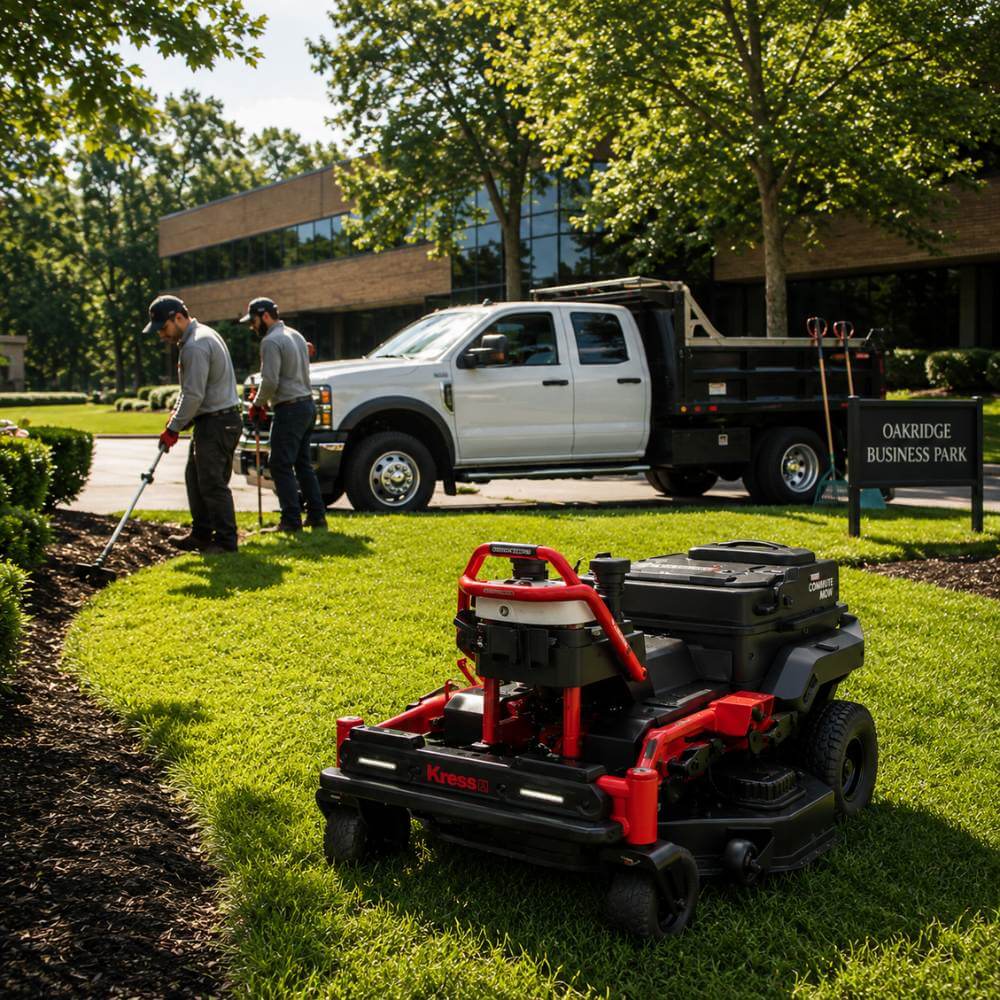
The Route-Based Operating Model: A crew running Voyager deploys it autonomously at each property while crew members focus on edging, trimming, blowing, bed maintenance, and client interaction (tasks that require human judgment and can’t be automated). The mower handles repetitive, time-consuming mowing work without tying up a crew member for hours.
After one-time perimeter mapping (completed in a single guided ride), Voyager permanently stores the property map. Crews transport it like a traditional zero-turn, deploy it at the property, and let it operate while they work on other tasks.
When Voyager Makes Financial Sense:
- Landscaping companies with regular mowing routes serving multiple properties
- Operations where labor availability constrains growth
- Companies seeking to redeploy crew members from mowing to higher-value services
- Municipal operations with large turf acreage and tight labor budgets
- Property management firms maintaining multiple commercial sites
When Voyager Doesn’t Fit:
- Residential homeowners (even large estates: EyePilot models or Husqvarna 560H handle 0.5-3.5 acres)
- Single-property operations where the mower can’t move between sites
- Operations without infrastructure to support fleet management systems
- Businesses unable to justify the capital investment against current mowing labor costs
Seacoast Power Equipment offers commercial fleet pricing for qualifying accounts. The fleet program provides 15-25% discount brackets based on volume, priority service scheduling, and extended payment terms for approved commercial buyers.
Vision AI in Practice: What It Actually Does
Vision AI sounds like marketing until you see it handle situations that stop GPS-only mowers:
Under Heavy Tree Canopy: GPS signal degrades to the point where satellite-only systems lose positioning accuracy. The Kress mower switches to visual navigation, recognizes landmarks (tree trunks, garden beds, property features), and continues mowing accurately using V-SLAM technology.
Near Buildings and Structures: Satellite signals bounce off structures, creating multipath interference that confuses GPS systems. Vision AI identifies the building visually, understands its position relative to the mowing area, and navigates correctly even when GPS provides conflicting data.
During Satellite Outages: GPS satellites occasionally experience service interruptions or degraded signals. A GPS-only mower stops or operates with reduced accuracy. A Vision AI mower continues operating normally using its visual understanding of the property.
Complex Obstacle Fields: A yard with multiple garden beds, decorations, furniture, and play equipment creates a complex obstacle environment. Vision AI recognizes each object type, remembers their locations, and plans efficient mowing paths that avoid them (even when they’re moved to different positions).
This is the fundamental navigation difference: GPS-only mowers are blind when the satellite signal weakens. Vision AI mowers see the environment and navigate visually when needed.
New Hampshire Seacoast Terrain Considerations
Seacoast properties present specific challenges that affect robotic mower selection:
Slopes and Rolling Terrain Properties in North Hampton, Portsmouth, Hampton, and Exeter frequently feature grade changes. The 84% slope rating on all EyePilot models handles steep residential slopes common on waterfront properties and hillside lots. Any property with sections steeper than 45% needs the EyePilot 4WD capability. Fortunately, all US models include it as standard.
Tree Canopy and GPS Obstruction Mature trees create GPS challenges for satellite-only systems. Kress Vision AI technology specifically addresses this New Hampshire reality. Properties with heavy tree cover maintain reliable navigation through visual positioning when satellite signals weaken.
Coastal Property Considerations Properties near the seacoast often combine multiple terrain challenges: slopes, mature landscaping blocking GPS, irregular lot shapes, and salt air exposure. The EyePilot 4WD models handle these conditions effectively. Seacoast Power Equipment’s service department provides corrosion-resistant maintenance for equipment operating in coastal environments.
Property Size Distribution Most residential seacoast properties fall within the EyePilot coverage range (0.5-1.5 acres). Properties exceeding 1.5 acres typically need larger-capacity equipment. For homeowners with 2-3.5 acre properties, we also carry the Husqvarna Automower 560H and other options that bridge residential and light commercial capability without requiring fleet management infrastructure.
Try Before You Buy at Seacoast Power Equipment
We carry the complete Kress lineup (all three EyePilot 4×4 models and the Voyager commercial unit) at our North Hampton showroom. More importantly, we let you test any robotic mower on your actual property before purchase.
Seeing how Vision AI handles your specific terrain, slopes, and obstacles before committing to a purchase eliminates guesswork. You’ll know whether the coverage capacity matches your property’s actual mowing time requirements. You’ll see how the system navigates under your tree canopy. You’ll understand the difference between specifications on paper and performance on your land.
Our factory-trained technicians handle installation, programming, boundary mapping, and system setup with every sale. We keep $150,000+ in parts on-site and service all brands we carry, not just what we sell. Our service department runs a 24- to 48-hour turnaround on most jobs, with pickup and delivery available for service appointments.
We’ve been equipping and maintaining the seacoast since 1965. Kress robotic mowers represent newer technology in our inventory, but our approach hasn’t changed: match the right equipment to your specific property, install it correctly, and support it for the life of the equipment.
FAQ: Kress EyePilot and Voyager
What’s the difference between KR282, KR284, and KR286?
Coverage capacity only. All three models share an identical drivetrain (4WD), navigation (Vision AI + RTKⁿ), slope capability (84%), obstacle clearance (2.4″), and cutting width (8.7″) and feature sets. Choose based purely on your property size: KR282 for 0.5 acres, KR284 for 1.0 acre, and KR286 for 1.5 acres.
Are there 2WD EyePilot models available?
No. The US market only sells 4WD EyePilot models (KR282, KR284, KR286). All EyePilot mowers sold in the United States come with four-wheel drive and 84% slope capability standard. There are no 2WD options.
Does Vision AI actually work in heavy shade?
Yes. That’s specifically what it’s designed for. When the GPS signal degrades under a tree canopy or near buildings, the Vision AI system switches to visual navigation using cameras and V-SLAM technology. The mower recognizes landmarks and navigates by visual reference rather than satellite positioning. This is the core advantage over GPS-only systems.
Can I use Voyager on my 3-acre residential property?
Technically capable but operationally wrong. Voyager is engineered for route-based commercial operations (traveling between multiple properties daily, storing unlimited site maps, and integrating with fleet management systems). A residential property doesn’t need or benefit from that infrastructure. For 3-acre residential properties, we’d recommend Husqvarna Automower 560H or other residential models that handle larger acreage without commercial fleet requirements.
How does Kress slope handling compare to competitors?
Kress EyePilot 4×4 models handle slopes up to 84% (40°), among the highest in the residential category. Husqvarna Automower models typically handle 45-50% slopes, depending on the model. The Segway Navimow Move series handles 45-50% slopes on residential models. For extreme slopes above 60%, the Kress 4×4 models provide the highest residential slope rating we carry.
All models include integrated 4G. Is WiFi required?
All EyePilot models include integrated 4G connectivity with an embedded SIM for reliable remote control and monitoring. The 4G connection operates independently of your home network. Contact us at (603) 964-8384 for current connectivity terms, as data arrangements may vary by model year or region.
What’s included in commercial fleet pricing?
Seacoast Power Equipment offers 15-25% discount brackets based on volume for qualifying commercial accounts. Fleet pricing also includes priority service scheduling, loaner equipment availability during service, and extended payment terms. Contact us to discuss your operation’s specific needs and qualify for commercial fleet program benefits.
Ready to See Kress Models in Person?
Stop by our North Hampton showroom or call to schedule a property demo. We’ll match the right Kress model (or alternative brand if something else fits better) to your specific property and operation.
Questions about equipment or inventory?
Call: (603) 964-8384
Visit: 106 Lafayette Road Unit #1, North Hampton, NH 03862
Hours: Mon-Fri 8:00 AM to 5:00 PM | Sat 8:00 AM to 4:00 PM
Related Content
- Try Before You Buy: How to Choose the Right Commercial Mower for Your Property in New Hampshire
- The Complete Guide to Zero-Turn Mower Maintenance: Spring Service Checklist for NH Residential and Commercial Users
- Commercial Fleet Spring Preparation: A 60-Day Strategy for Landscaping Professionals
- Preparing for Your First Mow of 2026: A New Hampshire Timing and Equipment Guide
- Sharp Blades vs. Dull Blades: The Hidden Impact on Your New Hampshire Lawn