
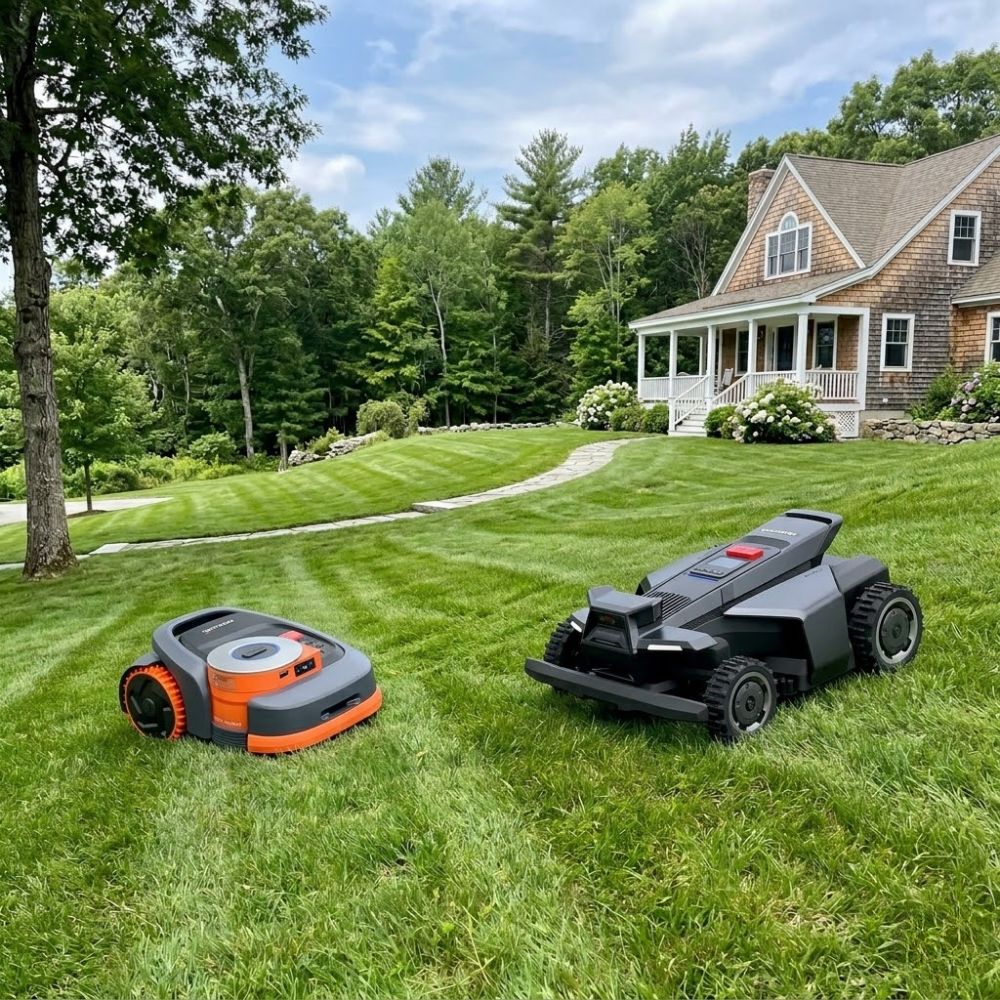
We’ve spent nearly 60 years helping seacoast homeowners and landscapers find equipment that actually works on their specific property. New Hampshire terrain is not flat, not simple, and not forgiving of the wrong equipment choice. That’s as true for robotic mowers as it is for zero-turns and tractors.
Robotic mowers eliminate the weekly chore of pushing or riding around your property. Navimow’s wire-free GPS-guided models represent where the technology is right now: satellite positioning instead of buried boundary wires, accurate to centimeters, controllable from your phone. No trenching. No wire installation. Just set up and go.
The catch is that H Series and X Series are not interchangeable. Coverage area, slope rating, navigation technology, and runtime differ significantly between these lines. Pick the wrong one and you’re either overpaying for capability you don’t need or buying a mower that can’t handle your property’s challenges.
This guide walks through what actually matters for New Hampshire lawns. We cover property size matching, slope handling for New England terrain, navigation differences under tree cover, and which series performs in real-world seacoast conditions. If you want to see these models in person before buying, visit our showroom in North Hampton or give us a call. We can also come to you for a site evaluation.
The Core Difference: Property Size and Terrain Complexity
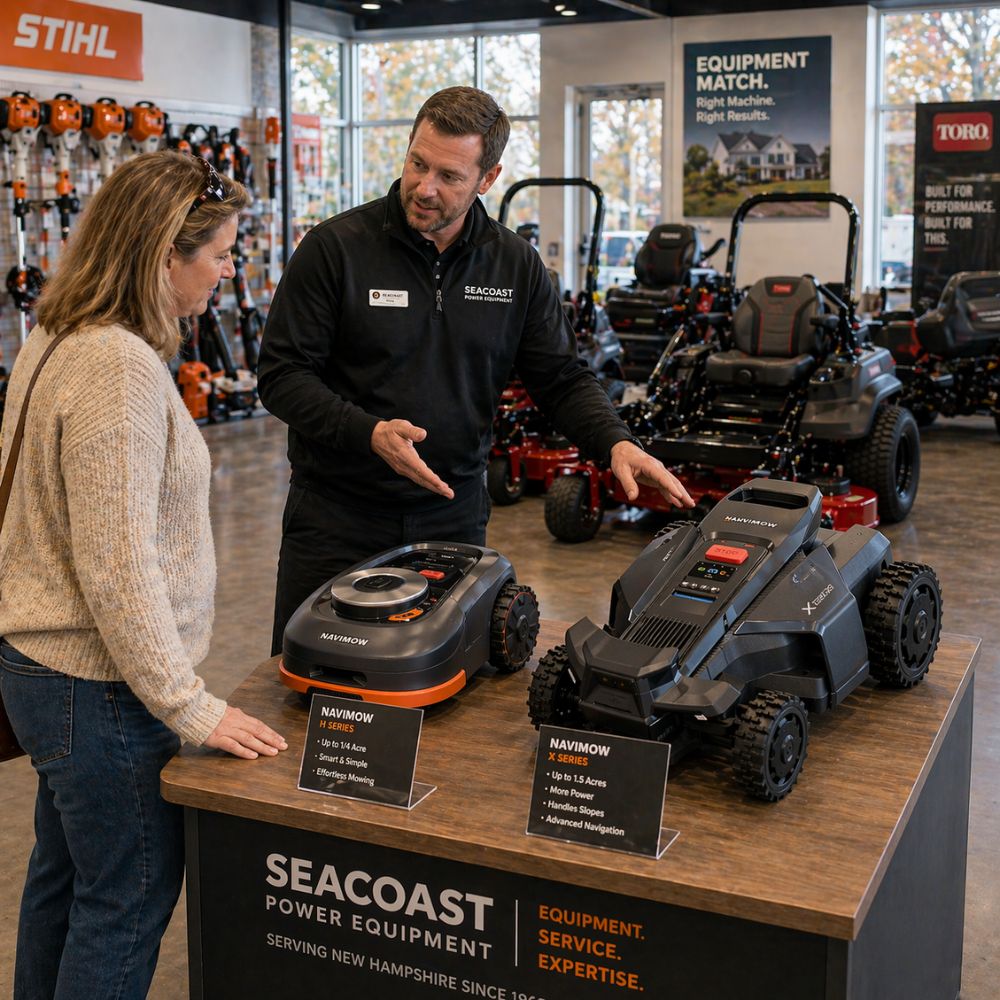
H Series mowers target medium residential lawns up to about a quarter acre with moderate terrain. X Series models scale from 1,500 square meters (X3 sub-series) up to 1.5 acres (X4 models) and handle steeper slopes with more advanced navigation.
That size distinction is a starting point, not the whole story. An H Series model can work on a half-acre property if the terrain is relatively flat and open. That same half-acre with significant slopes, heavy tree cover, or complex obstacle layouts may need an X3 or X4 model regardless of total square footage.
Think of the H Series as standard residential capability. The X Series is advanced residential to light commercial capability, built for properties that present commercial-level challenges at the homeowner scale.
Coverage Area and Mowing Efficiency
Actual coverage depends on lawn shape, obstacles, and navigation efficiency on your specific property, not just manufacturer specs.
H Series Coverage
H Series models like the H210 handle up to 0.25 acres effectively, completing that area in approximately 7.66 hours. Larger H Series variants extend coverage toward 2,500 square meters (roughly 0.62 acres) for properties within the series’ terrain capabilities.
These runtime figures assume relatively clear paths with minimal backtracking. Properties with numerous obstacles, irregular shapes, or narrow passages to reach separate lawn areas take longer than open rectangular lots of the same size.
The H Series uses an 18cm cutting disc. The narrower disc helps maneuver around landscaping features in tighter spaces, but more passes are needed to cover the same ground compared to X Series models.
X Series Coverage
X3 models start at 1,500 square meters and scale up by battery and model variant. X4 models like the X430 handle up to 1 acre in approximately 15 hours. The X450 extends to 1.5 acres in about 23 hours.
The X Series uses a 21 cm cutting disc with an enhanced blade configuration that improves cutting efficiency. Combined with faster travel speeds, X Series models cover ground noticeably quicker than H Series equivalents on the same property.
Runtime reaches up to 240 minutes on a single charge, compared to roughly 110 minutes for H Series. Fewer charging interruptions on larger properties is one of the practical advantages that makes X Series genuinely worth the price step-up when your lawn is bigger.
What Specs Don’t Tell You
Manufacturer coverage specs assume ideal conditions. Thick grass, slope, and navigation complexity all reduce effective coverage per charge. For typical New Hampshire residential properties, plan on 75 to 85 percent of rated coverage. Challenging terrain or complex layouts can bring that down to 60 to 70 percent.
Slope Capability: The Factor That Matters Most in New England
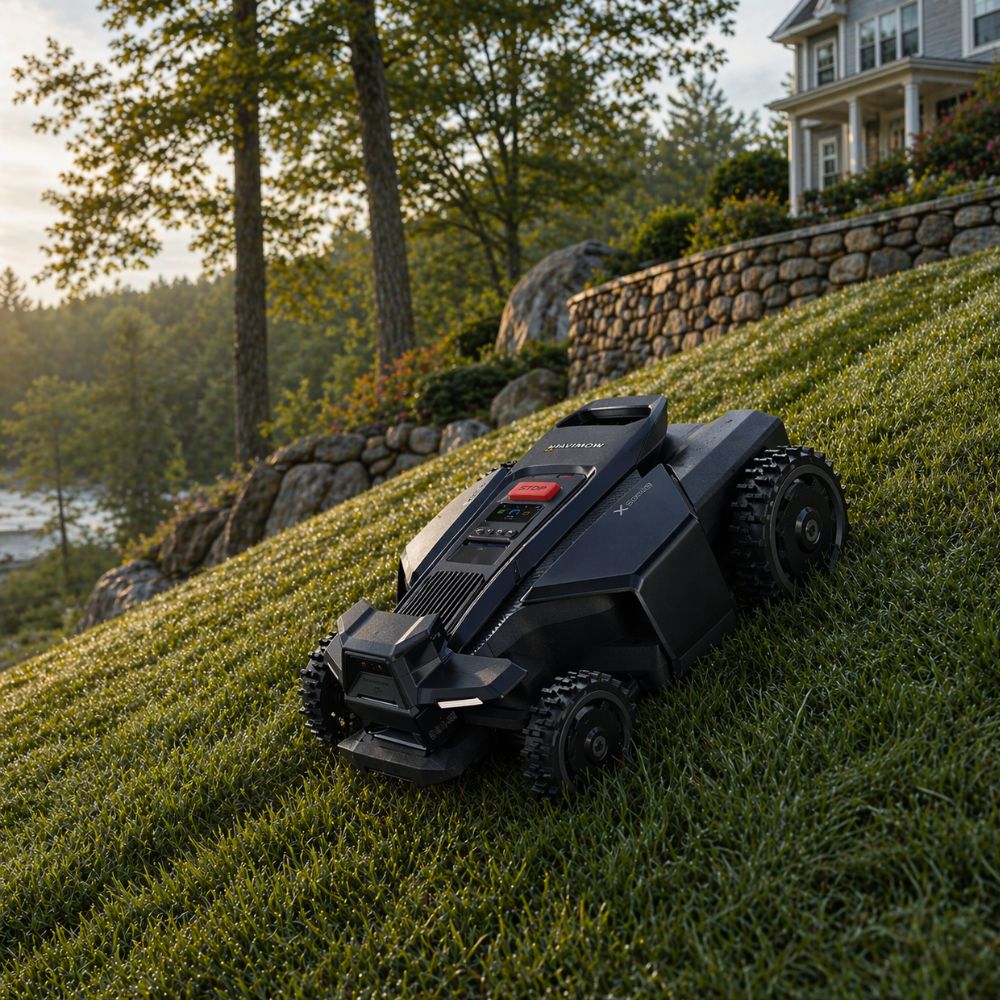
New Hampshire properties rarely offer flat terrain. The ability to handle slopes safely is often what decides which series is right for a given property.
H Series Slope Performance
H Series models handle slopes up to approximately 30 percent grade (about 17 degrees). This works for most residential properties with gentle rolling terrain or gradual slopes near foundation plantings.
On dry grass, the drive system handles moderate inclines without much trouble. Wet grass is a different story. H Series single-drive systems can lose traction on inclines approaching the maximum rating when mowing damp grass, which is a regular condition here on the seacoast. Operators often find they need to restrict H Series mowers to gentler slopes than the rated maximum to maintain reliable operation across variable conditions.
X Series Slope Performance
X Series models, particularly X4 variants, handle slopes up to a 50 percent grade, with some all-wheel drive X4 configurations managing slopes up to an 84 percent grade under ideal conditions. That’s a meaningful engineering difference from the H Series.
Several upgrades combine to deliver that capability. X Series models use 10-inch wheels with better contact area and obstacle clearance. Weight distribution runs 7-to-3 front-to-rear for optimized traction on inclines. X4 models with all-wheel drive and traction control systems maintain power to all four wheels, which is what prevents the traction loss that stops single-drive systems on steeper slopes.
Properties with drainage swales, hillside sections, or terrain variation around buildings often require X Series capability even if the total lawn area fits within H Series coverage limits. When in doubt, choose the slope-capable option. A mower that loses traction on a slope creates real risk.
A Note on Safe Operation
Never operate beyond manufacturer slope ratings, regardless of how the mower performs in dry conditions. Morning dew alone can reduce traction significantly. Set up your mowing zone conservatively on initial setup, then gradually include steeper areas after confirming reliable performance across different weather conditions.
Navigation Technology: EFLS 2.0 vs EFLS 3.0
The navigation system determines how accurately the mower follows boundaries, avoids obstacles, and builds efficient mowing patterns over time.
H Series Navigation: EFLS 2.0
H Series models use EFLS (Exact Fusion Locating System), which combines RTK GPS with onboard sensors for centimeter-level positioning. Virtual boundaries are created through the Navimow app with no buried perimeter wires required.
On open lawns with a clear sky view, the system works reliably. Accuracy depends on satellite visibility, so areas under heavy tree cover or near tall buildings can experience reduced precision. H Series VisionFence obstacle detection identifies and avoids typical residential obstacles adequately for most straightforward properties.
X Series Navigation: EFLS 3.0
X Series upgrades to EFLS 3.0, adding VSLAM (Visual Simultaneous Localization and Mapping) and VIO (Visual Inertial Odometry) to the base RTK GPS system. That sensor fusion is what maintains reliable positioning in situations where GPS alone struggles.
The VSLAM system uses cameras to build visual maps of the environment. Under tree cover, near buildings, or in other GPS-challenging areas, the mower uses those visual maps to hold accurate positioning where H Series models may drift. This matters significantly on New Hampshire properties with mature tree lines.
The X Series also includes AI Assist Mapping, which learns your property over time and refines navigation patterns for improved efficiency across repeated mowing sessions. VisionFence 2.0 offers 300-degree obstacle detection with recognition for over 150 object types. Visual edge detection identifies lawn boundaries more precisely, reducing the trimming needed along borders.
Navigation in New England Conditions
Mature trees, older buildings, and varied terrain create consistent GPS challenges on seacoast properties. The enhanced sensor fusion in X Series handles these conditions more reliably than H Series systems.
Dense canopy is common on New Hampshire lots, and VSLAM capability makes a genuine operational difference under that cover. Properties with numerous obstacles or complex layouts also benefit from the AI learning system, where navigation efficiency improves over time rather than following fixed patterns indefinitely.
Our service department handles Navimow software troubleshooting and navigation calibration for both series if you encounter issues after installation.
Runtime and Charging
H Series Runtime
H Series models run up to 200 minutes total with approximately 110 minutes of active mowing on a 5.1 amp-hour battery. Charging takes about 70 minutes to full capacity.
For smaller properties within the H Series range, this runtime completes the lawn in a single session with charging breaks as needed. The mower returns automatically to the charging station when the battery runs low, then resumes after recharging.
X Series Runtime
X Series models operate up to 240 minutes on a 12.8 amp-hour battery. Active mowing time per cycle runs approximately 110 minutes, similar to H Series, but the larger battery means fewer complete cycles needed to finish larger properties.
Charging takes about 90 minutes on X Series models. The extra 20 minutes is offset by fewer total charge cycles on bigger lawns.
Charging Station Placement
Both series require an outdoor electrical outlet for the charging station. Place the station on level ground with a clear approach path, away from heavy tree cover, metal structures, or low spots that collect water.
Good charging station placement reduces travel time to and from the far corners of your lawn, which directly increases effective mowing time per charge cycle.
Installation and Setup
Wire-free installation is one of Navimow’s genuine advantages over older robotic mower technology. No trenching, no boundary wire installation, no physical perimeter markers.
GPS Reference Setup
Navimow systems include a GNSS antenna that mounts on the charging station or a separate post. Mount the antenna at least 1.5 meters high with clear sky view and stable mounting that won’t shift in wind. This is the reference point for RTK positioning accuracy across your entire mowing zone.
Virtual Boundary Mapping
The Navimow app guides boundary creation through two options: guided walk or autonomous roam. The guided walk has you walk the perimeter while the mower follows, learning the boundary path precisely. Autonomous roam lets the mower explore independently to build the initial map. A guided walk is the better choice for properties with complex shapes or specific boundary requirements.
After initial mapping, you refine boundaries in the app, add no-go zones around garden beds or other features, and define passage routes through narrow areas between lawn sections.
WiFi and Connectivity
The mower connects via Bluetooth for initial setup, then uses WiFi for scheduling, updates, and remote monitoring. Strong 2.4GHz coverage across your lawn area ensures reliable ongoing operation. Large properties or areas far from your router may need a WiFi extender.
Winter Storage for New England
New Hampshire winters require taking the mower out of service. For complete guidance on proper shutdown and spring reactivation, see our robotic mower installation and care guide.
The short version: clean thoroughly, store indoors in a frost-free location, charge the battery to approximately 50 percent before storage, and disconnect from power for the winter. Freezing temperatures damage batteries and electronics. An unheated shed is not adequate storage.
We offer seasonal storage service that handles fall shutdown, indoor storage, and spring reactivation with software updates and system testing. It’s worth considering if you’d rather hand that off.
Maintenance
Both series have similar ongoing maintenance requirements.
Blade replacement happens yearly or when cutting performance drops, typically after every three to four mowing cycles during peak season. Navimow blades replace rather than sharpen. Keep spares on hand so a dull blade discovery doesn’t delay your mowing schedule.
Cleaning should happen every one to two weeks during active season. Use a soft cloth or brush on the exterior, blade disc, wheels, and undercarriage. The IP66 waterproof rating allows gentle rinsing, but avoid pressure washers and harsh chemicals. Keep the rain sensor clean so the mower docks properly during precipitation.
Software updates come over the air through the app. Check monthly during mowing season and always update before first use each spring. Updates improve navigation algorithms and fix bugs.
Battery care means inspecting the battery and charging contacts every six to eight weeks. Plan for battery replacement every three to five years depending on use. Proper winter storage extends battery life significantly.
Our parts department stocks Navimow blades and common maintenance components. We can also source parts quickly if something isn’t on the shelf.
Cost Comparison
H Series models start around $2,000 to $3,000 depending on model and coverage capacity. The X Series runs $3,500 to $6,000 or more depending on coverage area, slope capability, and features. X3 models price lower than X4 variants with all-wheel drive and maximum slope capability.
Professional installation costs $300 to $600 depending on property complexity. This covers charging station setup, GNSS antenna mounting, virtual boundary creation, and complete testing. DIY installation is manageable for most technically capable homeowners, but complex properties benefit from professional setup regardless of which series you choose.
Annual maintenance runs approximately $100 to $200 for blades, cleaning supplies, and occasional parts. Electricity costs are minimal, typically under $20 per season. Seasonal storage service runs $150 to $300 annually if you prefer professional management over DIY preparation.
Which Series Fits Your Property?
Choose H Series if:
Your property is a quarter acre or less with moderate terrain and slopes under 25 to 30 percent grade. Your lawn has good satellite visibility with minimal tree cover or building obstruction. You want reliable automated mowing for a straightforward residential application, and the lower price point makes sense for your budget.
Choose X Series if:
Your property approaches or exceeds half an acre. Slopes exceed a 25 percent grade, or you have multiple slope areas across the property. Heavy tree cover, buildings, or terrain features create GPS challenges. Your layout includes separate lawn areas, numerous obstacles, or narrow passages between zones. You want maximum capability now and as your landscaping matures.
When the choice is genuinely unclear based on your property, we can do a site evaluation and give you a direct recommendation. That’s part of what we do.
Frequently Asked Questions
Do Navimow mowers work under tree cover?
H Series can struggle under a dense canopy where GPS signals are blocked. The X Series handles this better with VSLAM visual mapping that maintains positioning even when satellite signals are intermittent. If your New Hampshire property has significant tree cover, X Series is the more reliable choice.
Do I need to bury boundary wires?
No. Navimow uses GPS-guided virtual boundaries set up entirely through the app. No wire installation required.
What slope grade can these mowers handle?
The H Series handles up to a 30 percent grade. The X Series handles up to a 50 percent grade, with X4 all-wheel drive configurations managing up to 84 percent under ideal conditions.
Can Navimow mowers work in the rain?
Both series carry IP66 waterproof ratings and include rain sensors that automatically dock the mower during precipitation.
How do these mowers handle New Hampshire winters?
The mower must be stored indoors in a frost-free location during winter months. Freezing temperatures damage electronics and batteries. Both series require proper seasonal shutdown. We offer storage and spring reactivation services if you want that handled professionally.
What happens if the mower needs service?
Our service department provides factory-trained support for Navimow systems, including software diagnostics, component repair, and parts replacement. We also offer pickup and delivery so you don’t need to transport the equipment yourself.
Can I try the mower before buying?
Yes. Contact us to arrange an equipment demonstration and site evaluation at your property. Seeing how the system handles your specific terrain before purchase is always worthwhile.
Seacoast Power Equipment’s Robotic Mower Support
We’ve been equipping and maintaining the seacoast since 1965. Navimow robotic mowers are a newer addition to our lineup, but our approach is the same as with every piece of equipment we sell: we match the right model to your specific property, handle installation properly, and support it for the life of the equipment.
Professional installation includes site evaluation, optimal charging station placement, GNSS antenna mounting, virtual boundary creation, and full system testing. We verify GPS coverage across your property and adjust boundary mapping for reliable operation before we consider the job done.
Seasonal services cover fall shutdown and storage preparation, indoor storage through winter if needed, and spring reactivation with software updates and system testing. Our pickup and delivery service covers the entire seacoast region, so you don’t need to haul equipment for service or storage.
Parts for blade replacements and common maintenance components are stocked in our parts department, with two- to three-day sourcing on anything we don’t have on the shelf.
Ready to explore robotic mowing for your New Hampshire property? Visit us in North Hampton, call our sales team, or ask about scheduling a site evaluation. We’ll take a look at your terrain and tell you straight which model handles your specific challenges.
Seacoast Power Equipment. North Hampton, NH. Serving the NH seacoast, Southern Maine, and Northern Massachusetts since 1965.