
Understanding Lawn Compaction in New Hampshire
New Hampshire lawns face unique challenges that most homeowners don’t fully appreciate until grass starts thinning despite regular fertilization and watering. The culprit is often soil compaction, a condition where soil particles press together so tightly that air, water, and nutrients can’t reach grass roots effectively.
The region’s clay-heavy soils compound this problem. Unlike sandy or loamy soils that drain well naturally, clay particles pack tightly, especially after our notorious freeze-thaw cycles. Each winter, ice forms in soil pores, expanding and contracting the ground. When spring arrives, foot traffic, lawn equipment, and heavy rain compress soil into a hardened layer that restricts oxygen exchange and root expansion.
The screwdriver test reveals compaction instantly. Push a six-inch screwdriver into your lawn. If it requires significant force or won’t penetrate fully, your soil is compacted and needs aeration. This simple test works better than visual inspection because compaction occurs below the surface.
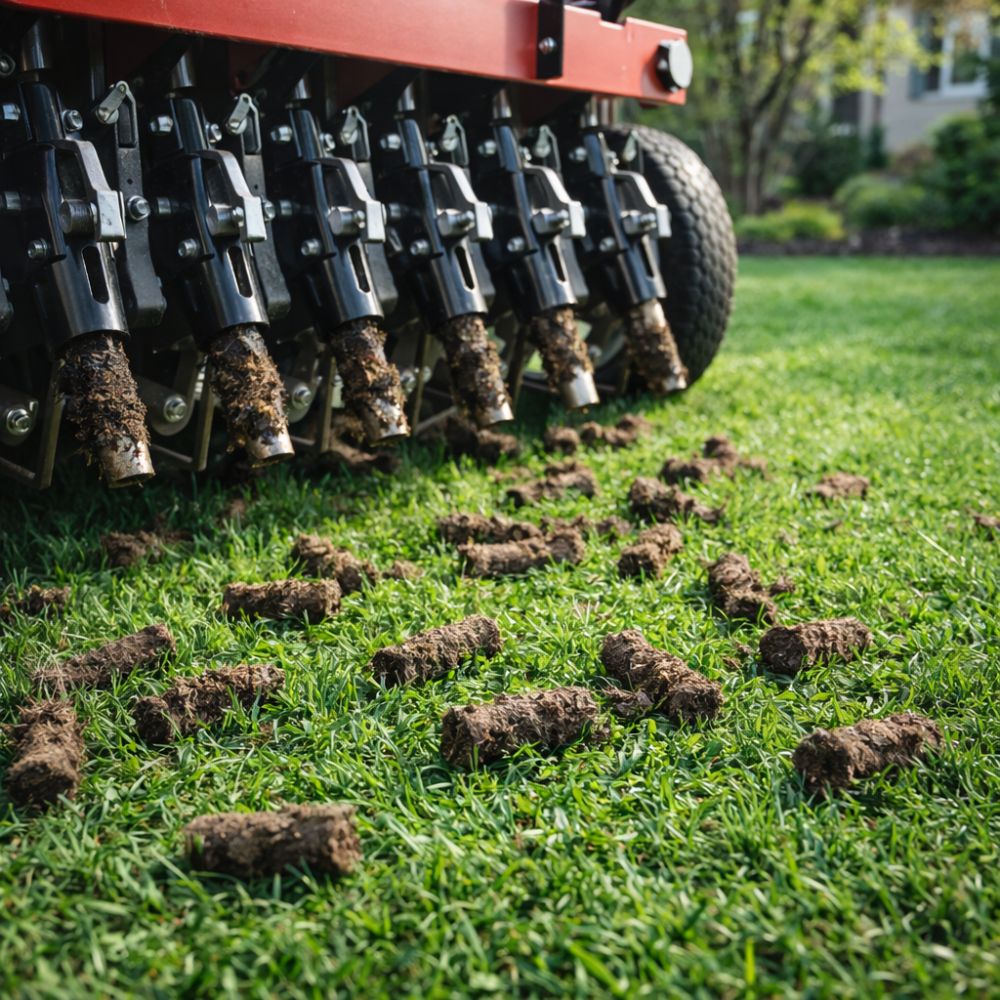
Aeration solves this problem by removing thousands of small soil cores, creating channels for air, water, and nutrients to penetrate deep into the root zone. But timing matters enormously in New Hampshire, where we grow cool-season grasses like Kentucky bluegrass, fescue, and perennial ryegrass. Combined with proper early spring lawn care practices, aeration ensures your grass develops the deep root systems needed for a healthy, resilient lawn.
Fall Aeration: The Preferred Choice for New Hampshire Lawns
September through October represents the optimal aeration window for New Hampshire properties. This timing aligns perfectly with cool-season grass biology, giving your lawn maximum recovery time and growth potential before winter dormancy.
Cool-season grasses thrive when temperatures range from 60 to 75 degrees Fahrenheit. Fall delivers these ideal conditions consistently, triggering vigorous root growth. When you aerate during this active growth period, grass plants quickly fill in the temporary holes, establishing stronger root systems that survive winter stress and emerge healthier in spring.
Feature Snippet: Fall aeration in New Hampshire should occur between September 10 and October 15 for seacoast properties, September 1 and October 5 for central NH, and August 25 and September 30 for northern regions. Soil temperatures between 55 and 65 degrees Fahrenheit provide optimal conditions for grass recovery and root development before winter.
The six to eight weeks of growing season remaining after fall aeration gives grass time to establish roots through the aeration holes. This recovery period proves critical. Grass doesn’t just grow back over the holes but grows down into them, creating deeper, more extensive root systems that access water and nutrients more efficiently.
| NH Region | Fall Aeration Window | Spring Window (If Necessary) | Optimal Soil Temperature |
| Seacoast/Southern NH | September 10 – October 15 | April 15 – May 15 | 55-65°F |
| Central NH | September 1 – October 5 | April 20 – May 20 | 55-65°F |
| Northern NH | August 25 – September 30 | May 1 – May 30 | 55-65°F |
Fall aeration also creates the perfect opportunity for overseeding. The aeration holes provide ideal seed-to-soil contact, protecting grass seed from birds and wind while maintaining consistent moisture. Seeds germinate in the protective environment of each hole, establishing new grass plants that thicken lawn density significantly. Spring weeds haven’t emerged yet, so new grass seedlings don’t face competition for resources.
Weed pressure drops dramatically in fall compared to spring. Crabgrass, the most problematic annual weed in New Hampshire lawns, germinates in spring when soil temperatures reach 55 degrees. Fall aeration occurs after crabgrass season ends, eliminating the risk of creating a perfect seedbed for weed germination.
Spring Aeration: Understanding the Limitations
Spring aeration works in specific situations but comes with significant drawbacks. The primary issue involves pre-emergent herbicide applications, which most lawn care programs apply in early spring to prevent crabgrass germination.
Pre-emergent herbicides create a chemical barrier in the top layer of soil that prevents weed seeds from germinating. Aeration breaks this barrier by removing thousands of soil cores, creating openings where crabgrass seeds can germinate successfully. You must choose one or the other in spring: aerate and accept some crabgrass, or apply pre-emergent and skip aeration until fall.
Quick Decision: Should You Aerate This Spring or Wait for Fall?
Choose SPRING aeration if:
- Severe winter damage visible from heavy equipment or excessive snow
- Lawn is in crisis mode requiring immediate intervention
- You’re skipping pre-emergent herbicide this year
- New construction property with extreme compaction
Choose FALL aeration if:
- Lawn is in acceptable condition currently
- You want to combine with overseeding
- You applied pre-emergent herbicide in spring
- You want maximum recovery and benefits
Choose BOTH spring and fall if:
- Heavy clay soil with severe ongoing compaction
- High traffic areas (commercial properties, sports fields)
- Budget allows for twice-yearly professional service
Spring aeration makes sense only when severe winter damage from heavy equipment, excessive foot traffic, or snow and ice compaction warrants emergency intervention. New construction properties with extreme compaction from heavy machinery benefit from spring intervention because the compaction is so severe that grass can’t establish without immediate relief.
If you must aerate in spring, timing becomes critical. Wait until grass shows active growth, typically mid-April through mid-May across most of the state. Soil must dry out from spring thaw but retain enough moisture for effective core extraction.
Choosing the Right Aeration Equipment for Your Property
Equipment selection depends primarily on property size, existing equipment ownership, and physical capability. As a Honda Premier Dealer and authorized retailer for Stihl, Toro, Husqvarna, Simplicity, and Ferris, Seacoast Power Equipment helps New Hampshire homeowners evaluate their lawn equipment needs and match the right tools to their specific property requirements.
| Equipment Type | Best For Property Size | Initial Cost | Time Required | Pros | Cons |
| Manual Core Aerator | Under 1,000 sq ft | $30-60 | 4+ hours | Low cost, no storage issues | Extremely labor-intensive |
| Tow-Behind Aerator | 0.5-5 acres | $300-800 | 1-2 hours | Pays for itself in 2 years | Requires riding mower |
| Walk-Behind Rental | 1,000-10,000 sq ft | $100/day rental | 2-3 hours | No purchase needed | Limited availability, transport issues |
| Professional Service | Any size | $150-600/year | None (technician does work) | Convenience, expertise | Recurring annual cost |
Manual Core Aerators: Limited Application
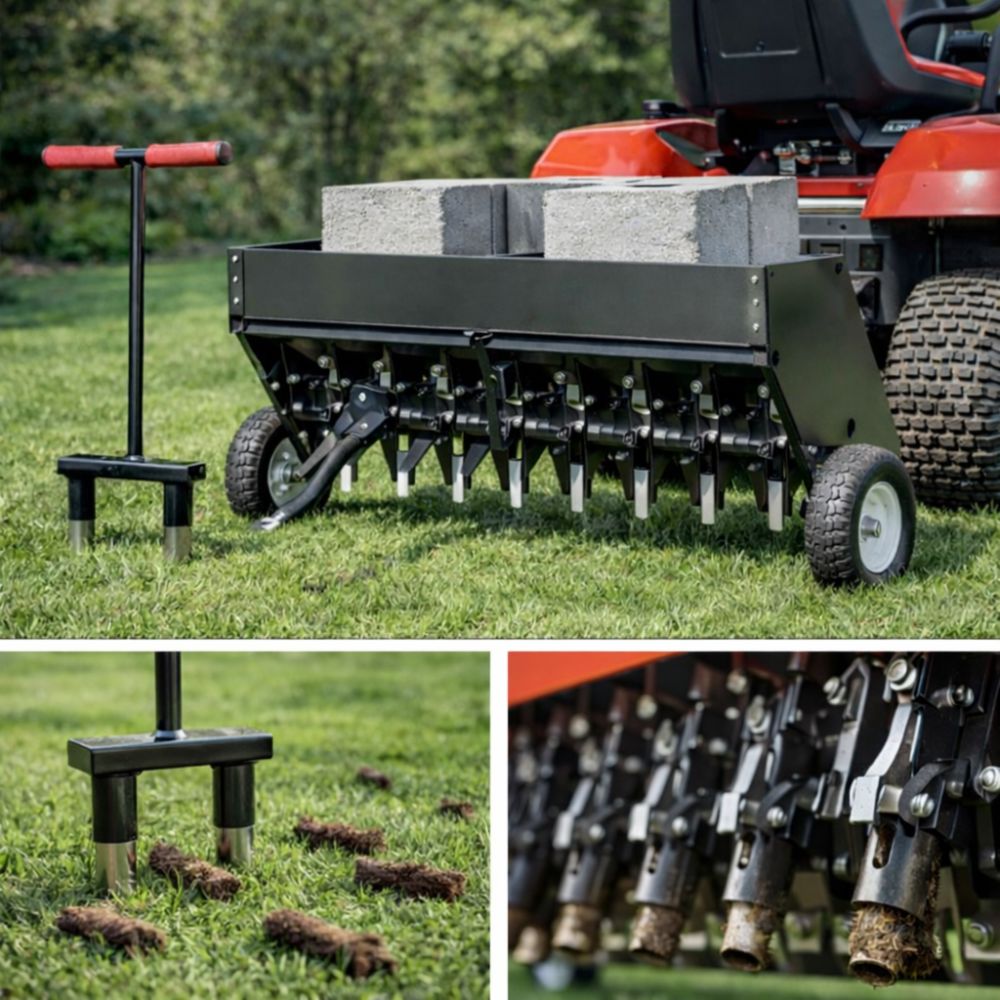
Manual aerators work only for very small areas under 1,000 square feet or spot treatment around trees and garden beds. These foot-powered tools extract two to four cores per step, requiring enormous physical effort to aerate even a small lawn section. They cost between $30 and $60, representing the most affordable entry point, though most homeowners use them only for supplemental aeration rather than primary lawn care. For those seeking lightweight yard equipment that reduces physical strain, powered options provide significantly better results with less effort.
Tow-Behind Aerators: The DIY Sweet Spot
Tow-behind aerators represent the best value for homeowners who already own riding mowers or lawn tractors. These attachments connect to your mower’s hitch, using the mower’s engine for forward motion while the aerator’s weight provides tine penetration force.
Property owners with half-acre to five-acre lots find tow-behind aerators particularly cost-effective. A quality core aerator costs $300 to $800, paying for itself after two to three uses compared to professional service costs. The key specifications include working width (36 to 48 inches), tine spacing (two to three inches for optimal penetration), and weight capacity (100 to 200 pounds of sand or water for adequate penetration force).
At Seacoast Power Equipment in North Hampton, we help customers match tow-behind aerators to their existing riding mowers or tractors. Our nearly 60 years serving the seacoast region means we understand local soil conditions and can recommend equipment that works effectively in New Hampshire’s challenging clay soils. Our parts department stocks replacement tines and hardware, ensuring your aeration equipment stays functional season after season.
For customers who need aeration capability but don’t yet own a riding mower, we offer complete solutions. Our inventory includes Toro, Husqvarna, Simplicity, and Ferris riding mowers and tractors that provide the towing power necessary for effective aeration while delivering year-round lawn care capability. If you’re considering a zero-turn mower for your property, we can help you choose a model with adequate horsepower and hitch capacity for tow-behind aerator attachments.
Walk-Behind Aerators and Professional Services
Walk-behind aerators deliver commercial-quality results without requiring a riding mower. These self-propelled machines weigh 150 to 300 pounds and feature five- to seven-horsepower gas engines. They work well on properties from 1,000 to 10,000 square feet, covering approximately 4,000 square feet per hour.
Walk-behind aerators cost $1,500 to $3,500 new. For most homeowners aerating annually, equipment rental companies throughout New Hampshire offer daily rentals for $80 to $120. Seacoast Power Equipment focuses on equipment sales and service rather than rentals, but we maintain relationships with local rental centers throughout the seacoast area and can recommend reputable options.
Professional lawn care companies provide complete aeration services using commercial stand-on aerators. Costs vary by property size: small properties under 5,000 square feet typically run $80 to $150, medium properties from 5,000 to 10,000 square feet cost $150 to $250, and large properties from 10,000 to 20,000 square feet range from $250 to $400. Property managers maintaining multiple locations should review our commercial equipment maintenance guide for fleet care strategies that minimize downtime.
While Seacoast Power Equipment doesn’t provide lawn aeration services directly, we know reputable lawn care companies throughout the seacoast region. Stop by our North Hampton location or call (603) 964-8384 for referrals to professionals we trust.
Recognizing When Your Lawn Needs Aeration
Several physical tests and visual indicators reveal compaction problems. The screwdriver test provides the quickest assessment: push a six-inch screwdriver into several lawn areas, testing both sunny and shaded sections. Compacted soil resists penetration, requiring significant force or stopping the screwdriver short of full depth.
Water infiltration testing shows drainage problems caused by compaction. Water a small area with a hose, then observe how quickly water absorbs. Compacted soil causes water to pool on the surface or run off rather than soaking in. Healthy, well-aerated soil absorbs water within minutes.
Thatch measurement requires digging a small plug of grass and soil. Examine the brown layer between green grass blades and soil. Thickness under half an inch indicates healthy decomposition. More than half an inch suggests poor microbial activity, often accompanying soil compaction that restricts air movement necessary for decomposition.
Feature Snippet: Clay soil (common in New Hampshire) and high foot traffic require annual fall aeration. Moderate-use lawns with loam soil need aeration every two years. Sandy soil (rare in NH) requires aeration every two to three years. Commercial properties and athletic fields benefit from aeration twice yearly in spring and fall.
Visual compaction signs include worn paths where people regularly walk, bare spots that won’t fill in despite overseeding, moss growth indicating poor drainage, and thinning turf in high-use areas. Water pooling after rain or irrigation reveals drainage problems directly related to compaction. If your lawn shows persistent thinning despite regular maintenance, consider whether dull mower blades might be compounding the stress from compacted soil.
Property factors requiring more frequent aeration include clay soil composition, high foot traffic from children and pets, commercial property constant use, new construction soil compaction from heavy machinery, and regular lawn equipment operation that compacts surface soil.
The Aeration Process: Step-by-Step Guide
Successful aeration begins one to two days before you operate equipment. Check soil moisture to ensure optimal conditions for core extraction. Soil should feel like a wrung-out sponge: moist but not soggy. If soil feels too dry, water your lawn one to two days before aerating, applying approximately one inch of water.
Mark all obstacles before starting. Flag sprinkler heads, which aerator tines can damage. Identify invisible dog fences and irrigation lines. Note septic system components and shallow utility lines.
Mow your lawn to normal height, typically three to 3.5 inches for New Hampshire cool-season grasses. Remove grass clippings if your lawn is particularly thick. Clear all debris, including sticks, rocks, toys, and any obstacles that could damage aerator tines.
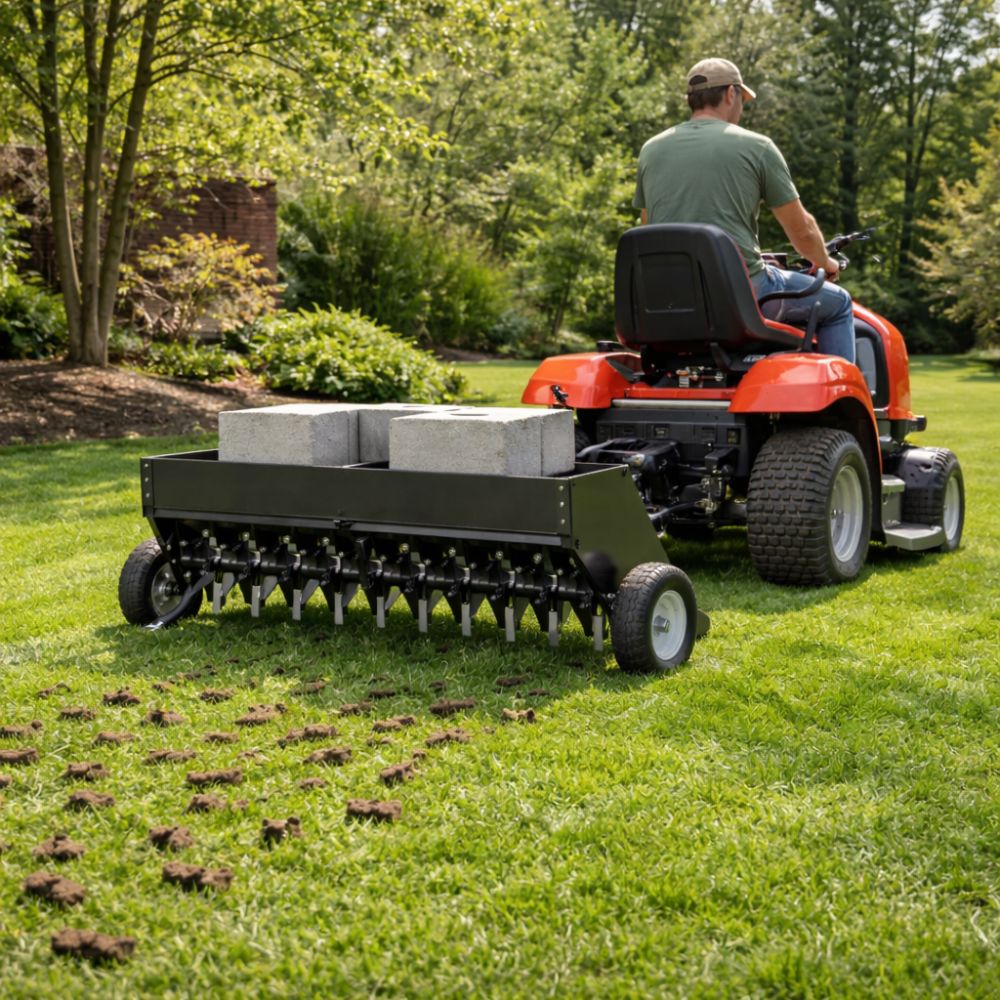
For tow-behind aerators, add 100 to 200 pounds of sand or water to the weight tray before beginning. Attach the aerator to your riding mower’s hitch, securing all pins and safety clips. Start with a perimeter pass around lawn edges, then make parallel passes in straight lines, overlapping wheel tracks by six inches. Maintain consistent speed, typically two to three mph.
For severely compacted lawns, make a second pass perpendicular to the first. This cross-hatching pattern creates hole spacing as close as two inches. Handle slopes carefully by driving across the slope rather than up and down.
After completing aeration, leave soil cores on your lawn. Don’t rake them up. Cores break down naturally over two to four weeks, returning beneficial microorganisms and organic matter to your soil.
If overseeding, spread grass seed within 48 hours of aeration. Aeration holes provide perfect seed-to-soil contact. Apply starter fertilizer and keep soil moist until germination, typically seven to 14 days.
Water lightly if no rain is forecast, but don’t overwater. Fertilize if desired, using slow-release formulas. Spring aeration benefits from high-nitrogen fertilizer. Fall aeration works well with balanced formulas or winterizer blends that build root reserves.
Avoid heavy traffic on your lawn for one to two days after aeration. Resume normal mowing after three to four days. Clean your aeration equipment after use by removing soil from tines and checking for damage. For comprehensive guidance on maintaining your equipment during active use, see our outdoor power equipment maintenance guide for peak season.
Combining Aeration with Other Lawn Care Tasks
Fall aeration and overseeding combine perfectly for maximum lawn improvement. Aeration holes create protected seedbeds with ten times better seed-to-soil contact than broadcasting seed on unprepared ground. Process this combination by aerating first, then overseeding within 24 to 48 hours. Apply starter fertilizer and water lightly daily until germination begins. For a complete approach to preparing your lawn for winter, review our fall equipment maintenance checklist.
Fertilization timing improves when combined with aeration. In spring, aerate first, then apply balanced fertilizer. Nutrients penetrate deeper into the root zone through aeration holes. Fall fertilization works exceptionally well after aeration. Apply winterizer fertilizer with high potassium content to build root reserves for winter survival.
Lime application benefits from aeration timing when soil tests indicate pH below 6.0. New Hampshire soils tend toward acidity, requiring periodic lime application. Aeration allows lime to reach deeper into the soil profile, providing more effective pH adjustment than surface application alone.
Avoid combining aeration with pre-emergent herbicide in spring. Aeration breaks the pre-emergent barrier, allowing weed seeds to germinate. Wait two to three weeks after aeration before applying post-emergent herbicides for existing weeds.
Lawn Aeration FAQ
Should I aerate my New Hampshire lawn in spring or wait until fall?
Fall aeration (September through October) provides superior results for New Hampshire’s cool-season grasses. Wait until fall unless you have severe winter compaction damage, missed last fall’s window, or don’t plan to use pre-emergent herbicide. Fall timing allows six to eight weeks of recovery before winter, eliminates weed competition, and combines perfectly with overseeding for maximum lawn improvement.
How often does my lawn need aeration?
Clay soil and high traffic areas require annual fall aeration. Average residential lawns with moderate use need aeration every two years. Sandy soil (rare in New Hampshire) requires aeration every two to three years. Commercial properties and athletic fields benefit from twice-yearly aeration in spring and fall. Use the screwdriver test annually to assess whether your specific lawn needs aeration.
What aeration equipment should I buy for my property?
Properties with half an acre to five acres benefit most from tow-behind aerators ($300 to $800) if you own a riding mower. Smaller properties under half an acre work best with professional service or walk-behind rentals. Visit Seacoast Power Equipment to match tow-behind aerators to your existing riding mower or explore complete mower-and-aerator solutions from Toro, Husqvarna, Simplicity, and Ferris.
Can I aerate my lawn myself, or should I hire a professional?
DIY aeration makes financial sense if you own a riding mower and have a half-acre or larger property. A tow-behind aerator pays for itself in two years compared to professional service costs of $250 to $400 annually. Smaller properties or homeowners without riding equipment benefit more from professional service convenience and commercial-quality results. Consider your physical capability, time availability, and equipment storage space when making this decision.
Prepare Your Lawn for Healthy Growth This Season
Seacoast Power Equipment in North Hampton has served New Hampshire homeowners since 1965, providing the equipment and expertise necessary for proper lawn maintenance. As a Honda Premier Dealer and authorized retailer for Stihl, Toro, Husqvarna, Simplicity, and Ferris, our sales team helps you select tow-behind aerators compatible with your existing riding mower or tractor, ensuring effective operation on your specific property conditions.
Our factory-trained technicians service all brands of power equipment, not just what we sell. Our parts department maintains over $150,000 in inventory, including replacement aerator tines, hitch adapters, and mounting hardware. When your equipment needs service or maintenance, we provide expert care with typical 24- to 48-hour turnaround times.
Fall aeration season runs from late August through October across New Hampshire. Contact us now to ensure you have the right equipment before peak season demand. Visit our North Hampton location to discuss your lawn aeration needs, or call (603) 964-8384 for equipment consultation.